|
|
|
|
|
Oil On
Canvas, Real Flavor of Old Masters
|
|

|
ARTWORKS
INDEX
A B C D E F G H I J K L M N O P Q R S T U V W X Y Z |
ARTISTS
INDEX
A B C D E F G H I J K L M N O P Q R S T U V W X Y Z |
|
|
| | |
|
|
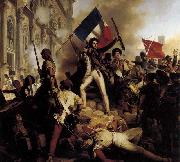 |
Jean-Victor Schnetz -- Click Here
|
|
1787-1870,was a French academic painter well-regarded for his historical and genre paintings. Schnez studied in Paris under Jacques-Louis David. His works can be found at the Louvre and the Petit Palais in Paris, the Hermitage in St. Petersburg, and the Museum of Fine Arts in San Francisco. In 1837 Schnetz was elected to the Academie des Beaux-Arts, and he was twice the Director of the French Academy in Rome, from 1841-1846 then again in 1853-1866 |
|
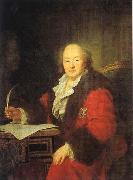 |
Jean-Louis Voille -- Click Here
|
|
painted Ivan Perfilevich Elagin in 1789 |
|
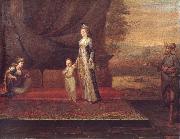 |
Jean-Baptiste Van Mour -- Click Here
|
|
17th Century Painters of the Bosporus,was a Flemish-French painter, remembered for his detailed portrayal of life in the Ottoman Empire during the Tulip Era and the rule of Sultan Ahmed III. Van Mour was a native of Valenciennes, a Flemish town that at he time of his birth belonged to the Spanish Netherlands, but since 1678 to France. He studied art in the studio of Jacques-Albert Gerin, and his work attracted the attention of an aristocrat and statesman of the time, Marquis Charles de Ferriol. Van Mour was invited to go to Istanbul when De Ferriol was appointed there as the French Ambassador in 1699. De Ferriol commissioned van Mour to do one hundred portraits of the local people. In 1711 De Ferriol returned to France and van Mour worked for a variety of other diplomats. In the meantime De Ferriol published a series of one hundred engravings (after the paintings) in Recueil de cent estampes representant differentes nations du Levant. The book had a great influence in Western Europe and was published in at least five languages. Painting audiences with the Sultan became van Mour's speciality; he only had to change the setting and a few faces. Van Mour worked with assistants to fulfill all his obligations. In 1725 he was granted the extraordinary title of Peintre Ordinaire du Roy en Levant in recognition of both his and the Levant's importance to the French government. In 1727 the Dutch ambassador Cornelis Calkoen asked Van Mour to record his audience with Sultan Ahmed III on canvas. Van Mour was allowed to enter the palace during these ceremonies accompanying the ambassador and his retinue; therefore, he was familiar with the special protocol that prevailed in the Ottoman court for ambassador's receptions. Calkoen took many paintings of Jean-Baptiste van Mour with him, when he was appointed as ambassador in Dresden for the Dutch Republic. In his will of 1762 the bachelor Calkoen forbade his heirs to sell the paintings, which are now part of the Rijksmuseum collection. |
|
 |
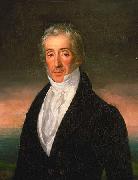
Jean Louis Voille -- Click Here
|
|
1744-1805
French
Jean Louis Voille |
|
 |
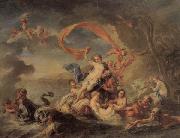
Jean Joseph Vaudechamp -- Click Here
|
|
(1790 - 1866) was a French painter born in Rambervillers, Vosges. He was a pupil of Anne-Louis Girodet de Roussy-Trioson. The market in Paris was competitive, so in the winter of 1831 - 32, he went to try his fortunes in New Orleans, Louisiana. The Louisiana Creole people identified with French culture and selected Vaudechamp to paint portraits for them. Over the next ten years he spent winters in New Orleans, and was a leading portrait painter in the region. He died at Neuilly-sur-Seine in 1866.
|
|
 |
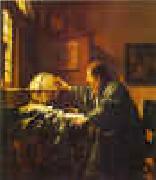
Jean Baptiste van Loo -- Click Here
|
|
Flemish Painter, 1684-1745
was a French subject and portrait painter. He was born in Aix-en-Provence, and was instructed in art by his father Louis-Abraham van Loo, son of Jacob van Loo. Having at an early age executed several pictures for the decoration of the church and public buildings at Aix, he was employed on similar work at Toulon, which he was obliged to leave during the siege of 1707. He was patronized by the prince of Carignan, who sent him to Rome, where he studied under Benedetto Luti. Here he was much employed on church pictures, and in particular executed a greatly praised Scourging of Christ for St Maria in Monticelli. At Turin he painted Charles Emmanuel II, Duke of Savoy and several members of his court. Then, moving to Paris, where he was elected a member of the Acad??mie Royale de Peinture et de Sculpture, he executed various altar-pieces and restored the works of Francesco Primaticcio at Fontainebleau. In 1737 he went to England, where he attracted attention by his portrait of Colley Cibber and of Owen McSwiny, the theatrical manager; the latter, like many other of van Loo's works, was engraved in mezzotint by John Faber Junior. He also painted Sir Robert Walpole, whose portrait by van Loo in his robes as chancellor of the exchequer is in the National Portrait Gallery, London, and the prince and princess of Wales. He did not, however, practise long in England, for his health failing he retired to Paris in 1742, and afterwards to Aix, where he died on 19 December 1745. |
|
 |
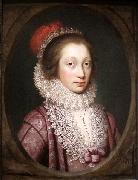
JanVermeer -- Click Here
|
|
1632-1675
Johannes (or Jan) Vermeer is now recognized as one of the great Dutch painters, but while he was alive he could barely make ends meet, and his artistic achievement was almost entirely ignored for 200 years after his death. Little is known about his personal life, other than he died poor and young and left behind a wife and eleven children. Vermeer is admired for his realistic style, his subtle use of color and light and his unusual and inventive brush technique, but fewer than forty of his paintings exist. His most famous works include domestic scenes such as Girl With a Peal Earring (1665) and The Music Lesson (1662-65), and tranquil landscapes such as The Little Street (1657-58) and View of Delft (1659-60).
Although his actual birth and death dates are unknown, Vermeer was baptized 31 October 1632 and buried 15 December 1675... During his career he used the names Johannes van der Meer, Johannes Vermeer and Jan Vermeer... He was played by actor Colin Firth in the 2003 film Girl With A Pearl Earring, which also starred Scarlett Johansson as the girl.
|
|
 |
Janssens van Ceulen -- Click Here
|
|
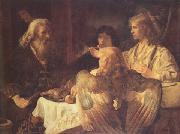
Cornelis Janssens van Ceulen (also Cornelius Jonson van Ceulen, Cornelius Johnson, Cornelis Jansz. van Ceulen and many other variants) (bapt. October 14, 1593, London - bur. August 5, 1661, Utrecht) was an English painter of portraits of Dutch or Flemish parentage. He has been described as "one of the most gifted and prolific portrait painters practising in England during the 1620s and 1630s".
|
|
 |
Jan victors -- Click Here
|
|
Dutch Baroque Era Painter, ca.1619-1676
was a Dutch Baroque painter that focused mainly on painting subject from the Bible. He was a student of Rembrandt van Rijn. |
|
 |
Jan Veth -- Click Here
|
|
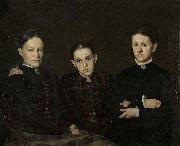
(18 May 1864 Dordrecht - 1 July 1925 Amsterdam), was a Dutch painter, poet, art critic and university lecturer.
Jan Veth was the son of Gerradus Huibert Veth, a Dordrecht iron merchant and liberal politician, and Anna Cornelia Giltay. On his mother's side he descended from the Dordrecht painter family of Van Strij (his mother was a granddaughter of Jacob van Strij). He married Anna Dorothea Dirks on 10 August 1888, from which marriage came five children.
Veth received his art education at the Rijksakademie voor Beeldende Kunsten in Amsterdam. With several of his fellow students he founded the St. Luke group. From 1885 he worked with the painter Anton Mauve in Laren. After his marriage in 1888 he settled in Bussum.
Jan Veth is especially noted as a portrait painter. Amongst his sitters were Max Liebermann, Lambertus Zijl, Frank van der Goes, Antoon Derkinderen and other contemporaries including various fellow painters.
In addition he was a well-known poet, belonging to the Eighties movement and publishing work in the De Nieuwe Gids. He designed the cover for "De Kleine Johannes", a book written by his friend, Frederik van Eeden, contributing to the development of book-art in Holland.
As Professor Extraordinary in History of Art and Aesthetics, he was associated with the Rijksakademie voor Beeldende Kunsten in Amsterdam.
|
|
 |
Jan Vermeer van Utrecht -- Click Here
|
|
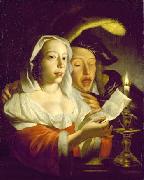
(bapt. 16 February 1630, Schipluiden - c. 1696, Vreeswijk), was a Dutch Golden Age painter. Though he was born near Delft, there is no known relation between this painter and Johannes Vermeer.
His father died when he was 10 and he was raised by his step-grandfather in Rotterdam. According to Houbraken he travelled to Italy with Lieve Verschuier and became friends with Willem Drost and Johann Carl Loth.
He returned North in 1662, where he became member of the Utrecht Guild of St. Luke in 1663 and became deacon of the guild 1664-1666.Houbraken tells a curious story about Vermeer van Utrecht in his biography of Jan Davidsz de Heem. In this story, on his return from Italy, Vermeer marries a widow who owns a white lead factory. He is wealthy and has a carefree life until his wife dies and then his factory is burned by French soldiers. He manages to save a garland painting by De Heem that he once paid 2000 guilders for. This was an enormous sum of money, but Houbraken mentions that his grandfather had been a wealthy man, and until his factory was destroyed, Vermeer van Utrecht had been painting for pleasure, rather than professionally. The amount is meant as an indication of the fame and esteem of De Heem, rather than the wealth of Vermeer van Utrecht. Vermeer van Utrecht then applies to his benefactor, Frederick Nassau de Zuylestein, to give him a government post in return for this painting, which he offers to paint with the likeness of the young prince Willem III in the middle of the garland. The lord of Zuylestein was the governor of the young prince from 1659 to 1666, so this deal must have been done sometime between 1662 (Vermeer van Utrecht's return from Italy), and 1672 (the death of the lord of Zuylestein). Apparently, the deal is done, and several years pass, in which Vermeer van Utrecht did become an appointed member of the Utrecht regency (Vroedschap), but where he felt like a fifth wheel. In 1672 the Utrecht council takes pity on him, and gave him the post of Toll-collector and controller of the river lock at Vreeswijk, where he later remarried. |
|
 |
Jan Vermeer -- Click Here
|
|
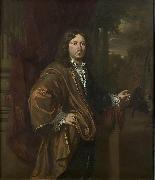
Dutch Baroque Era Painter, 1632-1675
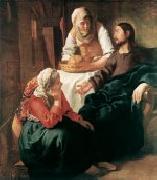
Johannes (or Jan) Vermeer is now recognized as one of the great Dutch painters, but while he was alive he could barely make ends meet, and his artistic achievement was almost entirely ignored for 200 years after his death. Little is known about his personal life, other than he died poor and young and left behind a wife and eleven children. Vermeer is admired for his realistic style, his subtle use of color and light and his unusual and inventive brush technique, but fewer than forty of his paintings exist. His most famous works include domestic scenes such as Girl With a Peal Earring (1665) and The Music Lesson (1662-65), and tranquil landscapes such as The Little Street (1657-58) and View of Delft (1659-60). Although his actual birth and death dates are unknown, Vermeer was baptized 31 October 1632 and buried 15 December 1675... During his career he used the names Johannes van der Meer, Johannes Vermeer and Jan Vermeer |
|
 |
Jan Verkolje -- Click Here
|
|
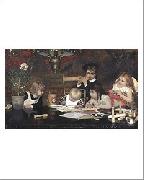
(Amsterdam, baptized on 27 February 1650 - Delft, 8 May 1693) was a Dutch Golden Age painter and engraver, often called Jan I to distinguish him from his son Jan II. He is known for his portraits and genre pieces.
|
|
 |
Jan Verhas -- Click Here
|
|
(9 January 1834-31 October 1896) was a genre painter and is considered the founder of the School of Dendermonde, best known for his paintings of children of the Belgian bourgeoisie, in a classical style but with a natural feeling to them. Born in Dendermonde as the younger brother of painter Frans Verhas, he studied at the Academy of Dendermonde and the Academy in Antwerp, finishing with the Belgian Prix de Rome in 1860. The Belgian government commissioned him to travel to Venice where he made the painting "Velleda et la Bataille de Callao" in 1862. The next four years, he lived in Binche, where he married. He then moved to Brussels. Verhas was a regular of the Salons of the time, winning a second class medal in the Paris Salon Exposition of 1881, and a gold medal at the 1889 Exposition Universelle. He was made a Chevalier in the Legion of Honor in 1881. Jan Verhas died in Schaarbeek in 1896.
Paintings by Jan Verhas can be seen at the Museum of Fine Arts in Ghent, the Royal Museum of Fine Arts, Antwerp and the City Hall of Dendermonde. |
|
 |
Jan Van Vucht -- Click Here
|
|
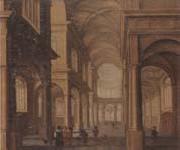
Dutch , Rotterdam 1603-1637
|
|
 |
Jan van Scorel -- Click Here
|
|
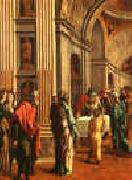
Dutch
1495-1562
Jan Van Scorel Galleries
Jan van Scorel (1495, Schoorl - December 6, 1562, Utrecht) was an influential Dutch painter credited with the introduction of High Italian Renaissance art to the Netherlands. It is not known whether he began his studies under Jan Gossaert in Utrecht or with Jacob Cornelisz in Amsterdam, but it certain that it was the master painters he would meet later in his life who would have the greatest effect on his technique. Van Scorel began traveling through Europe in his early twenties, first heading to Nuremberg and then to Austria. It was there, in 1520, that he completed his first representative work, the "Sippenaltar" in St. Martin's church in the village of Obervellach. Giorgione served as a considerable influence on van Scorel during a tenure in Venice. Upon leaving Venice, van Scorel passed through Rome and made a pilgrimage to the Holy Land. His experiences in Jerusalem are depicted in many of his later works.
In 1521, van Scorel returned to Rome where he met Pope Adrian VI, who appointed him painter to the Vatican. He himself sat for a portrait. Van Scorel enjoyed the influence of Michelangelo and Raphael, and succeeded Raphael as Keeper of the Belvedere.
Upon his return to the Netherlands in 1524, he settled in Haarlem where he began a successful career as a painter and a teacher. Van Scorel was a very educated man and skilled as an engineer and an architect, as well as an artist. He was also multi-lingual, no doubt as a result of his travels.
Considered to be the leading Netherlandish Romanist, van Scorel moved to Ghent for painting contracts before moving to Utrecht for the same reason, where he died in 1562, leaving behind a wealth of portraits and altarpieces. Though many of his works fell victim to the Iconoclasm in 1566, some still remain and can be seen primarily at museums in the Netherlands. |
|
|
|
 |
Jan van Noordt -- Click Here
|
|
Dutch Baroque Era Painter, 1620-1676 |
|
 |
jan van neck -- Click Here
|
|
(1634-1714), was a Dutch Golden Age painter. Biography. He was born in Naarden and became a painter, draftsman, engraver, and interior |
|
 |
Jan Van Kessel the Younger -- Click Here
|
|
1654-1708
Dutch
Jan Van Kessel Gallery |
|
 |
Jan Van Kessel -- Click Here
|
|
1626-1679
Dutch
Jan Van Kessel Gallery
Dutch painter and draughtsman. He was a follower, and probably a pupil, of Jacob van Ruisdael and covered the same range of subjects painted by Ruisdael, with the exception of marine paintings. However, van Kessel is best known for his townscapes and panoramic views, as exemplified by the Sluice and the New City Ramparts of Amsterdam in Winter (Amsterdam, Hist. Mus.) and the Bleaching Grounds near Haarlem (Brussels, Mus. A. Anc.). He imitated the water-mills and village scenes of his friend Meindert Hobbema, as well as the waterfalls of Allaert van Everdingen, the wooded landscapes of Jan Wijnants and the winter scenes of Jan van de Cappelle. Many of van Kessel's 120 surviving pictures, including The Avenue (Stuttgart, Staatsgal.) and the Ford in the Woods (Dresden, Gem?ldegal. Alte Meister), were once attributed to van Ruisdael and these other masters (often with an authentic signature covered by the better-known name). Van Kessel is also frequently confused with other minor artists in van Ruisdael's circle, especially Jan Vermeer van Haarlem the younger, Isaac Koene (1637/40-1713), Jacob Salomonsz. van Ruysdael (1629/30-1681) and Anthonie van Borssom. As a draughtsman, van Kessel emulated van Ruisdael's mature style, working almost exclusively in black chalk and grey wash. The best of his 70 drawings are townscapes, although his studies of trees and depictions of farmsteads are noteworthy. A number of correlations exist between his sketches and paintings. There is no known relationship with the Flemish artists of the same name. |
|
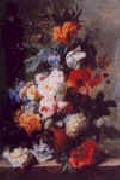 |
Jan van Huysum -- Click Here
|
|
1682-1749
Dutch
Jan Van Huysum Galleries
He was the brother of Jacob van Huysum, and the son of Justus van Huysum, who is said to have been expeditious in decorating doorways, screens and vases. A picture by Justus is preserved in the gallery of Brunswick, representing "Orpheus and the Beasts in a wooded landscape", and here we have some explanation of his son's fondness for landscapes of a conventional and Arcadian kind; for Jan van Huysum, though skilled as a painter of still life, believed himself to possess the genius of a landscape painter.
Half his pictures in public galleries are landscapes, views of imaginary lakes and harbours with impossible ruins and classic edifices, and woods of tall and motionless trees-the whole very glossy and smooth, and entirely lifeless. The earliest dated work of this kind is that of 1717, in the Louvre, a grove with maidens culling flowers near a tomb, ruins of a portico, and a distant palace on the shores of a lake bounded by mountains.
Some of the finest of van Huysum's fruit and flower pieces have been in English private collections: those of 1723 in the earl of Ellesmere's gallery, others of 1730-1732 in the collections of Hope and Ashburton. One of the best examples is now in the National Gallery, London (1736-1737). No public museum has finer and more numerous specimens than the Louvre, which boasts of four landscapes and six panels with still life; then come Berlin and Amsterdam with four fruit and flower pieces; then St Petersburg, Munich, Hanover, Dresden, the Hague, Brunswick, Vienna, Carlsruhe, Boston and Copenhagen. |
|
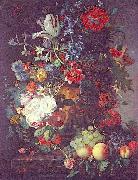 |
Jan van Huijsum -- Click Here
|
|
also spelled Huijsum, (April 15, 1682, Amsterdam - February 8, 1749, Amsterdam) was a Dutch painter.
He was the brother of Jacob van Huysum, the son of the flower painter Justus van Huysum, and the grandson of Jan van Huysum I, who is said to have been expeditious in decorating doorways, screens and vases. A picture by Justus is preserved in the gallery of Brunswick, representing "Orpheus and the Beasts in a wooded landscape", and here we have some explanation of his son's fondness for landscapes of a conventional and Arcadian kind; for Jan van Huysum, though skilled as a painter of still life, believed himself to possess the genius of a landscape painter.
Half his pictures in public galleries are landscapes, views of imaginary lakes and harbours with impossible ruins and classic edifices, and woods of tall and motionless trees-the whole very glossy and smooth, and entirely lifeless. The earliest dated work of this kind is that of 1717, in the Louvre, a grove with maidens culling flowers near a tomb, ruins of a portico, and a distant palace on the shores of a lake bounded by mountains.
Some of the finest of van Huysum's fruit and flower pieces have been in English private collections: those of 1723 in the earl of Ellesmere's gallery, others of 1730-1732 in the collections of Hope and Ashburton. One of the best examples is now in the National Gallery, London (1736-1737). No public museum has finer and more numerous specimens than the Louvre, which boasts of four landscapes and six panels with still life; then come Berlin and Amsterdam with four fruit and flower pieces; then St Petersburg, Munich, Hanover, Dresden, the Hague, Brunswick, Vienna, Carlsruhe, Boston and Copenhagen. |
|
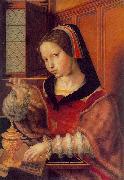 |
Jan van Hemessen -- Click Here
|
|
(c. 1500 - c. 1566) was a Flemish Northern Renaissance painter. He was born in Hemiksem, then called Hemessen or Heymissen. Following studies in Italy, in 1524 he settled in Antwerp. A mannerist, his images focused on human failings such as greed and vanity. Like his daughter, Catarina van Hemessen,he specialised in painted portraits.
Jan Sanders van Hemessen was a Flemish Northern Renaissance painter who was part of the mannerist movement. He was born in Hemessen in the Netherlands but settled in Antwerp in 1524 after studying in Italy. Hemessen specialized in scenes of human character flaws such as vanity and greed.
His pictures are often religious, while his style helped found the Flemish traditions of genre painting. Hemessen was also a portrait painter, which influenced his daughter to become a Flemish Northern Renaissance painter as well. The Surgeon of 1555 is an oil painting by Jan Sanders Van Hemessen currently in the Museo del Prado in Madrid, Spain. The scene likely represents a stonecutter at a fair. The surgeon, who is clearly happy that his operations have been successful, painstakingly moves his knife towards the stone, which is already visible. Behind him hang stones which have been successfully cut out of the head of other patients as a sign of his skill. Next to the quack stands a man who is wringing his hands in desperation, clearly going to be the next patient under the scalpel. |
|
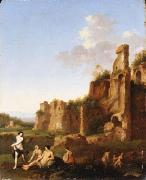 |
Jan van Haensbergen -- Click Here
|
|
(1642-1705) was a Dutch Golden Age painter.
He was registered in the Utrecht Guild of St. Luke in 1668 and in 1669 he was registered in the Confrerie Pictura in The Hague, where he worked until he died.According to Houbraken he was a student of Cornelius van Poelenburgh, and though he was quite successful in imitating his master's style, he switched to portraits since he could make a comfortable living that way.Though he is considered by some to have been born in Utrecht, he signed his name 'Joh. Haensbergh Gorco fecit', which leads historians to conclude he was from Gorinchem. His portraits show the influence of Caspar Netscher. |
|
 |
Jan van Goyen -- Click Here
|
|
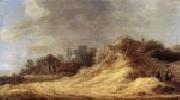
Dutch Baroque Era Painter, 1596-1656
Jan van Goyen was born in Leiden on Jan. 13, 1596. Apprenticed from the age of 10, he had several masters. About 1617 he went to Haarlem to study with Esaias van de Velde, an important innovator in the Haarlem movement of realistic landscape painting. Van Goyen's works between 1621 and 1625 are sometimes hard to distinguish from those of his teacher. They are colorful, detailed views of villages and roads, usually busy with people, as in Winter (1621). It was Van Goyen's usual practice to sign or monogram and date his paintings. He traveled extensively through the Netherlands and beyond, recording his impressions in sketchbooks, occasionally with dates and often depicting recognizable scenes. Thus the chronology of his development is clear. His paintings of the late 1620s show a steady advance from the strong colors and scattered organization of his early works toward tonality and greater simplicity and unity of composition. By 1630 he was painting monochromes in golden brown or pale green; he played a leading part in the tonal phase of Dutch landscape painting. In 1631 Van Goyen settled in The Hague, where he became a citizen in 1634. The simplicity, airiness, and unification of his compositions continued to increase in his abundant production of dune landscapes, river views, seascapes, town views, and winter landscapes. The River View (1636) displays a river so open and extensive as to suggest the sea, with reflections that prolong the vast and luminous sky. In its monumentalization of humble structures and its composition built on a firm scaffolding of horizontal and vertical forces, it forecast at this early date developments that dominated landscape painting in the 1650s and later. In the Village and Dunes (1647) the traditional double-diagonal composition still exists, but it is dominated by horizontal and vertical accents. Stronger contrasts of light and dark replace the earlier tonality. In the last year of his life Van Goyen produced an eloquent new style, in which powerful forms stand out against the radiant sky and water in an exquisitely balanced composition (Evening Calm; 1656). The commission in 1651 to paint a panoramic view of The Hague for the Burgomaster's Room shows the high regard in which Van Goyen was held. He was enormously productive; well over 1,000 of his paintings still exist, and almost as many drawings. |
|
 |
Jan van Gool -- Click Here
|
|
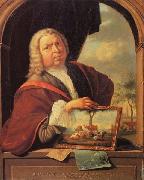
Johan, or Jan van Gool (1685 - 1763) was a Dutch painter and writer from The Hague, now remembered mainly as a biographer of artists from the Dutch Golden Age.
According to the RKD he learned to paint from Simon van der Does and Mattheus Terwesten. He became a member of the Confrerie Pictura in 1711. He was first regent, and then five years later became director, of the Hague Drawing School from 1720-1734. He spent most of his time in the Hague, but travelled to England twice and is recorded there in 1711. He specialized in Italianate landscapes.
He is best known today for his book of artist biographies, otherwise known as the "Nieuw Schouburg". The full title is De Nieuwe Schouburg der Nederlantsche kunstschilders en schilderessen: Waer in de Levens- en Kunstbedryven der tans levende en reets overleedene Schilders, die van Houbraken, noch eenig ander schryver, zyn aengeteekend, verhaelt worden. (The Hague, 1750). |
|
 |
Jan Van Eyck -- Click Here
|
|
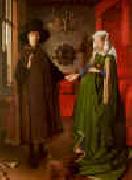
1395-1441
Flemish
Jan Van Eyck Locations
Painter and illuminator, brother of Hubert van Eyck.
According to a 16th-century Ghent tradition, represented by van Vaernewijck and Lucas d Heere, Jan trained with his brother Hubert. Pietro Summonte assertion (1524) that he began work as an illuminator is supported by the fine technique and small scale of most of Jan works, by manuscript precedents for certain of his motifs, and by his payment in 1439 for initials in a book (untraced) for Philip the Good, Duke of Burgundy. Jan is first documented in The Hague in August 1422 as an established artist with an assistant and the title of Master, working for John III, Count of Holland (John of Bavaria; reg 1419-25), who evidently discovered the artist while he was bishop (1389-1417) of the principality of Liege. Jan became the court official painter and was paid, with a second assistant when the work increased in 1423, continuously, probably until the count death in January 1425. |
|
 |
Jan Van Dornicke -- Click Here
|
|
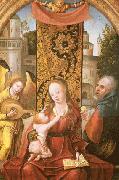
was a South Netherlandish painter who was born about 1470 and died about 1527. His first name is sometimes spelled Janssone, and his last name is sometimes spelled van Doornik or van Dornick. He was active in Antwerp from about 1509 to about 1525. His paintings are classified stylistically as Antwerp Mannerism, and he may be the same person as the Master of 1518. |
|
 |
Jan van der Straet -- Click Here
|
|
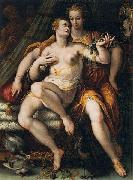
painted Vanity, Modesty and Death in 1569 |
|
 |
Jan van der Heyden -- Click Here
|
|
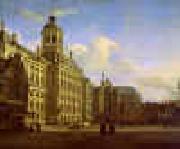
1637-1712
Dutch
Jan Van Der Heyden Gallery
Van der Heyden grew up in Gorcum, but the family moved to Amsterdam around 1650. They lived on Dam Square. As a young guy he witnessed the fire in the old townhall which made a deep impression on him. He later would describe or draw 80 fires in almost any neighborhood of Amsterdam. When he married in 1661 the family was living on Herengracht, the most fashionable canal in Amsterdam. In 1668 Cosimo II de' Medici bought one of his paintings, a view of the townhall with a manipulated perspective. Van der Heyden often painted country estates, like Goudestein, owned by Joan Huydecoper II. He was not good in drawing figures and used for his paintings a metal plate for bricks, a sponge or moss for the leaves. Johannes Lingelbach, Adriaen van de Velde und Eglon van der Neer assisted him drawing the figures. Jan van der Heyden also introduced the lamp post and in 1672 impoved the design of the fire engine. He died in wealth as the superintendent of the lighting and director of the (voluntary) firemen's guild at Amsterdam.
Van der Heyden was a contemporary of the landscape painters Hobbema and Jacob van Ruisdael, with the advantage, which they lacked, of a certain professional versatility; for, whilst they painted admirable pictures and starved, he varied the practice of art with the study of mechanics. Until 1672 he painted in partnership with Adriaen van de Velde. After Adrian's death, and probably because of the loss which that event entailed upon him, he accepted the offices to which allusion has just been made. At no period of artistic activity had the system of division of labour been more fully or more constantly applied to art than it was in Holland towards the close of the 17th century.
Van der Heyden, who was perfect as an architectural draughtsman insofar as he painted the outside of buildings and thoroughly mastered linear perspective, seldom turned his hand to the delineation of anything but brick houses and churches in streets and squares, or rows along canals, or "moated granges," common in his native country.
He was a travelled man, had seen The Hague, Ghent and Brussels, and had ascended the Rhine past Xanten to Cologne, where he copied over and over again the tower and crane of the great cathedral. But he cared nothing for hill or vale, or stream or wood. He could reproduce the rows of bricks in a square of Dutch houses sparkling in the sun, or stunted trees and lines of dwellings varied by steeples, all in light or thrown into passing shadow by moving cloud.
He had the art of painting microscopically without loss of breadth or keeping. But he could draw neither man nor beast, nor ships nor carts; and this was his disadvantage. His good genius under these circumstances was Adrian van der Velde, who enlivened his compositions with spirited figures; and the joint labour of both is a delicate, minute, transparent work, radiant with glow and atmosphere. |
|
 |
Jan Van Den Hoecke -- Click Here
|
|
Flemish Baroque Era Painter, 1611-1651
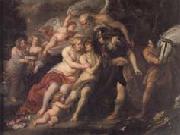
was a Flemish Baroque painter and draughtsman. He was born and died in Antwerp. He first apprenticed with his father, the painter Gaspar van den Hoecke (1595?C1648); then worked in the studio of Peter Paul Rubens. Jan's brother Robert van den Hoecke (1622?C1668) was also a painter. The artist and his father were well known for their 1635 execution of decorations for the Arch dedicated to the Emperor Ferdinand III in Antwerp. In this collaboration, Jan painted monumental representations, as seen in his piece, Triumphal Entrance of Cardinal Prince Ferdinand of Spain, (Uffizi Gallery). Hoecke then traveled to Austria under the commission of the Emperor Ferdinand III after 1637, staying for about ten years. He also painted for Ferdinand's brother, Archduke Leopold Wilhelm of Austria (1614-C1662), including a Madonna and Child and a number of allegorical pieces. Before this he traveled to Italy and worked in Rome, which may have influenced his style some. Another piece by Hoecke is his, Hercules between Vice and Virtue, (Uffizi Gallery), which shows an influence from both Rubens, and another pupil of the master Baroque painter, Anthony van Dyck. |
|
 |
Jan van den Hecke -- Click Here
|
|
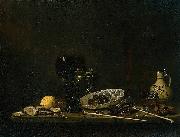
(1620-1684) was a Flemish Baroque painter.
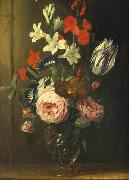
According to Houbraken he painted landscapes, which he populated with animals and other figures himself. He also made flower and fruit still lifes and could paint gold, silver, crystal, and porcelain quite well. He spent a long period travelling and working in Italy, which is noticeable in his landscapes.
According to the RKD he was registered in the Antwerp Guild of Saint Luke as an apprentice in 1636 and learned to paint from Abraham Hack, who also taught his contemporary, the flower painter Hieronymus Galle. In 1641 Van den Hecke was registered as a master of the guild. From 1653-1658 he was in Italy, but somewhere in the mid-50's he went back and forth to Belgium, since he is also registered in Brussels during that period. He died the same year as his wife Maria Adriana Heijens; when they died they left three children; Jan (II), aged 24, Maria, aged 21, and Peeter, aged 20. Van den Hecke's pupil Peeter de Clerc eventually became a master painter in the guild. Van den Hecke's son Jan van den Hecke II became a popular flower painter. |
|
 |
Jan van de Velde -- Click Here
|
|
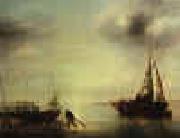
(1593, Delft or Rotterdam-ca. 1 November 1641, Enkhuizen) was a Dutch Golden Age painter and engraver of animal, landscape and still-life subjects. He was the father of the still life painter Jan Jansz van de Velde.
He was apprenticed to engraver Jacob Matham in 1613, entered the Haarlem guild in 1614, and then probably visited Italy. He is better known for his etching and engraving than for his painting. According to Houbraken, he was the brother of Esaias van de Velde and Willem van de Velde the Elder, but according to John Denison Champlin, Esaias was his cousin, and he was no relation at all to the family of Willem. |
|
 |
Jan van de Cappelle -- Click Here
|
|
1624-1679
Dutch Jan van de Cappelle Locations
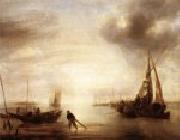
Dutch businessman, collector, painter, draughtsman and etcher. Though now considered the outstanding marine painter of 17th-century Holland, he was not a professional artist nor a member of the Amsterdam Guild of St Luke. His father owned a successful dye-works in Amsterdam, in which both Jan and his brother Louis were active. Their father enjoyed a long life and probably managed the firm until close to his death in 1674, when Jan inherited it. This left Jan with plenty of spare time to pursue his hobby, painting. He married Annetje Jansdr. (Anna Grotingh) before 1653. He died a widower, survived by his seven children, who inherited his considerable fortune. His last will shows that in addition to the dye-works and immense cash assets, van de Cappelle owned extensive properties and an art collection that must be rated among the most important of his time. |
|
 |
Jan van de Capelle -- Click Here
|
|
seascape master Dutch Baroque Era Painter, C.1624-1679 |
|
|
|
 |
Jan van Bijlert -- Click Here
|
|
Dutch Baroque Era Painter, ca.1597-1671
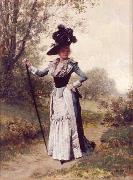
Dutch painter. He was the son of the Utrecht glass painter Herman Beerntsz. van Bijlert (c. 1566-before 1615). Jan must have trained first with his father but was later apprenticed to the painter Abraham Bloemaert. After his initial training, he visited France and travelled to Italy, as did other artists from Utrecht. Jan stayed mainly in Rome, where he became a member of the Schildersbent; he returned to Utrecht in 1624. In Rome he and the other Utrecht artists had come under the influence of the work of Caravaggio; after their return home, this group of painters, who became known as the UTRECHT CARAVAGGISTI, adapted the style of Caravaggio to their own local idiom. The Caravaggesque style, evident in van Bijlert's early paintings, such as St Sebastian Tended by Irene (1624; Rohrau, Schloss; see fig.) and The Matchmaker (1626; Brunswick, Herzog Anton Ulrich-Mus.), is characterized by the use of strong chiaroscuro, the cutting off of the picture plane so that the image is seen close-up and by an attempt to achieve a realistic rather than idealized representation. |
|
 |
Jan van Beers -- Click Here
|
|
(22 February 1821 - 14 November 1888) was Flemish poet born in Antwerp. He is usually referred to as "van Beers the elder" to distinguish him from his son, Jan van Beers, the painter.
Van Beers was essentially a Netherlander, though politically a Belgian, expressing his thoughts in the same language as any North Netherland writer. In fact, the poems of Jan van Beers are perhaps more popular in the Netherlands than in Belgium, and of many of them there exist more editions printed in the Netherlands than in his political fatherland.
Van Beers started life as a teacher of Dutch language and literature, first at Mechelen, then at Lier, and in 1860 was appointed a professor of both at the Athenaeum (high school) in Antwerp, where he had also been a sub-librarian in the communal library. Van Beers as a teacher was early in the field, with Hendrik Conscience, Willems and others, when the Flemish movement began. He composed a Dutch grammar (1852), which, in enlarged editions, still holds the field, and a volume of selections from Dutch authors, both books being so much appreciated that the Belgian government made them text-books in the public schools.
Van Beers's historical poems, the principal of which is, perhaps, Jakob Van Maerlant (Amsterdam, 1860), helped the Flemish revival in Belgium as powerfully as his school-books. He is best known, however, as the writer of ballads and songs. Jongelingsdroomen ("A Young Man's Dreams") first appeared at Antwerp and Amsterdam in 1853. These poems were followed by Levensbeelden ("Life Figures or Pictures," Amsterdam, 1858) and by Gevoel en Leven ("Feeling Living," Amsterdam, 1869). His Rijzende Blaren ("Rising Leaves") first made its appearance at Ghent and Rotterdam in 1883. |
|
 |
Jan van Goyen -- Click Here
|
|
1596-1656
Dutch
Jan van Goyen Galleries
Dutch landscape painter. He studied at Leiden and Haarlem. In 1631 he settled at The Hague. His typically Dutch landscapes of harbors, canals, riverbanks, and winter scenes with skaters and sleighs are naturalistically painted in a grayish-green tonality. He was one of the first landscape painters to sacrifice minute detail for atmospheric effect and space, and he had a considerable influence on later Dutch landscapists. His paintings are in many collections in Europe and the United States. Famous examples are Panorama of The Hague (The Hague); Banks of a Canal (Louvre); and View of Dordrecht (Rijks Mus.). The Metropolitan Museum has five of van Goyen's works, and the Pennsylvania Academy, two. |
|
 |
Jan Sanders van Hemessen -- Click Here
|
|
1500-1566
Dutch
Jan Sanders Van Hemessen Gallery
was a Flemish Northern Renaissance painter. He was born in Hemiksem, then called Hemessen or Heymissen. Following studies in Italy, in 1524 he settled in Antwerp. A mannerist, his images focused on human failings such as greed and vanity. Like his daughter, Catarina van Hemessen, he also painted portraits. |
|
 |
Jan Philip van Thielen -- Click Here
|
|
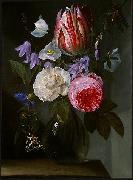
(Mechelen, 1618 - Mechelin, 1667) was a Flemish Baroque painter who specialized in flowers.
Van Thielen was the son of a minor nobleman and eventually assumed the title of Lord of Couwenberch. In 1631 or 1632 he began studying at the age of thirteen with his future brother-in-law, the history painter Theodoor Rombouts (1597-1637), and in 1641 he commenced his studies with the flower painter Daniel Seghers (1590-1661). According to Houbraken (who mistakenly wrote his birth year as 1681 instead of 1618), his reputation during his lifetime was such that he received patronage from the Spanish crown, |
|
 |
Jan josephsz van goyen -- Click Here
|
|
Dutch , Leyden 1596-The Hague 1656
was a Dutch landscape painter. Van Goyen was an extremely prolific artist; approximately twelve hundred paintings and more than one thousand drawings by him are known. Jan van Goyen was the son of a shoemaker and started as an apprentice in Leiden. Like many Dutch painters of his time, Jan van Goyen studied art in the town of Haarlem with Esaias van de Velde. At age 35, he established a permanent studio at Den Haag (The Hague). Crenshaw tells (and mentions the sources) that Van Goyen's landscape paintings rarely fetched high prices, but he made up for the modest value of individual pieces by increasing his production, painting thinly and quickly with a limited palette of inexpensive pigments. Despite his market innovations, he always sought more income, not only through related work as an art dealer and auctioneer but also by speculating in tulips and real estate. Although the latter was usually a safe avenue of investing money, in Van Goyen's experience it led to enormous debts. Paulus Potter rented one of his houses. Nicolaes van Berchem became his pupil. In 1652 and 1654 he was forced to sell his collection of paintings and graphic art, and he subsequently moved to a smaller house. He died in 1656, still unbelievably 18,000 guilders in debt, forcing his widow to sell their remaining furniture and paintings. |
|
 |
Jan Gerritsz. van Bronckhorst -- Click Here
|
|
(1603-1661) was a Dutch Golden Age painter and engraver. He is considered today to be a minor member of the Utrecht Caravaggisti group.
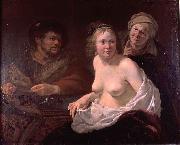
According to Houbraken, van Bronckhorst apprenticed as an eleven-year-old with the glass engraver Verburgh in Utrecht. He worked with him for 6 months and worked with two other Utrecht glassworkers before embarking on a Grand Tour in 1620. He did not get far before he was offered work in Arras by the glassworker Peeter Matthys. After six months, he continued on to Paris in 1620, where he worked with the glassworker Chamu. He returned to Utrecht in 1622, where Cornelis Poelenburg taught him to paint. He married Catalijntje van Noort in 1626. He frequented the studio of Gerard van Honthorst. In 1647 he moved to Amsterdam where he created the stained glass windows and the organ doors (almost the only area in a Calvinist church where figurative painting was sometimes allowed) of the Nieuwe Kerk (finished in 1655). He has been described as the last of the great stained glass painters in Holland.. Unlike his work for churches, his secular paintings show the influence of Caravaggio, and also show a striking appeal to sensuality. Among his pupils are counted his sons Jan Jansz and Gerrit Jansz, and Cesar van Everdingen. |
|
 |
Jan Frans van Dael -- Click Here
|
|
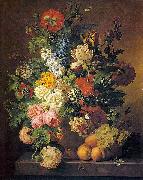
an excellent painter of fruit and flowers, was born at Antwerp in 1764, but went early to Paris and settled there. He was self-inatructed in art, but made such progress that he soon distinguished himself at the exhibitions, on one occasion obtaining the prize of 4000 francs, and on two others, the large gold medal. His style is in the manner of Van Huysum and Van Spaendonck, although he did not confine himself strictly to fruit and flowers, but painted other subjects, in which such objects might with propriety be introduced. Two of his pictures, which he painted for the Empress Josephine, represent 'An Offering to Flora,' and 'The Tomb of Julia'; the latter is now in the Louvre. His master-piece, known as 'La Croisee,' the fruit of three years' labour, was likewise purchased by the Empress Josephine, and is now in a private collection at Liege. He was also patronized by the Empress Marie Louise, who took one of his pictures with her to Parma. He died in Paris in 1840, and was buried in the cemetery of Pere Lachaise by the side of his friend Van Spaendonck. The Louvre has also by him three pictures of 'Flowers' and one of 'Fruit.' |
|
 |
Jan Cornelisz Vermeyen -- Click Here
|
|
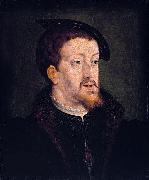
(c.1500-1559) was a Dutch Northern Renaissance painter.
According to Karel van Mander he was born in Beverwijk in 1500 and was honored for his career in the service of Charles V. He was a friend of Jan van Scorel and his portrait was engraved by Jan Wierix for Dominicus Lampsonius.
Vermeyen was a painter and tapestry designer, probably a pupil of Jan Mabuse. About 1525 he became Court Painter to Margaret of Austria, regent of the Netherlands at Mechelen and in 1535 he accompanied the Emperor Charles V, at the Conquest of Tunis (1535). This journey supplied him with scenes for later works, including tapestries designed 1545/48 for the Regent, Mary of Hungary. He died in Brussels.
Many portraits are ascribed to him on very little evidence, according to modern scholars.
|
|
 |
Jan Baptiste Vanmour -- Click Here
|
|
1671-1737
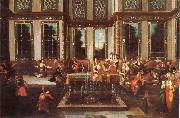
was a Flemish-French painter, remembered for his detailed portrayal of life in the Ottoman Empire during the Tulip Era and the rule of Sultan Ahmed III. Van Mour was a native of Valenciennes, a Flemish town that at he time of his birth belonged to the Spanish Netherlands, but since 1678 to France. He studied art in the studio of Jacques-Albert Gerin, and his work attracted the attention of an aristocrat and statesman of the time, Marquis Charles de Ferriol. Van Mour was invited to go to Istanbul when De Ferriol was appointed there as the French Ambassador in 1699. De Ferriol commissioned van Mour to do one hundred portraits of the local people. In 1711 De Ferriol returned to France and van Mour worked for a variety of other diplomats. In the meantime De Ferriol published a series of one hundred engravings (after the paintings) in Recueil de cent estampes representant differentes nations du Levant. The book had a great influence in Western Europe and was published in at least five languages. Painting audiences with the Sultan became van Mour's speciality; he only had to change the setting and a few faces. Van Mour worked with assistants to fulfill all his obligations. In 1725 he was granted the extraordinary title of Peintre Ordinaire du Roy en Levant in recognition of both his and the Levant's importance to the French government. In 1727 the Dutch ambassador Cornelis Calkoen asked Van Mour to record his audience with Sultan Ahmed III on canvas. Van Mour was allowed to enter the palace during these ceremonies accompanying the ambassador and his retinue; therefore, he was familiar with the special protocol that prevailed in the Ottoman court for ambassador's receptions. Calkoen took many paintings of Jean-Baptiste van Mour with him, when he was appointed as ambassador in Dresden for the Dutch Republic. |
|
 |
Jan Antonisz. van Ravesteyn -- Click Here
|
|
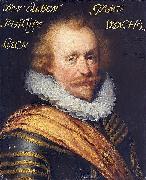
(1572(?) - buried June 21, 1657) was a successful painter to the Dutch court in The Hague.
Van Ravensteyn was born in The Hague. It is unknown who taught him how to paint, but he was a follower of the Delft portrait painter Michiel Jansz van Mierevelt. Van Ravesteyn is mentioned there in the city archives 1597. From 1598 until his death he lived in the Hague, where in 1598 he became a member of the Guild of St. Luke of the Hague. In 1604 he married Anna Arentsz van Berendrecht and in the same year he was mentioned as a good painter by Karel van Mander (though his earliest dated works are from 1611). In 1608 he bought a house on the Molstraat and in 1628 he moved in the Molstraat. In 1640 his wife was buried and in the same year his daughter Marie married one of his pupils, the painter Adriaen Hanneman. In 1654 he moved to the Nobelstraat next to the house of his daughter. In 1656 he left the guild with a group of dissatified painter friends and was one of the founders of the Confrerie Pictura. He was a Catholic and his name occurs often as a witness in the records of the church in the Molstraat, such as for the marriage of his daughter Agnes in 1641 with Willem van Culemborgh. His portrait was painted by Sir Anthony van Dyck and he produced Schutterstuk works. His workshop produced many portraits for the royal house of Nassau and he competed with Miereveld for several commissions.
Van Ravesteyn was in turn, the teacher of Dirck Abrahamsz., Leendert Barthouts, Johannes Harmensz. Borsman, Aelbert Dircksz. Coeppier, Pieter Craen, Jacob Dirksz. van den Enden, Fransise de Goltz, Adriaen Hanneman, Barent Jansz., Thomas Ouwater, Clement Ram, Jan Rassenbourch, Frederick Sonnius, Dirck Verlaer, Jan Pous Voet and Pauwels Willemsz.
|
|
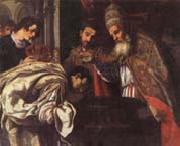 |
Jacopo Vignali -- Click Here
|
|
Italian painter who died on 03 August 1664
Italian painter. At an early age he entered the studio of Matteo Rosselli in Florence, and his first works, Virgin and Saints (1616; Florence, S Brigida, Santuario della Madonna del Sasso) and the ceiling painting Love of the Fatherland (1616; Florence, Casa Buonarroti), were influenced by Rosselli and Ludovico Cigoli. In 1616 he enrolled at the Accademia del Disegno in Florence, becoming an academician in 1622. In the 1620s he moved away from Rosselli's influence and developed a style distinguished by dramatic light effects, rich colour and painterly technique and by the expression of deep emotion. The decade opened with the Investiture of St Benedict (1620; Florence, Semin. Maggiore), one of a series of works painted in honour of St Benedict for the Confraternit? di S Benedetto Bianco, to which Vignali had belonged since 1614. Having learnt the technique of fresco painting from Rosselli, he also began to work in that medium and was involved in the decoration of the Casa Buonarroti throughout the decade, the ceiling fresco Jacob's Dream dating from 1621. |
|
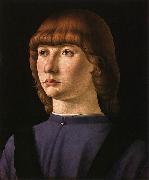 |
Jacometto Veneziano -- Click Here
|
|
Italy (Venezia 1472 -1497 ) - Painter |
|
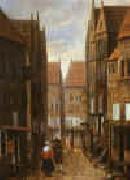 |
Jacobus Vrel -- Click Here
|
|
Dutch Baroque Era Painter, active ca.1654-1662
Dutch painter. Some 38 paintings, depicting domestic interiors, street scenes and a church interior, have been attributed to this enigmatic artist. Four copies after his works are possibly autograph; one drawing has also been ascribed to him. Over half of Vrel's paintings are signed or bear traces of signatures that were altered to read Johannes Vermeer or Pieter de Hooch, with whose paintings Vrel's work was often confused. Indeed, Theophile Thore discussed Vermeer as a townscape painter largely on the basis of works that were actually by Vrel. |
|
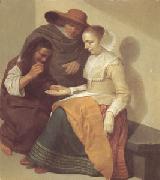 |
Jacob Van Velsen -- Click Here
|
|
delft before 1625-Amsterdam 1656 |
|
 |
Jacob van Schuppen -- Click Here
|
|
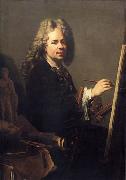
Born in Fontainebleau, France, as the son of the painter-engraver Pieter van Schuppen, he worked in the Netherlands before moving to Vienna. He was taught to paint by his father and his uncle Nicolas de Largilliere.
In 1719 he was registered in Luneville, but he moved in the same year to Vienna where he became court painter. In 1725 he was appointed director of the Academy of Fine Arts Vienna, when it was refounded by Emperor Charles VI as the k.k. Hofakademie der Maler, Bildhauer und Baukunst (Imperial and Royal Court Academy of painters, sculptors and architecture). |
|
 |
Jacob van Ruisdael -- Click Here
|
|
Dutch Baroque Era Painter, ca.1628-1682
Ruysdael's favorite subjects are simple woodland scenes, similar to those of Everdingen and Hobbema. He is especially noted as a painter of trees, and his rendering of foliage, particularly of oak leaf age, is characterized by the greatest spirit and precision. His views of distant cities, such as that of Haarlem in the possession of the marquess of Bute, and that of Katwijk in the Glasgow Corporation Galleries, clearly indicate the influence of Rembrandt.
He frequently painted coast-scenes and sea-pieces, but it is in his rendering of lonely forest glades that we find him at his best. The subjects of certain of his mountain scenes seem to be taken from Norway, and have led to the supposition that he had traveled in that country. We have, however, no record of such a journey, and the works in question are probably merely adaptations from the landscapes of Van Everdingen, whose manner he copied at one period. Only a single architectural subject from his brush is known--an admirable interior of the New Church, Amsterdam. The prevailing hue of his landscapes is a full rich green, which, however, has darkened with time, while a clear grey tone is characteristic of his seapieces. The art of Ruysdael, while it shows little of the scientific knowledge of later landscapists, is sensitive and poetic in sentiment, and direct and skillful in technique. Figures are sparingly introduced into his compositions, and such as occur are believed to be from the pencils of Adriaen van de Velde, Philip Wouwerman, and Jan Lingelbach.
Unlike the other great Dutch landscape painters, Ruysdael did not aim at a pictorial record of particular scenes, but he carefully thought out and arranged his compositions, introducing into them an infinite variety of subtle contrasts in the formation of the clouds, the plants and tree forms, and the play of light. He particularly excelled in the painting of cloudscapes which are spanned dome-like over the landscape, and determine the light and shade of the objects.
Goethe lauded him as a poet among painters, and his work shows some of the sensibilities the Romantics would later celebrate. |
|
 |
Jacob van Loo -- Click Here
|
|
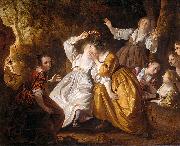
(1614 - 26 November 1670) was a Flemish painter who is considered one of the Dutch Masters of the 17th Century. Van Loo is known for his conversational groupings, his use of a subtle color palette and his nudes. He was the founder of the Van Loo family of painters.
Van Loo was born in Sluis, Zeeland, in the Dutch Republic. Some sources have spe,culated that his father, Jan van Loo, may have been a notary, but more often his father is described as a painter from whom Jacob van Loo received his early training. Little is known of Van Loo's early history due to the destruction of the city archives in Sluis during World War II.
His early influences included Thomas de Keyser and Jacob Adriaensz Backer. In 1642, van Loo moved to Amsterdam, where his contemporaries included Rembrandt, Frans Hals, and Bartholomeus van der Helst. In 1643 he married the sister of the painter, Martinus Lengele. The couple had six children. They lived on Rozengracht in the Jordaan district of Amsterdam. Eglon van der Neer became one of his pupils. In 1660, Van Loo fled the city after fatally stabbing someone during an altercation at an inn. He was sentenced to death in absentia which forever prevented his return to Holland. Van Loo settled in Paris, where he was admitted to the Academie de peinture et de sculpture. He died in Paris in 1670.
Van Loo's work was done in the Baroque style that had originated in Rome. The Baroque style was popular throughout Europe during this period. Van Loo was a major influence on Johannes Vermeer as can be seen in Vermeer's painting, Diana and Her Companions.
Van Loo painted many portraits. Among his subjects were Johan Huydecoper van Maarssenveen; his sister, Leonara Huydecoper, who was married to Jan J. Hinlopen; Joan Ortt, who was later involved with Antoinette Bourignon; and his wife.
Jacob van Loo's son, Louis Abraham van Loo, was also a painter, as were his grandsons, Jean-Baptiste van Loo and Charles-Andra van Loo.
|
|
 |
Jacob van Es -- Click Here
|
|
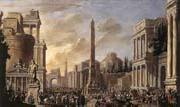
Flemish Baroque Era Painter, 1596-1666
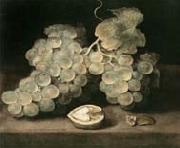
was a Flemish Baroque still life painter active in Antwerp. His restrained ontbijt (breakfast) pieces share many similarities to contemporaries Osias Beert and Clara Peeters, and typically show various foods on a sharply angled table in the foreground. |
|
 |
Jacob van der Ulft -- Click Here
|
|
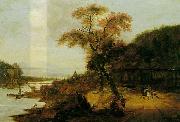
Dutch Baroque Era Painter, 1627-1689 |
|
 |
Jacob van der Does -- Click Here
|
|
(4 March 1623, Amsterdam - buried 17 November 1673, Sloten) was a Dutch Golden Age landscape painter.
Van der Does was the son of the secretary of the Amsterdam city council. He was more attracted to the arts than to note-taking, and went to study drawing with Claes Corneliszoon Moeyaert. He left at 21 to go to France, and from there on foot to Italy. In Rome he joined the Bentvueghels and was dubbed Tamboer, which means drummerboy, since he was somewhat short and had been meant for the military life. He studied with Pieter van Laer (Bamboots). When he eventually returned North, he settled in The Hague where he married Margaretha Boortens and got 4 sons and a daughter. His wife died in 1661. Houbraken liked his natural style of painting, and especially his way of painting sheep was very admirable.His wife's sister was Maria Boortens, and they both were good artists themselves. All three of them made drawings for the album of the wealthy Hague diplomat Cornelis de Glarges in 1659. Through Maria Boortens, Jacob van der Does was connected to Jacob van Campen and Adriaen van Nieulandt the younger. He became involved in the Guild of St. Luke in The Hague. He was one of the founders of the Confrerie Pictura in 1656. His pupils were Theodor Bernoille, Marcus de Bye, Gamaliel Day, Alexander Havelaer, Anthony Schinckels, and his sons Jacob II and Simon van der Does. |
|
 |
Jacob Isaacksz. van Ruisdael -- Click Here
|
|
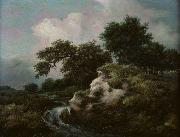
painted Landscape with Dune and Small Waterfall in 1646 |
|
 |
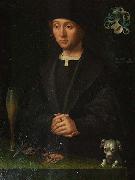
Jacob Ferdinand Voet -- Click Here
|
|
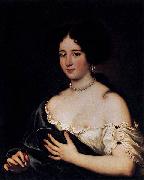
(c. 1639 - c. 1689/1700) was a Flemish Baroque portrait painter.
According to the Netherlands Institute for Art History (RKD) he was born at Antwerp as the son of the painter Elias Voet.[1] He travelled to Rome in 1679-1680, Milan in 1680, Florence in 1681, Turin in 1682-1684, and returned to Antwerp in 1684. While in Rome he lived with the painter-engraver Cornelis Bloemaert until he was banned for his portraits of women portrayed with unseemly decollet, whereupon they left Rome together. He undertook a journey to Paris in 1686 where he became court painter until he died there.He is registered as a painter of miniature portraits.
According to Houbraken, he made his return journey to Antwerp from Turin in the company of Jan van Bunnik, who he had already met in Rome in the company of Cornelis Bloemaert. From Turin they set out for Lyons, where they met Adriaen van der Cabel, Peter van Bloemen, and Gillis Wenix. They set off for Paris in the company of a third painter who was a good painter of "bataljes" or battle scenes. Houbraken reports that this was Jacob, Jan van Bunnik's brother, but had not mentioned him earlier in his Jan van Bunnik biography. The RKD makes no mention of a Jacob van Bunnik. |
|
 |
Jacob Claesz van Utrecht -- Click Here
|
|
also named by his signature Jacobus Traiectensis (born c. 1479 - dead after 1525) was a Flemish early Renaissance painter who worked in Antwerp and Lebeck.
Jacob van Utrecht's life is still very much in the dark. Research on this important Flemish artist did not start before the end of 19th century. He was probably born in Utrecht, although it is not certain. It is assumed that he became a citizen of Antwerp around 1500 and he is recorded as a "free master craftsman" of the Guild of St Luke there from 1506 to 1512.
From 1519 to 1525 he is recorded as a member of the Leonardsbruderschaft ("Leonard's Brotherhood"), a religious confraternity of merchants in Lebeck among whose ranks the leaders of the Protestant Reformation in the 1530s could be found.
From then on no traces of his life have been found.
|
|
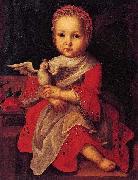 |
Ivan Vishnyakov -- Click Here
|
|
(1699 - 1761) was a Russian painter.
Vishnyakov was born in Moscow. He was a pupil of Louis Caravaque, a French artist, who worked in Russia. Vishnyakov worked in the painting department of the Ministry of Construction, and painted primarily portraits at that time. In 1739 he was promoted to the head of the department, and led the decoration of many palaces and churches in Moscow, Kiev, and Saint Petersburg. He died in Saint Petersburg in 1761.
|
|
 |
Ivan Vishnyakov -- Click Here
|
|
1699-1761
Russian Ivan Vishnyakov Gallery
Russian painter. He trained at the Admiralty College under Vasily Gruzinets (1667-1739) and in 1727 joined the staff of the Office of Buildings with the rank of apprentice, working for a time under Louis Caravaque (1684-1754). In 1739 he became a Master and head of the Office department of paintings. He contributed to the monumental and decorative works, which he also supervised, in the palaces and churches of St Petersburg and environs, Moscow and Kiev, and in the decoration of triumphal arches in Moscow and St Petersburg. |
|
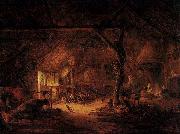 |
Isaac van Ostade -- Click Here
|
|
(bapt. June 2, 1621, Haarlem - buried October 16, 1649, Haarlem) was a Dutch genre and landscape painter.
Van Ostade began his studies under his brother, Adriaen, with whom he remained till 1641, when he started his own practice. At an early period he felt the influence of Rembrandt, and this is apparent in a Slaughtered Pig of 1639, in the gallery of Augsburg. He soon found a style more suited to his own inclinations. He produced pictures in 1641-1642 on the lines of his brother - amongst these, the Five Senses, which Adrian afterwards represented by a Man reading a Paper, a Peasant tasting Beer, a Rustic smearing his Sores with Ointment and a Countryman sniffing at a Snuff-box. A specimen of Isaac's work at this period may be seen in the Laughing Boor with a Pot of Beer, in the museum of Amsterdam; the cottage interior, with two peasants and three children near a fire, in the Berlin museum; a Concert, with people listening to singers accompanied by a piper and flute player, and a Boor stealing a Kiss from a Woman, in the Lacaze collection at the Louvre.
The interior at Berlin is lighted from a casement in the same Rembrandtesque style as Adrian's interior of 1643 at the Louvre. He received low prices for this kind of painting, in which he could only remain subordinate to his brother. Gradually he abandoned Adrian's cottage subjects for landscapes in the fashion of Esaias van de Velde and Salomon van Ruysdael. Once only, in 1645, he reverted to the earlier mode, when he produced the Slaughtered Pig, with a boy puffing out a bladder, in the museum of Lille.
Isaac's progress in his new path was greatly facilitated by his previous experience as a figure painter; and, although he now selected his subjects either from village high streets or frozen canals, he gave fresh life to the scenes by depicting animated groups of people with a refined and searching study of picturesque contrasts. He did not live long enough to bring his art to the highest perfection. He died on 16 October 1649 having painted about 400 pictures (see H de Groot, 1910).
The first manifestation of Isaac's surrender of Adrian's style is apparent in 1644 when the skating and sledging scenes were executed which we see in the Lacaze collection and the galleries of the Hermitage, Antwerp and Lille. Three of these examples bear the artists name, spelled Isack van Ostade, and the dates of 1644 and 1645. The roadside inns, with halts of travellers, form a compact series from 1646 to 1649. This is the last form of Isaac's art and has very distinct peculiarities. The air which pervades his composition is warm and sunny, yet mellow and hazy, as if the sky were veiled with a vapour coloured by moor smoke. The trees are rubbings of umber, in which the prominent foliage is tipped with touches hardened in a liquid state by amber varnish mediums. The same principle applied to details such asglazed bricks or rents in the mud lining of cottages gives an unreal and conventional stamp to them.
These quirks are overcome by his broad contrasts of light and shade and the masterly figures of horses, riders, travellers, rustics, quarrelling children, dogs, poultry and cattle. A favorite place is always given to the white horse, which seems as invariable an accompaniment as the grey in the skirmishes and fairs of Philip Wouwerman.
Isaac displays the best qualities in winter scenes. The absence of foliage, the crisp atmosphere and the calm air of cold January days, unsullied by smoke or vapour, preclude the use of the brown tinge, and leave the painter no choice but to ring the changes with a great variety of opal tints. Then the figures emerge with masterly effect on the light background. Amongst the roadside inns it is worth noting those in the collections of Buckingham Palace, the National Gallery, London, the Wallace Collection and Holford collections in England, the Louvre, Berlin, Hermitage and Rotterdam museums and the Rothschild collection at Vienna. The finest of the ice scenes is the famous one at the Louvre.
|
|
|
|
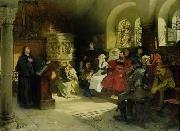 |
Hugo Vogel -- Click Here
|
|
painted Martin Luther preaching at the Wartburg in 1882 |
|
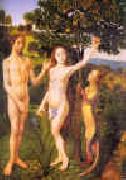 |
Hugo van der Goes -- Click Here
|
|
1440-1482
Flemish
Hugo van der Goes Galleries
Hugo became a member of the painters' guild of Ghent as a master in 1467. In 1468 he was involved in the decoration of the town of Bruges in celebration of the marriage between Charles the Bold and Margaret of York and he provided heraldic decorations for Charles's joyeuse entr??e to Ghent in 1469 and again in 1472. He was elected dean of the Ghent guild in 1473 or 1474.
In 1475, or some years later, Hugo entered Rooklooster, a monastery near Brussels belonging to the Windesheim Congregation, and professed there as a frater conversus. He continued to paint, and remained at Rooklooster until his death in 1482 or 1483. In 1480 he was called to the town of Leuven to evaluate the Justice Scenes left unfinished by the painter Dieric Bouts on his death in 1475. Shortly after this, Hugo, returning with other members of his monastery from a trip to Cologne, fell into a state of suicidal gloom, declaring himself to be damned. After returning to Rooklooster, Hugo recovered from his illness, and died there. His time at Rooklooster is recorded in the chronicle of his fellow monk, Gaspar Ofhuys. A report by a German physician, Hieronymus M??nzer, from 1495, according to which a painter from Ghent was driven to melancholy by the attempt to equal the Ghent Altarpiece, may refer to Hugo.
His most famous surviving work is the Portinari Triptych (Uffizi, Florence), an altarpiece commissioned for the church of San Egidio in the hospital of Santa Maria Nuova in Florence by Tommaso Portinari, the manager of the Bruges branch of the Medici Bank. The triptych arrived in Florence in 1483, apparently some years after its completion by van der Goes. The largest Netherlandish work that could be seen in Florence, it was greatly praised. Giorgio Vasari in his Vite of 1550 referred to it as by "Ugo d'Anversa" ("Hugo of Antwerp"). This the sole documentation for its authorship by Hugo; other works are attributed to him based on stylistic comparison with the altarpiece.
Hugo appears to have left a large number of drawings, and either from these or the paintings themselves followers made large numbers of copies of compositions that have not survived from his own hand. A drawing of Jacob and Rachel preserved at Christ Church, Oxford is thought to be a rare surviving autograph drawing. |
|
 |
Hubert Vos -- Click Here
|
|
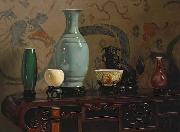
(1855-1935) was a Dutch painter who was born in Maastricht on February 15, 1855. He studied at the Academie Royale des Beaux-Arts in Brussels and with Fernand Cormon (1845-1924) in Paris. He exhibited widely in Paris, Amsterdam, Brussels, Dresden and Munich. From 1885 to 1892, he worked in England, where he exhibited at the Royal Academy between 1888 and 1891. He was a member of the Royal Society of British Artists.
In 1898, he visited Hawaii, where he painted the local people. In that same year, Vos traveled to Korea, where he completed at least three paintings in duplicate. In each case, he left one copy in Korea and kept one copy. The paintings are a life-sized portrait of Emperor Gojong, a portrait of Min Sang-ho (1870-1933) and a landscape of Seoul. The copies left in Korea hung in the Deoksugung Palace until all except the landscape of Seoul, were destroyed by fire in 1904. In 1905, on his second and last trip around the world. |
|
 |
Horace Vernet -- Click Here
|
|
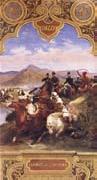
French Academic Painter, 1789-1863, Painter, son of Carle Vernet. He was born in his father's lodgings at the Palais du Louvre, where his grandfather Joseph Vernet also lived; his maternal grandfather was Jean-Michel Moreau. To these antecedents and influences are ascribed the supreme ease of his public career, his almost incredible facility and his fecundity. His early training in his father's studio was supplemented by formal academic training with Franeois-Andre Vincent until 1810, when he competed unsuccessfully for the Prix de Rome. He first exhibited at the Salon in 1812. In 1814 Vernet received the Legion d'honneur for the part he played in the defence of Paris, which he commemorated in the Clichy Gate: The Defence of Paris, 30 March 1814 |
|
 |
HESS, Heinrich Maria von -- Click Here
|
|
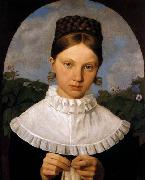
German painter b. 1798, Dsseldorf, d. 1863, Mnchen,German painter. After training (1813-17) under Peter von Langer (1756-1824) at the Akademie der bildenden Kenste in Munich, he painted religious subjects under the influence of Peter Cornelius. In 1821 he joined the Lukasbreder, and the circle around Crown Prince Ludwig I of Bavaria, in Rome. Apollo among the Muses (1824; Munich, Neue Pin.), painted for Maximilian I, shows Hess to be among the most gifted of the German artists working in Rome. The influence of Raphael, glowing but carefully harmonized colours, gliding figures and drapery animate this early masterpiece. Among other important works from this time are exquisitely detailed and colouristically sophisticated, intimate character portraits with early Renaissance settings, such as that of Marchesa Marianna Florenzi (1824; Munich, Neue Pin.), as well as fresh and lively Naturalist landscapes from the environs of Rome, for example Campagna Landscape near Ponte Nomentano (1821-6; Hamburg, Ksthalle). |
|
 |
Hermann Volz -- Click Here
|
|
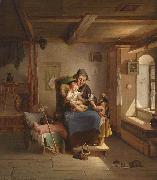
painted Das kleine Katzchen, signiert und datiert H. Volz Munchen in 1858 |
|
 |
Herman van der Mijn -- Click Here
|
|
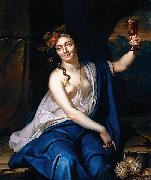
(1684, Amsterdam - 1741, London), was an 18th century painter from the Northern Netherlands.
According to Houbraken he introduced Jan van Nickelen to Jan Frans van Douven.
According to the RKD he learned to paint flowers from Ernst Stuven, and became a master of the Antwerp Guild of St. Luke in 1712, and the following year court painter to Johann Wilhelm, Elector Palatine. He took the family of Jan van Nickelen in tow to Dusseldorp, where they painted at court, and Van der Mijn taught Van Nickelen's daughter Jacoba Maria van Nickelen to paint flowers. She met the painters Rachel Ruysch and Willem Troost (whom Jacoba married) there. Van der Mijn returned to the Netherlands in 1717, but left on a trip via Brussels and Paris to London, where he stayed until 1737, when he took a trip to Leeuwarden
|
|
 |
Henri-Nicolas Van Gorp -- Click Here
|
|
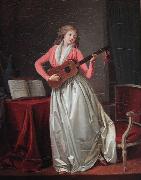
painted Nina chantant la romance in |
|
 |
Henri van Assche -- Click Here
|
|
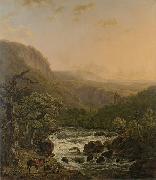
born at Brussels in 1774, showed from his earliest years a predilection for painting, and received from his father, who was a distinguished amateur artist, the first principles of design and perspective. He was afterwards placed with Deroy of Brussels, from whom he received further instructions in painting. Journeys in Switzerland and Italy contributed to develop his talent as a landscape painter. His great partiality for representing waterfalls, mountain streams, and mills gained for him the name of 'The Painter of Waterfalls.' Several pictures by him may be seen in public and private collections of Brussels, Ghent, Lille, and Haarlem, some of which are enriched with figures and animals by Ommeganck. He died at Brussels in 1841.
|
|
|
|
 |
Hendrik Valkenburg -- Click Here
|
|
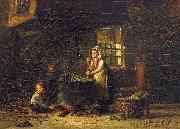
painted An old kitchen with a mother and two children at the cauldron in 1872 |
|
 |
Hendrik Cornelisz. Vroom -- Click Here
|
|
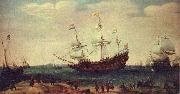
painted Ausfahrt der Ostindiensegler in c. 1630-1640
|
|
 |
Hendrick van Somer -- Click Here
|
|
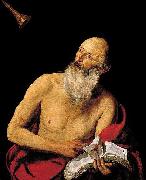
Hendrick van Someren, or Somer (1615, Amsterdam - 1685, Amsterdam), was a Dutch Golden Age painter.
According to Houbraken he was the son of the "van Zomeren" who took in the young Adriaen Brouwer after he fled Frans Hals' workshop to try his luck in Amsterdam. Houbraken claimed Henrik van Someren was a good painter of historical allegories, landscapes, and flower still lifes.
According to the RKD no works survive in the styles Houbraken mentioned, only "hermits" in the style of Ribera. He was the son of the painter Barend van Someren and the grandson of Aert Mijtens. He was the pupil of Jusepe de Ribera and at least one of his works had a forged signature of Ribera.He is possibly the same painter sometimes referred to as Enrico Fiammingo.
|
|
 |
Hendrick van Balen the Elder -- Click Here
|
|
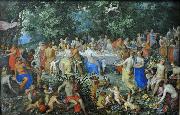
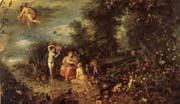
painted The Wedding of Thetis and Perseus with Apollo and the Concert of the Muses, or The Feast of the Gods in ca. 1618
|
|
 |
Hendrick van balen -- Click Here
|
|
Dutch Baroque Era Painter, ca.1575-1632
was a Flemish painter, who was born and died in Antwerp. Van Balen studied art while traveling in Italy. He was the teacher of Anthony Van Dyck and Frans Snyders and was also a contemporary of many of the other famous Flemish artists |
|
|
|
|
| | |
|
|
|
|