|
|
|
|
|
Oil On
Canvas, Real Flavor of Old Masters
|
|

|
ARTWORKS
INDEX
A B C D E F G H I J K L M N O P Q R S T U V W X Y Z |
ARTISTS
INDEX
A B C D E F G H I J K L M N O P Q R S T U V W X Y Z |
|
|
| | |
|
|
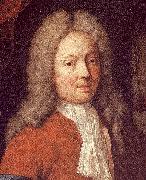 |
Mattheus Terwesten -- Click Here
|
|
Mattheus Terwesten (1670-1757) was a Dutch painter of portraits, architectural, and historical themes. He was court painter to Frederick William I of Prussia and professor of the art academy in Berlin.
Mattheus Terwesten studied with his brother Augustinus Terwesten, Willem Doudyns, and Daniel Mijtens the Younger. In 1695 he traveled via Berlin to Rome, where he stayed until 1699. In Rome he became a member of the painters' circle known as the Bentvueghels, where he earned the nickname "Arend", or eagle. In 1710 he joined his older brother Augustinus and younger brother Ezaias, and when Augustinus died in 1711, he succeeded him as court painter in Berlin, while Ezaias went to Italy, where he married and settled permanently.
His pupils were Herman Diederik Cuipers, Pieter van Cuyck (I), Jan van Gool, Johan Graham, Hendrik van Hulst, Jacob van Nachenius, Andries Storck, and his two sons Augustinus (II) and Pieter Terwesten. |
|
 |
MASTER THOMAS de Coloswar -- Click Here
|
|
first half of 15th century |
|
 |
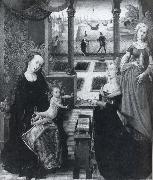
Master Theodoric -- Click Here
|
|
Bohemian painter
active 1350-70 in Prague |
|
 |
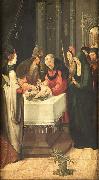
Master of the View of Sainte Gudule -- Click Here
|
|
Netherlandish Northern Renaissance Painter, active ca.1485 |
|
 |
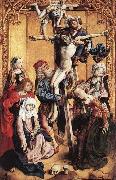
Master of the Vienna Lamentation -- Click Here
|
|
painted Left wing of an altarpiece with the Circumcision and the Virgin of an Annunciation in c. 1515-1525
|
|
 |
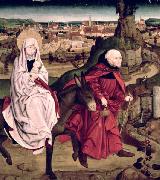
MASTER of the St. Bartholomew Altar -- Click Here
|
|
German painter
active 1470-1510 in Cologne |
|
 |
Master of the Schotten Altarpiece -- Click Here
|
|
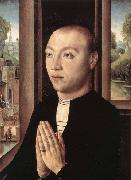
was a German painter, active in Nuremberg during the 14th and 15th centuries. His name is derived from an altarpiece dated to about 1390, which once stood in the church of St. Mary in Schotten. The altarpiece was dismantled in 1828.
|
|
 |
Master of the Saint Ursula Legend -- Click Here
|
|
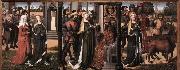
Flemish Northern Renaissance Painter, active 1475-1500 |
|
 |
Master of the Saint Lucy Legend -- Click Here
|
|
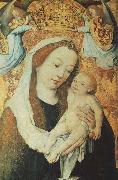
Netherlandish Northern Renaissance Painter, 15th Century |
|
 |
Master of the Prelate Mur -- Click Here
|
|
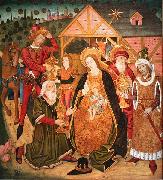
painted The Adoration of the Magi in 15th century
|
|
 |
MASTER of the Pfullendorf Altar -- Click Here
|
|
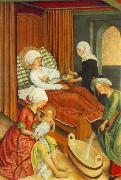
German Northern Renaissance Painter, 15th Century |
|
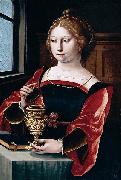 |
Master Of The Parrot -- Click Here
|
|
painted Mary Magdalen in between 1525(1525) and 1550(1550)
|
|
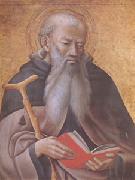 |
Master of the observanza Triptych -- Click Here
|
|
active in Siena after 1425 |
|
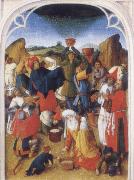 |
Master of the Manna -- Click Here
|
|
French Early Renaissance,
15th Century |
|
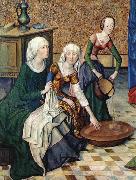 |
MASTER of the Life of the Virgin -- Click Here
|
|
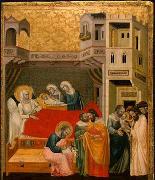
German Northern Renaissance Painter, active 1460-1480 |
|
 |
Master of the Life of Saint John the Baptist -- Click Here
|
|
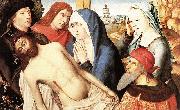
Italian Byzantine Style Painter, 14th Century |
|
 |
Master of the Legend of St. Lucy -- Click Here
|
|
(fl. 1480-1510) was an unidentified Early Netherlandish painter who worked in Bruges, now a city in Belgium. His name comes from for an altarpiece in the church of Saint James in Bruges, which is dated 1480 and depicts three scenes from the life of Saint Lucy. Since then, twenty-five to thirty-five paintings have been attributed to the same hand. He may have trained Spanish students at his studio in Bruges. Many of them are characterized by views of the city of Bruges in the background, and can be dated according to the level of construction of its belfry. He may have trained with Dieric Bouts, and was certainly influenced by Bruges' greatest artist at the time, Hans Memling.
|
|
 |
Master of the Joseph Legend -- Click Here
|
|
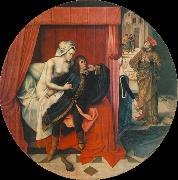
Flemish Northern Renaissance Painter, active ca.1500 |
|
 |
Master of the Housebook -- Click Here
|
|
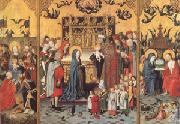
German Northern Renaissance Painter, 15th Century, German graphic artist. The master is named for a series of vigorous and sophisticated drawings of everyday life found in the Hausbuch at Castle Wolfegg. Many of his engravings are in the Rijksmuseum, Amsterdam. His work is thought to have influenced Bosch, Bruegel, and Durer. |
|
 |
master of the Holy Kindred -- Click Here
|
|
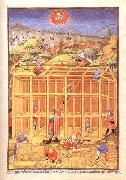
active in Cologne 1470/80-1515 |
|
 |
MASTER of the Duke of Bedford -- Click Here
|
|
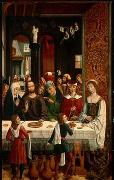
French Early Renaissance Miniaturist, active 1405-1435 |
|
 |
MASTER of the Catholic Kings -- Click Here
|
|
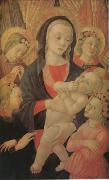
Spanish painter
active 1485-1500 in Castilia |
|
 |
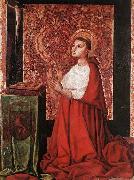
Master of The Castello Nativity -- Click Here
|
|
Florence ca 1450-ca 1475 |
|
 |
MASTER of the Avignon School -- Click Here
|
|
French Early Renaissance Painter, 15th Century |
|
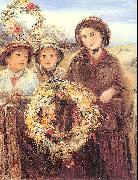 |
Marshall, Thomas Falcon -- Click Here
|
|
English, 1818-1878 |
|
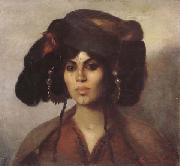 |
Marie Caire Tonoir -- Click Here
|
|
Naturalist artist
France
1860-1934 |
|
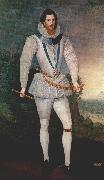 |
Marcus Gheeraertz the Younger -- Click Here
|
|
painted Robert Devereaux, Earl of Essex in 1596 |
|
|
|
 |
Ludger tom Ring the Younger -- Click Here
|
|
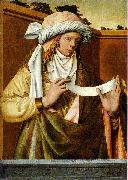
(1522-1584) was a German painter and draughtsman.
Ring was born in Menster. His father and brothers were also painters. Ring primarily painted portraits and still lifes. He died in Braunschweig in 1584.
|
|
 |
Ludger tom Ring -- Click Here
|
|
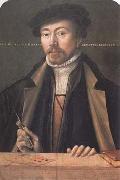
German Painter, 1522-1584 |
|
 |
Lucas Cranach the Younger -- Click Here
|
|
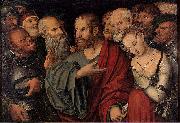
(October 4, 1515 ?C January 25, 1586) was a German Renaissance artist, known for his woodcuts and paintings.
He was a son of Lucas Cranach the Elder who began his career as an apprentice in his father's workshop. Henceforth, his own reputation and fame grew. After his father's death, he assumed control over the workshop.
The style of their paintings can be so similar that there have been some difficulties in attribution of their works. |
|
 |
Lucas Cranach the Elder -- Click Here
|
|
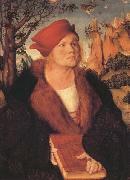
b. 1472, Kronach, d. 1553, Weimar. German painter and printmaker. He took his name from the town of his birth. Little is known about his early life or training. In Vienna (c. 1501 ?C 04) he painted some notable portraits and landscapes characteristic of the Danube school. From 1505 to 1550 he was court painter in Wittenberg, where he achieved great success and wealth painting portraits, mythological subjects, and altarpieces for Protestant and Catholic churches. He attracted so many young artists to Wittenberg that the town became an art centre. A friend of Martin Luther, Cranach became known as the chief pictorial propagandist of the Protestant cause in Germany. He produced numerous engravings and more than 100 woodcuts, notably for the first German edition of the New Testament (1522). After his death, his style was perpetuated by his son, Lucas the Younger (1515 C 86). |
|
 |
Luca di Tomme -- Click Here
|
|
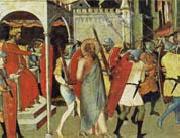
Italian Painter, ca.1330-1390 |
|
|
|
 |
Louis Rolland Trinquesse -- Click Here
|
|
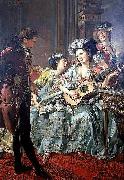
(c.1746-1800) was a French painter.
|
|
 |
Louis Gallait -- Click Here
|
|
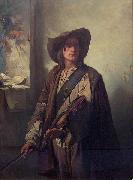
(9 or 10 May 1810 - 20 November 1887) was a Belgian painter. His d his reputation especially with the large painting of Charles V's abdication. Gallait's works were considered as the basis for a desirable renewal of historical paintings because of the realism, costume faithfulness and colorful posture of his paintings. His last artwork was sent on tour in Germany and that led to new signals even among German historians. He was also a distinguished portrait painter.
Gallait died in Brussels in 1887. There is a painting by Louis Gallait at the Norton Art Museum in West Palm Beach, Florida ("Art and Liberty").
|
|
 |
Louis Comfort Tiffany -- Click Here
|
|
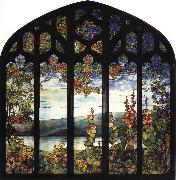
American Art Nouveau Stained Glass Artist, 1848-1933
was an American artist and designer who worked in the decorative arts and is best known for his work in stained glass and is the American artist most associated with the Art Nouveau and Aesthetic movements. Tiffany was affiliated with a prestigious collaborative of designers known as the Associated Artists which included Lockwood de Forest, Candace Wheeler, and Samuel Colman. Tiffany designed stained glass windows and lamps, glass mosaics, blown glass, ceramics, jewelry, enamels and metalwork Louis was the son of Charles Lewis Tiffany, founder of Tiffany and Company; and Harriet Olivia Avery Young. Louis married Mary Woodbridge Goddard (c1850-1884) on May 15, 1872 in Norwich, Connecticut and had the following children: Mary Woodbridge Tiffany (1873-1963) who married Graham Lusk; Charles Louis Tiffany I (1874-1874); Charles Louis Tiffany II (1878-1947); and Hilda Goddard Tiffany (1879-1908). After the death of his wife, he married Louise Wakeman Knox (1851-1904) on November 9, 1886. They had the following children: Louise Comfort Tiffany (1887-1974); Julia DeForest Tiffany (1887-1973) who married Gurdon S. Parker then married Francis Minot Weld; Annie Olivia Tiffany (1888-1892); and Dorothy Trimble Tiffany (1891-1979). Many of Tiffany's descendants are active in the arts, politics, and the sciences. Only one descendant is working in glass today- Dr. Rodman Gilder Miller of Seattle, WA, |
|
 |
Lorenzo Tiepolo -- Click Here
|
|
Venice 1736 -C Madrid 1776
|
|
 |
Lorens Pasch the Younger -- Click Here
|
|
(1733-1805) was a Swedish painter
He grew up in an artistic family (he was the brother of Ulrika Pasch, alongside whom he was elected to the Art Academy in 1773), but his father Lorens Pasch the Elder wanted him to become a priest. He was thus sent to study in Uppsala aged 10. However, he decided on an artistic career after all and began an apprenticeship in his father's studio before going to Copenhagen, with introductions from his wealthy and influential uncle Johan Pasch. There he studied painting for three years in the studio of Carl Gustaf Pilo. Despite good offers of studio-apprenticeships and commissions from Sweden, he then set off for Paris in 1758 to complete his artistic education. There he specialised in history painting in the studios of Eustache Le Sueur and François Boucher (though for financial reasons he also continued his training in portraiture) and became friends with fellow-Swede Alexander Roslin.
In 1764 he left Paris and got back to Sweden in 1766. He fully completed his training in the studio of the French painter Guillaume Taraval, who in 1735 founded the Royal Swedish Academy of Arts in Stockholm. Soon after his arrival back in Sweden Pasch's gained a great reputation as a portraitist, gaining favour and commissions from the royal court and gaining the esteem of Adolf Frederick, King of Sweden and his queen Louisa Ulrika - one of his most notable works is his Portrait of Louisa Ulrika of Prussia. He served as a professor at the Academy of Arts from 1773 to his death, becoming its director on Pilo's death in 1793. At the end of his life he concentrated more on training young artists and managing the Academy than on painting. He died unmarried in 1805 and due to his powerful portraits remains one of the most respected painters of the Gustavian era in Sweden. |
|
 |
Lodewyck Toeput -- Click Here
|
|
Mechin ca.1545-Treviso 1610
|
|
 |
Lodewijk Toeput -- Click Here
|
|
(ca.1550, Antwerp - 1605, Treviso), was a Mannerist landscape painter active in Italy.
According to Karel van Mander who listed him as one of two painters from Northern Europe who he met in Venice, he was a good poet (rederijker) as well as a painter, who he thought came from Mechelen. Van Mander listed him with Dirck de Vries, a painter of kitchen pieces and fruit markets from Friesland. According to the RKD he was from Antwerp and spent most of his life in Treviso, Italy. He painted several historical allegories from the Bible and mythological themes from Metamorphoses. |
|
|
|
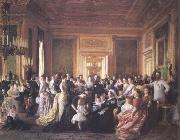 |
Laurits Tuxen -- Click Here
|
|
Danish Painter, 1853-1927
was a Danish painter specialising in figure painting. He was also associated with the Skagen group of painters. Tuxen grew up in Copenhagen and studied at the Royal Danish Academy of Art where together with P.S. Krøyer he was considered to be one of the best painters. He first visited Skagen in 1870 and he returned on several occasions. In the 1880s and 1890s, he travelled widely painting portraits for Europe's royal families including Christian IX of Denmark, Queen Victoria and the Russian royalty. In 1901, after the death of his first wife Ursule, he married the Norwegian Frederikke Treschow and shortly aferwards purchased Madam Bendsen's house at the artists' colony in Skagen in the north of Jutland, converting it into a stately summer residence. |
|
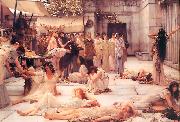 |
Laura Theresa Alma-Tadema -- Click Here
|
|
(1852 C 15 August 1909 in Hindhead) was from 1871 the second wife of the painter Lawrence Alma-Tadema and a painter in her own right.
A daughter of Dr George Napoleon Epps (who was brother of Dr John Epps), her two sisters were also painters (Emily studied under John Brett, a Pre-Raphaelite, and Ellen under Ford Madox Brown), whilst Edmund Gosse and Rowland Hill were her brothers-in-law. It was at Madox Brown's home that Alma-Tadema first met her in December 1869, when she was aged 17 and he 33. (His first wife had died in May that year.) He fell in love at first sight,and so it was partly her presence in London (and partly the fact that only in England had his work consistently sold) that influenced him into relocating in England rather than elsewhere when forced to leave the continent by the outbreak of the Franco Prussian War in July 1870. Arriving in London at the beginning of September 1870 with his small daughters and sister Artje, Alma-Tadema wasted no time in contacting Laura, and it was arranged that he would give her painting lessons. During one of these, he proposed marriage. As he was then thirty-four and Laura was now only eighteen, her father was initially opposed to the idea. Dr Epps finally agreed on the condition that they should wait until they knew each other better. They married in July 1871 and, though this second marriage proved childless, it also proved enduring and happy, with Laura acting as stepmother to her husband's children by his first marriage.
The Paris Salon in 1873 gave Laura her first success in painting, and five years later, at the Paris International Exhibition, she was one of only two English women artists exhibited. |
|
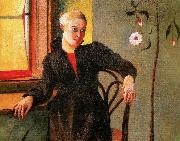 |
Kosztka, Tivadar Csontvry -- Click Here
|
|
Hungarian Painter, 1853-1919 |
|
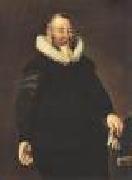 |
KEYSER, Thomas de -- Click Here
|
|
Dutch Baroque Era Painter, ca.1596-1667
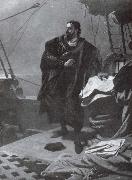
son of Hendrick de Keyser I. Following an apprenticeship with an unidentified master in painting, he trained from 1616 to 1618 with his father in architecture. Although he ultimately followed his father and two brothers, Pieter and Willem, into service for the city of Amsterdam as city mason (1662-7), no designs for buildings by Thomas are known, with the exception of an unbuilt triumphal arch published in Salomon de Bray's Architectura moderna |
|
 |
Karl Theodor von Piloty -- Click Here
|
|
German, 1826-1886,German painter. He received his first training from his father, the lithographer Ferdinand Piloty (1786-1844). In 1838 Piloty entered the Munich Akademie der Bildenden Kenste and from 1840 became a pupil of Julius Schnorr von Carolsfeld. Piloty had to manage the family business after his father's death in 1844, but in 1846 he returned to the Akademie as a pupil of Karl Schorn (1801-50). His artistic development was influenced by the work of the Antwerp artist Louis Gallait (1810-87), the heightened colour and multi-figure compositions in whose history paintings especially impressed him. Besides his study of Old Masters, especially Veronese and Rubens, he was influenced by French history painters like Paul Delaroche and Horace Vernet. His history painting Seni by the Body of Wallenstein (1855; Munich, Neue Pin.) was an enormous success, allowing him to take a leading role in the art life of Munich. In 1860 he was ennobled. |
|
 |
Karl Jakob Theodor Leybold -- Click Here
|
|
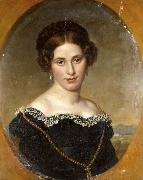
painted Portrait of a young woman in 1822 |
|
 |
Justus Tiel -- Click Here
|
|
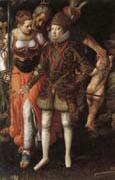
active end of sixteenth century |
|
 |
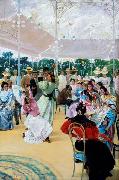
Julius Jacob the Younger -- Click Here
|
|
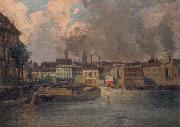
painted in ca. 1910 |
|
 |
Julio Romero de Torres -- Click Here
|
|
was a Spanish painter.
He was born and died in Cerdoba, Spain, where he lived most of his life. His father was the famous painter Rafael Romero Barros and his mother was Rosario de Torres Delgado. Julio learned about art from his father who was the director, curator and founder of Cerdoba's Museo Provincial de Bellas Artes and an impressionist painter. He took an interest in art at a young age and started studying at the School of Fine Arts when he was 10. He went to Madrid to work and study in 1906. He also traveled all over Europe to study and he picked up a symbolist style, for which he is best known. A museum dedicated to the work of de Torres is situated at Plaza del Potro 1 Cordoba 14002.
He spent most of his life living in Cerdoba and Madrid and both places had influences on his paintings. He combined many different styles when he painted because he had many different influences including realism, which was a popular style at that time and impressionism, which he picked up from living in Cerdoba and from his father. While in Cerdoba he became part of the late 19th century intellectual movement that was based on the Royal Academy of Science, Arts and Literature. Julio Romero also won many awards in his lifetime. In 1895 he won an honorable mention at the National Exhibition and later won third place in 1899 and 1904.
El Retablo del Amor by Julio Romero de Torres, painted in 1910.In 1914 he relocates to Madrid, where he makes contact with the intellectual and artistic environment of the time together with his brother Enrique. He became a regular at the cafe Nuevo Levante and his paintings began to reflect the philosophical currents of the times, represented by such writers of the times as Ramen del Valle-Inclen and Ruben Dareo. When the war broke out in 1914 Julio Romero fought for the allies as a pilot
|
|
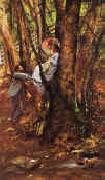 |
Jules Tavernier -- Click Here
|
|
1844-1889 Jules Tavernier was born in Paris in 1844. He studied with the French painter, F??lix Joseph Barrias (1822-1907), but left France in the 1870s, never to return. Tavernier was employed as an illustrator by Harper's Magazine, which sent him on assignment to California in the 1870s. Eventually he continued westward to Hawaii, where he made a name for himself as a landscape and portrait painter. He was captivated by Hawaii??s erupting volcanoes??a subject that was to pre-occupy him for the rest of his life, which was spent in Hawaii, Canada and the western United States. He is considered the most important artist of Hawaii??s Volcano School. Tavernier died in Honolulu, Hawaii in 1889. His students included David Howard Hitchcock (1861-1943), Am??d??e Joullin (1862-1917), Charles Rollo Peters (1862-1917) and Manuel Valencia (1856-1935). The Honolulu Academy of Arts and the Stark Museum of Art (Orange, Texas) are among the public collections having paintings by Jules Tavernier. |
|
|
|
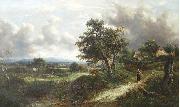 |
Joseph Thors -- Click Here
|
|
(ca. 1835 - 1884) was an English landscape artist who exhibited widely in England during the late 19th century.
Relatively little is known about Thors's life though he was recorded as living and working in London, then Birmingham - he also travelled for a while in France. He exhibited at the Royal Academy of Arts, British Institution, and Society of British Artists in London, and was also exhibited in Birmingham between 1869 - 1900. |
|
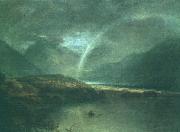 |
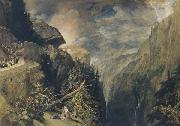
Joseph Mallord William Turner -- Click Here
|
|
English Romantic Painter, 1775-1851
Joseph Mallord William Turner (23 April 1775 ?C 19 December 1851) was an English Romantic landscape painter, watercolourist and printmaker, whose style is said to have laid the foundation for Impressionism. Although Turner was considered a controversial figure in his day, he is now regarded as the artist who elevated landscape painting to an eminence rivalling history painting.
Turner's talent was recognised early in his life. Financial independence allowed Turner to innovate freely; his mature work is characterised by a chromatic palette and broadly applied atmospheric washes of paint. According to David Piper's The Illustrated History of Art, his later pictures were called "fantastic puzzles." However, Turner was still recognised as an artistic genius: the influential English art critic John Ruskin described Turner as the artist who could most "stirringly and truthfully measure the moods of Nature." (Piper 321)
Suitable vehicles for Turner's imagination were to be found in the subjects of shipwrecks, fires (such as the burning of Parliament in 1834, an event which Turner rushed to witness first-hand, and which he transcribed in a series of watercolour sketches), natural catastrophes, and natural phenomena such as sunlight, storm, rain, and fog. He was fascinated by the violent power of the sea, as seen in Dawn after the Wreck (1840) and The Slave Ship (1840).
Turner placed human beings in many of his paintings to indicate his affection for humanity on the one hand (note the frequent scenes of people drinking and merry-making or working in the foreground), but its vulnerability and vulgarity amid the 'sublime' nature of the world on the other hand. 'Sublime' here means awe-inspiring, savage grandeur, a natural world unmastered by man, evidence of the power of God - a theme that artists and poets were exploring in this period. The significance of light was to Turner the emanation of God's spirit and this was why he refined the subject matter of his later paintings by leaving out solid objects and detail, concentrating on the play of light on water, the radiance of skies and fires. Although these late paintings appear to be 'impressionistic' and therefore a forerunner of the French school, Turner was striving for expression of spirituality in the world, rather than responding primarily to optical phenomena.
Rain, Steam and Speed - The Great Western Railway painted (1844).His early works, such as Tintern Abbey (1795), stayed true to the traditions of English landscape. However, in Hannibal Crossing the Alps (1812), an emphasis on the destructive power of nature had already come into play. His distinctive style of painting, in which he used watercolour technique with oil paints, created lightness, fluency, and ephemeral atmospheric effects. (Piper 321)
One popular story about Turner, though it likely has little basis in reality, states that he even had himself "tied to the mast of a ship in order to experience the drama" of the elements during a storm at sea.
In his later years he used oils ever more transparently, and turned to an evocation of almost pure light by use of shimmering colour. A prime example of his mature style can be seen in Rain, Steam and Speed - The Great Western Railway, where the objects are barely recognizable. The intensity of hue and interest in evanescent light not only placed Turner's work in the vanguard of English painting, but later exerted an influence upon art in France, as well; the Impressionists, particularly Claude Monet, carefully studied his techniques. |
|
 |
Joseph Mallord William Truner -- Click Here
|
|
born: London, England; 23 April 1775 died: London, England; 19 December
1851. |
|
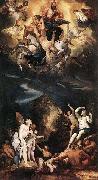 |
Joseph Heintz the Elder -- Click Here
|
|
the Elder (Basle, 11 June 1564 - near Prague, Bohemia, October 1609) was a Swiss painter, draftsman and architect.
He appears to have been a pupil of Hans Bock, and to have educated himself by diligent practice in copying the works of Hans Holbein the younger. Between 1585 and 1587 he lived in Rome, registering himself a pupil; to Hans von Aachen. He next settled in Bohemia in 1591, and was at once appointed court painter to Rudolf II, but he remained in Prague for two years only, as in 1593 he was commissioned to make some copies from the antique for the emperor, and for that purpose went to Rome, where he spent some years. In 1604 we hear of him in Augsburg, and from the time we know little of his history, until his decease is recorded in a village outside of Prague.
Heintz's paintings included religious images, portraits, and, following the emperor's taste, erotic mythological themes. They were at one time in high demand, but later on suffered an eclipse. Among them are a family portrait in Berne and that of Rudolf II in Vienna. He was constantly investigating subtle questions of light, and almost all of his landscapes show the interest he took in this technical matter. A notable work by him is the Rape of Proserpine, which hangs in the Dresden Gallery, and was engraved by Lukas Kilian; in the same gallery are two other works, Lot and His Daughters and Ecce Homo. Finally there is his portrait of Constance of Austria. He had a son, who bore the same name, and who painted a few religious pictures; several of these works hitherto attributed to the son are now believed to be late productions by the father.
|
|
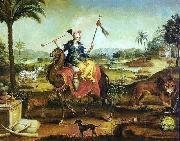 |
Jose Teofilo de Jesus -- Click Here
|
|
painted asia in 1758-1847 |
|
|
|
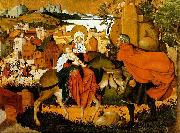 |
Jorg Breu the Elder -- Click Here
|
|
(c. 1475 -- 1537), of Augsburg, was a painter of the German Danube school. He was the son of a weaver.
He journeyed to Austria and created several multi-panel altarpieces there in 1500-02, such as the Melk Altar (1502). He returned to Augsburg in 1502 where he became a master. He travelled to Italy twice, in ca. 1508 and in 1514/15.
After his death in 1537, his son, Jörg Breu the Younger continued to lead his Augsburg workshop until his own death 10 years later. |
|
 |
JONES, Thomas -- Click Here
|
|
Welsh Painter, 1742-1803 |
|
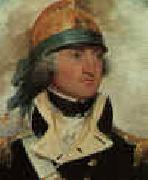 |
John Trumbull -- Click Here
|
|
1756-1843
John Trumbull Gallery
Trumbull was born in Lebanon, Connecticut, to Jonathan Trumbull, who was Governor of Connecticut from 1769 to 1784. He entered the 1771 junior class at Harvard University at age fifteen and graduated in 1773. Due to a childhood accident, Trumbull lost use of one eye, which may have influenced his detailed painting style.
As a soldier in the American Revolutionary War, Trumbull rendered a particular service at Boston by sketching plans of the British works, and witnessed the famous Battle of Bunker Hill. He was appointed second personal aide to General George Washington, and in June 1776 deputy adjutant-general to General Horatio Gates, but resigned from the army in 1777.
In 1780 he traveled to London where he studied under Benjamin West, who suggested to him that he paint small pictures of the War of Independence and miniature portraits, of which he produced about 250 in his lifetime.
On September 23, 1780 and October 2, 1780, British agent Major John Andr?? was, respectively, captured and hanged as a spy in America. News reached Europe, and as an officer of similar rank as Andr?? in the Continental Army, Trumbull was imprisoned for seven months in London's Tothill Fields Bridewell.
In 1784 he was again in London working under West, in whose studio he painted his Battle of Bunker Hill and Death of Montgomery, both of which are now in the Yale University Art Gallery.
In 1785 Trumbull went to Paris, where he made portrait sketches of French officers for The Surrender of Cornwallis, and began, with the assistance of Jefferson, Declaration of Independence, well-known from the engraving by Asher Brown Durand. This latter painting was purchased by the United States Congress along with his Surrender of General Burgoyne, Surrender at Yorktown, and Washington Resigning his Commission, and these paintings now hang in the United States Capitol. Trumbull's The Sortie Made by the Garrison of Gibraltar, 1789, owned by the Boston Athenaeum, is now in the Boston Museum of Fine Arts. |
|
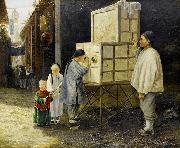 |
John Thomson -- Click Here
|
|
John Thomson (14 June 1837 - 29 September 1921) was a pioneering Scottish photographer, geographer and traveller. He was one of the first photographers to travel to the Far East, documenting the people, landscapes and artifacts of eastern cultures. Upon returning home, his work among the street people of London cemented his reputation, and is regarded as a classic instance of social documentary which laid the foundations for photojournalism. He went on to become a portrait photographer of High Society in Mayfair, gaining the Royal Warrant in 1881.
The son of William Thomson, a tobacco spinner and retail trader, and his wife Isabella, Thomson was born the eighth of nine children in Edinburgh in the year of Queen Victoria's accession. After his schooling in the early 1850s, he was apprenticed to a local optical and scientific instrument manufacturer, thought to be James Mackay Bryson. During this time, Thomson learned the principles of photography and completed his apprenticeship around 1858.
During this time he also undertook two years of evening classes at the Watt Institution and School of Arts (formerly the Edinburgh School of Arts, later to become Heriot-Watt University). He received the "Attestation of Proficiency" in Natural Philosophy in 1857 and in Junior Mathematics and Chemistry in 1858. In 1861 he became a member of the Royal Scottish Society of Arts, but by 1862 he had decided to travel to Singapore to join his older brother William, a watchmaker and photographer.
|
|
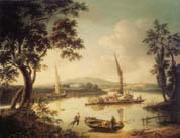 |
John Thomas Serres -- Click Here
|
|
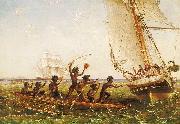
1759-1825 English painter, born in London in December 1759. He was the eldest son of Dominic (1722-93), a successful marine painter who was to be one of the founder members of the Royal Academy.Son of Dominic Serres. John Thomas Serres's colourful career began with landscape painting. He later travelled extensively, spending periods in Paris (1789), Rome and Naples (1790-91), before succeeding his father to the office of Marine Painter to George III in 1793. He worked promisingly as a painter (in both oils and watercolour) of sea-pieces in the European tradition, advanced in England by Phillipe Jacques de Loutherbourg. After becoming Marine Draughtsman to the Admiralty in 1800 he took on the less challenging employment of making drawings and elevations of the west coasts of France and Spain. This connection with the Navy was probably related to his appointment as drawing instructor at Chelsea Naval School, London. |
|
 |
John Thomas Baines -- Click Here
|
|
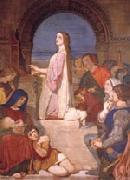
(John) Thomas Baines (27 November 1820 - 8 May 1875) was an English artist and explorer of British colonial southern Africa and Australia. Born in King's Lynn, Norfolk, Baines was apprenticed to a coach painter at an early age. When he was 22 he left England for South Africa aboard the "Olivia" (captained by a family friend William Roome) and worked for a while in Cape Town as a scenic and portrait artist, and as official war artist during the so-called Eighth Frontier War for the British Army.
|
|
 |
John Tenniel -- Click Here
|
|
English Golden Age Cartoonist and Illustrator.
(1820-1914)
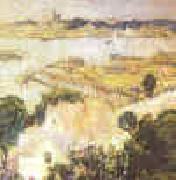
English illustrator and painter. Impatient with the hierarchic structure of the curriculum at the Royal Academy schools in London, he left to follow a less formal education at the Clipstone Street Art Society's life and anatomy classes and in the British Museum's sculpture galleries and Print Room. His research into the history of costume and armour provided material for his early oils of chivalric scenes, which he exhibited at the Royal Academy (1837-42, 1851). Tenniel was among the artists commissioned to decorate the New Palace of Westminster, and he went in 1845 on a state-sponsored trip to Munich to study fresco technique. His contact with the school of Peter Cornelius while there confirmed his emphatic preference for a precisely drawn line. |
|
 |
John Henry Twatchman -- Click Here
|
|
1853-1902
John Henry Twatchman Galleries |
|
 |
John Henry Twachtman -- Click Here
|
|
American Impressionist Painter, 1853-1902
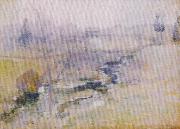
American painter and printmaker. He began as a painter of window-shades but developed one of the most personal and poetic visions in American landscape painting, portraying nature on canvases that were, in the words of Childe Hassam, 'strong, and at the same time delicate even to evasiveness'. His first artistic training was under Frank Duveneck, with whom he studied first in Cincinnati and then in Munich (1875-7). His absorption of the Munich style, characterized by bravura brushwork and dextrous manipulation of pigment, with the lights painted as directly as possible into warm, |
|
 |
John Bettes the Elder -- Click Here
|
|
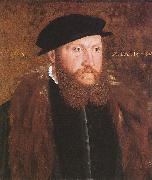
(active c. 1531 - 1570) was a Tudor artist whose few known paintings date from between about 1543 and 1550. His most famous work is his Portrait of a Man in a Black Cap. His son John Bettes the Younger, with whom he is sometimes confused, was a pupil of Nicholas Hilliard who painted portraits during the reign of Elizabeth I and James I.
Nothing is known of John Bettes's life, except that he was living in Westminster in 1556, according to a documented court case. He is first recorded as working for Henry VIII at Whitehall Palace in 1531. Queen Catherine Parr's accounts for 1546/47 record payments to Bettes for "lymning" (painting in miniature) the king's and queen's portraits, and for six other portraits. Her new year's gift of 1547 to Prince Edward was a pair of portraits of the king and herself. Bettes has been identified as the designer of the engraved title-border for William Cuningham's Cosmographical Glasse, printed by John Day in 1559. He may also be the designer of engravings for Edward Hall's Chronicle, published in 1550, and of a woodcut portrait of Franz Burchard, the Saxon ambassador to England, published in 1560. In 1576, John Foxe referred to Bettes as already dead. An earlier second edition of Foxe's Actes and Monuments printed in 1570 refers to Bettes' death. |
|
 |
Johann-Baptist Lampi the Elder -- Click Here
|
|
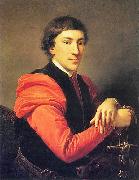
painted Portrait of Paweł Grabowski. in1790 |
|
 |
johann tischbein -- Click Here
|
|
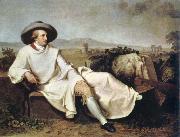
Johann Heinrich Wilhelm Tischbein, also known as Goethe-Tischbein (15 February 1751 in Haina ?C 26 February 1828 in Eutin) was a German painter. He was a descendant of the Tischbein family of painters, and a pupil of his uncle Johann Jacob Tischbein.
Like many contemporary colleagues, Tischbein lived in Rome for some years. During his first stay in Rome (1779?C1781) his style changed from Rococo to Neoclassicism. He painted landscapes, historical scenes and still lifes. His second stay in Rome lasted 16 years (1783?C1799). He met Johann Wolfgang von Goethe there in 1786, made friends with him and accompanied him to Naples in 1787. Later, Goethe recounted this travel in his Italian Journey. Also in 1787, Tischbein painted his most famous work, a portrait of Goethe as a traveller in the Roman Campagna (now in the Städel museum, Frankfurt am Main).
From 1808, Tischbein was a painter at the court of Oldenburg in Northern Germany.
|
|
 |
johann friedrich august tischbein -- Click Here
|
|
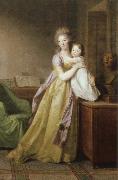
German Painter, 1750-1812. 1750 Maastricht ?C Heidelberg 1812. First he was a pupil of his father Johann Valentin Tischbein (1715-1768) in Hildburghausen, from 1768 one of his uncle Johann Heinrich Tischbein the elder (1722-1789) in Kassel.
Supported by Prince Friedrich von Waldeck he stayed in Paris from 1772 until 1777, where he studied at the academy of arts under N. B. L??pici?? (1735-1784).
Afterwards he travelled to Rome, where he got in contact with the painters A.R. Mengs (1728-1779), J.L. David (1748-1825) and Fr.H. F??ger (1751-1818) and probably also with the English style of portrait painting. 1779 he travelled to Naples.
In 1780 he returned to Arolsen via Vienna, Munich, Stuttgart and Kassel, where he worked for the Prince of Waldeck. From 1780 he was his councillor
and court painter. During this time he made several journeys e.g. to Holland and after 1785 to Weimar where he met Wieland (1785), Schlegel (1792) and other important people.
From 1795 he worked for Leopold III. of Anhalt-Dessau. 1800 he succeeded A. Fr. Oeser (1717-1799) as director of the academy of arts in Leipzig. From 1806 to 1808 he stayed in St Petersburg. He died 1812 when he visited his daughter Caroline Wilken (1783-1843) in Heidelberg
|
|
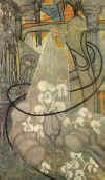 |
Johan Thorn Prikker -- Click Here
|
|
1868-1932 Dutch Johan Thorn Prikker Gallery
Dutch painter, printmaker, mosaicist and stained-glass artist. He attended the Koninklijke Academie van Beeldende Kunsten in The Hague (1881-8). During this period he painted mainly landscapes in the style of The Hague school. Until c. 1896 he produced Symbolist works, in which the emphatic line flow and the subtle colour shading are especially noticeable, for example The Bride (1893; Otterlo, Kr?ller-M?ller). From 1892 until 1897 he corresponded with Henri Borel, partly about his Symbolist work, often drawing in the letters. During this time he came into close contact with Belgian artists, in particular with Henry Van de Velde through whom he was able to exhibit with Les XX in Brussels. In summer he regularly stayed in Vise, where he produced pastel drawings in a rhythmic pointillism, a style with which he could achieve a form of abstraction. |
|
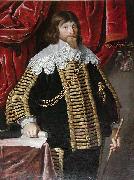 |
Johan Thim -- Click Here
|
|
painted Jørgen Rosenkrantz in 1640 |
|
 |
Joaquin Mir Trinxet -- Click Here
|
|
Spanish , 1873-1940 |
|
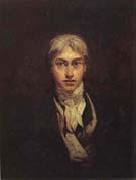 |
Jmw Turner -- Click Here
|
|
1775-1851
British landscape painter. The son of a barber, he entered the Royal Academy school in 1789. In 1802 he became a full academician and in 1807 was appointed professor of perspective. His early work was concerned with accurate depictions of places, but he soon learned from Richard Wilson to take a more poetic and imaginative approach. The Shipwreck (1805) shows his new emphasis on luminosity, atmosphere, and Romantic, dramatic subjects. After a trip to Italy in 1819, his colour became purer and more prismatic, with a general heightening of key. In later paintings, such as Sunrise, with a Boat Between Headlands (1845), architectural and natural details are sacrificed to effects of colour and light, with only the barest indication of mass. His compositions became more fluid, suggesting movement and space. In breaking down conventional formulas of representation, he anticipated French Impressionism. His immense reputation in the 19th century was due largely to John Ruskin's enthusiasm for his early works |
|
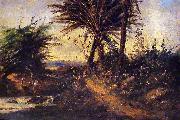 |
Jeronimo Jose Telles Junior -- Click Here
|
|
painted Landsape 1851-1914 |
|
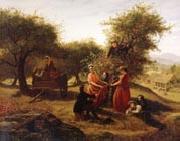 |
Jerome B Thompson -- Click Here
|
|
American Impressionist ,
1814-1886 |
|
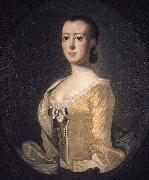 |
Jeremiah Theus -- Click Here
|
|
(April 5, 1716 - May 17, 1774) was a Swiss-born American painter, primarily of portraits. He was active mainly around Charleston, South Carolina, in which city he remained almost without competition for the bulk of his career.
Theus was born in the city of Chur, in the Swiss canton of Graubenden, and was the eldest child of Simeon and Anna Walser Thees. He was nineteen when he immigrated with his family to the Province of South Carolina, whose General Assembly had provided land grants and transport funds to encourage European Protestants to settle in the colony. Simeon Thes was given 250 acres (1.0 km2) of land along the Edisto River in what was then Orangeburgh Township, |
|
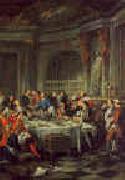 |
Jean-Francois De Troy -- Click Here
|
|
French
1679-1752
Jean-Francois
De Troy Gallery
Jean François de Troy was born on January 27, 1679 in Paris. The successful career of Jean François de Troy was based initially on large historical and allegorical compositions, such as Time Unveiling Truth (1733) in the National Gallery, London, but he is now most highly regarded for his smaller and more spirited scenes of elegant social life. They are among the best of those that rode on the wave of Watteau's success??indeed The Alarm, or the Gouvernante Fid??le (Victoria and Albert Museum, London, 1723) was attributed to Watteau in the 19th century. A versatile artist, he made tableaux de modes famous, painting histories and mythologies in a colourful and fluent manner which owed something to both Veronese and Peter Paul Rubens.
He undertook commissions for Versailles and Fontainebleau between 1724 and 1737, and designed two sets of tapestries for the Gobelins, each of seven subjects, the Histoire d'Esther (1737-40) and the Histoire de Jason (1743-6).
In 1738 he was appointed Director of the French Academy in Rome, and spent the rest of his life there. De Troy's wife died prematurely, and he lost of all his seven children. Jean François de Troy died on January 26, 1752 in Rome. |
|
|
|
|
| | |
|
|
|
|