|
|
|
|
|
Oil On
Canvas, Real Flavor of Old Masters
|
|

|
ARTWORKS
INDEX
A B C D E F G H I J K L M N O P Q R S T U V W X Y Z |
ARTISTS
INDEX
A B C D E F G H I J K L M N O P Q R S T U V W X Y Z |
|
|
| | |
|
|
 |
Rosso Fiorentino -- Click Here
|
|
Italian Mannerist Painter, ca.1495-1540
Born in Florence Italy with the red hair that gave him his nickname, Rosso first trained in the studio of Andrea del Sarto alongside his contemporary, Pontormo. In late 1523, Rosso moved to Rome, where he was exposed to the works of Michelangelo, Raphael, and other Renaissance artists, resulting in the realignment of his artistic style.
Fleeing Rome after the Sacking of 1527, Rosso eventually went to France where he secured a position at the court of Francis I in 1530, remaining there until his death. Together with Francesco Primaticcio, Rosso was one of the leading artists to work at the Chateau Fontainebleau as part of the "First School of Fontainebleau", spending much of his life there. Following his death in 1540 (which, according to an unsubstantiated claim by Vasari, was a suicide ), Francesco Primaticcio took charge of the artistic direction at Fontainebleau.
Rosso's reputation, along those of other stylized late Renaissance Florentines, was long out of favour in comparison to other more naturalistic and graceful contemporaries, but has revived considerably in recent decades. That his masterpiece is in a small city, away from the tourist track, was a factor in this, especially before the arrival of photography. His poses are certainly contorted, and his figures often appear haggard and thin, but his work has considerable power. |
|
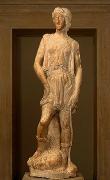 |
ROSSELLINO, Bernardo -- Click Here
|
|
Italian sculptor
Florentine school (b. 1409, Settignano, d. 1464, Firenze).Italian architect and sculptor. Influenced by Donatello, Filippo Brunelleschi, and Luca Della Robbia, he developed a moderately Classical style. His tomb for Leonardo Bruni (1444 C 50) in Santa Croce, Florence, was one of the greatest achievements of early Renaissance sculpture and inaugurated a new type of sepulchral monument. Its fine balance between sculpture and architecture, figure and decoration, made it the prototypical niche tomb of its time. He also designed the apse of St. Peter's Basilica and the cathedral and Piccolomini Palace in Pienza (1460 ?C 64). He presumably trained his brother Antonio (1427 ?C 79), who regularly assisted him.
|
|
 |
ROSSELLI, Cosimo -- Click Here
|
|
Italian Early Renaissance Painter, 1439-1507
Painter. He was documented in Neri di Bicci's workshop between May 1453 and October 1456; in 1459 he received his first known commission, for an altarpiece in Santa Tr?nita, Florence (untraced). It is thought that he subsequently worked with Benozzo Gozzoli, whose influence is evident in his early work, but Cosimo was receptive to the styles of almost all his more gifted contemporaries, including Alesso Baldovinetti (said by Baldinucci to have been his master), Andrea del Verrocchio and the Pollaiuolo brothers. Cosimo's first surviving works of importance are the frescoes in the style of Baldovinetti in the Salutati Chapel, Fiesole Cathedral, datable to between 1462 and 1466, but these are heavily restored. |
|
 |
Rosalba carriera -- Click Here
|
|
Italian Rococo Era Painter, 1675-1757
Italian pastellist and painter. She was a daughter of Andrea Carriera, who worked in the mainland podesteria of the Republic of Venice, and of Alba Foresti, an embroiderer. She had two sisters: Angela, who married the painter Giovanni Antonio Pellegrini, and Giovanna, who, like Rosalba herself, never married. Pier Caterino Zeno (see Campori, 1886) and other, anonymous sources recorded that she was a pupil of Giuseppe Diamantini; according to Mariette, she originally painted snuff-boxes and later became a pupil of Federico Bencovich. There are more precise records of her life and of some of her works from 1700 onwards |
|
 |
ROSA, Salvator -- Click Here
|
|
Italian Baroque Era Painter, 1615-1673
Italian painter, draughtsman, etcher, poet and actor. He was one of the most original artists and extravagant personalities of the 17th century. His most popular and influential works were his landscapes, the wild and mountainous beauty of which contrasted with the pastoral scenes of Claude Lorrain. Yet Rosa also painted macabre subjects, erudite philosophical allegories and grand historical themes; he was, moreover, the most significant satirical poet of the Italian 17th century, and there is a close relationship between his poetry and painting. His earliest biographers, Filippo Baldinucci and Giovanni Battista Passeri, both of whom knew him well, described at length his fiery temperament |
|
 |
Rosa Bonheur -- Click Here
|
|
1822-1899 Realism,French,French painter and sculptor. She received her training from her father, Raymond Bonheur (d 1849), an artist and ardent Saint-Simonian who encouraged her artistic career and independence. Precocious and talented, she began making copies in the Louvre at the age of 14 and first exhibited at the Salon in 1841. Her sympathetic portrayal of animals was influenced by prevailing trends in natural history (e.g. Etienne Geoffroy Saint-Hilaire) and her deep affinity for animals, especially horses. Bonheur's art, as part of the Realist current that emerged in the 1840s, was grounded in direct observation of nature and meticulous draughtsmanship. She kept a small menagerie, frequented slaughterhouses and dissected animals to gain anatomical knowledge. Although painting was her primary medium, she also sculpted, or modelled, studies of animals, several of which were exhibited at the Salons, including a bronze Study for a Bull and Sheep . |
|
|
|
 |
ROMNEY, George -- Click Here
|
|
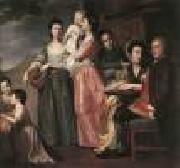
English Painter, 1734-1802
The son of a cabinetmaker, George Romney was born in Dalton, Lancashire. He was apprenticed in 1755 to Christopher Steele, a provincial portrait painter, but was largely self-taught. Romney's ambition was to become a history painter. In 1762 he moved to London, where he studied the Duke of Richmond's collection of casts of antique sculpture and established himself as a portraitist. He went to Italy in 1773, and after his return in 1775 he became the favorite painter of high society. Morbidly sensitive and retiring, Romney kept aloof from the social world of his sitters and from the Royal Academy. By 1782 he was under the spell of Emma Hart, later Lady Hamilton and the mistress of Nelson, who sat for him as Circe, a Bacchante, Cassandra, the Pythian Priestess, Joan of Arc, St. Cecilia, Mary Magdalene, and other impersonations he suggested. In the 1780s he executed a number of Eton leaving portraits, which established him as the supreme interpreter of aristocratic adolescence in his age. For much of his life in London, Romney was under the wing of the poet William Hayley, who encouraged him in the choice of subjects from Milton and Shakespeare as well as the Bible and Greek tragedy. Romney's history paintings are today chiefly known from engravings, like the dramatic Tempest (1787-1790) commissioned for John Boydell's Shakespeare Gallery. A large number of drawings for these projects survive. Romney had married early in life an uneducated woman whom he did not bring to London but to whom he returned when his health finally gave way. Ill health and the facility with which he converted his early realistic style into a fashionable sketchlike formula for idealizing his sitters probably account for an unevenness of execution that has partially justified his critics. Unlike Joshua Reynolds, Romney did not enter into the character of his sitters, unless they possessed nervous traits like his own, for example, the moving portrait William Cowper. But he was psychologically involved with the generalized charms of youth, beauty, and breeding that he admired in his aristocratic sitters, and by combining a neoclassic purity of line with free but masterly brushwork he achieved a number of incomparable images which transcend the realism of portraiture. |
|
 |
Romanoz Gvelesiani -- Click Here
|
|
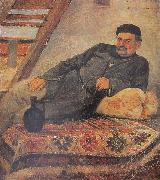
painted A Kakhetian man with a jar in 1883 |
|
 |
ROMANINO -- Click Here
|
|
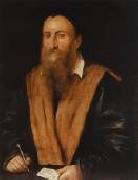
Italian painter, Brescian school (b. ca. 1484, Brescia, d. ca. 1559,
Brescia). |
|
 |
ROMANELLI, Giovanni Francesco -- Click Here
|
|
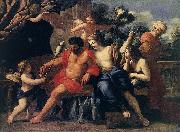
Italian painter, Roman school (b. 1610, Viterbo, d.1662, Viterbo).
Italian painter and draughtsman. He was the pupil first of Domenichino, then of Pietro da Cortona; his work also shows the influence of Bernini (in some of whose projects he became involved) and of Poussin. His calm and graceful synthesis of these extremes of austere Baroque classicism and High Baroque ebullience was prophetic of the effects of the Roman Late Baroque and of the generalized style of public painting that spread throughout Europe in the late 17th century and the early 18th. |
|
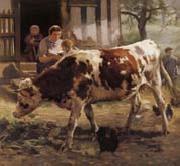 |
Roll Alfed Philippe -- Click Here
|
|
Paris 1846-Paris 1919
|
|
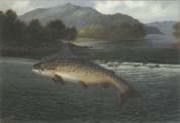 |
Roland Knight -- Click Here
|
|
British, active circa 1810-1840 |
|
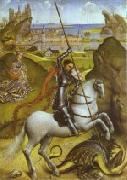 |
Rogier van der Weyden -- Click Here
|
|
Rogier van der Weyden 1399/1400 - 1464 was the most important representative of Netherlandish painting or Northern Renaissance ... is, with Jan van Eyck, considered one of the greatest exponents of the school of Early Netherlandish painting. Rogier van der Weyden was born in Tournai as 'Rogier de le Pasture' (Roger of the Pasture) in 1399 or 1400. His parents were Henri de le Pasture and Agnes de Watr??los. The family had settled before in the city of Tournai where Rogiers father worked as a 'maître-coutelier' (knife manufacturer). In 1426 Rogier married Elisabeth, the daughter of the Brussels shoemaker Jan Goffaert and his wife Cathelyne van Stockem. Rogier and Elisabeth had four children: Cornelius, who became a Carthusian monk, was born in 1427, a daughter Margaretha in 1432. Before 21 October 1435 the family settled in Brussels where the two younger children were born: Pieter in 1437 and Jan the next year. From the second of March 1436 onwards held the title of 'painter to the town of Brussels' (stadsschilder) a very prestigious post because Brussels was at that time the most important residence of the splendid court of the Dukes of Burgundy. It was at the occasion of his move to the Dutch-speaking town of Brussels that Rogier began using the Dutch version of his name: 'Rogier van der Weyden'Little is known about Rogier's training as a painter. The archival sources from Tournai (completely destroyed during World War II, but luckily partly transcribed in the 19th and early 20th century) are somewhat confusing and have led to different interpretations by scholars. From a document it is known that the city council of Tournai offered wine in honour of a certain 'Maistre Rogier de le Pasture' on March the 17th 1427. However, on the 5th of March of the following year the records of the painters' guild show a certain 'Rogelet de le Pasture' entered the workshop of Robert Campin together with Jacques Daret. Only five years later, on the first of August 1432, Rogier de le Pasture obtains the title of 'Master' (Maistre) as a painter.[1] Many have doubted whether Campin's apprentice 'Rogelet' was the same as the master 'Rogier' that was offered the wine back in 1426. The fact that in 1426-1427 Rogier was a married man in his late twenties, and well over the normal age of apprenticeship has been used as an argument to consider 'Rogelet' as a younger painter with the same name. In the 1420's however the city of Tournai was in crisis and as a result the guilds were not functioning normally. The late apprenticeship of Rogier/Rogelet may have been a legal formality. Also Jacques Daret was then in his twenties and had been living and working in Campin's household for at least a decade. It is possible that Rogier obtained an academic title (Master) before he became a painter and that he was awarded the wine of honour on the occasion of his graduation. The sophisticated and 'learned' iconographical and compositional qualities of the paintings attributed to him are sometimes used as an argument in favour of this supposition. The social and intellectual status of Rogier in his later life surpassed that of a mere craftsman at that time. In general the close stylistical link between the documented works of Jacques Daret, and the paintings attributed to Robert Campin and Rogier van der Weyden is considered as the main argument to consider Rogier van der Weyden as a pupil of Robert Campin. The last mention of Rogier de la Pasture in the financial records of Tournai, on October 21, 1435, lists him as demeurrant ?? Brouxielles ('living in Brussels'). At the same time, the first mention of Rogier de Weyden is made as the official painter of Brussels. Therefore Rogier de la Pasture and Rogier Van der Weyden are thought to be one and the same painter. The post of city painter was created especially for Van der Weyden and was meant to lapse on his death. It was linked to a huge commission to paint four justice scenes for the 'Golden Chamber' of Brussels City Hall.[2] Different properties and investments are documented and witness his material prosperity. The portraits he painted of the Burgundian Dukes, their relatives and courtiers, demonstrate a close relationship with the elite of the Netherlands. The Miraflores Altarpiece was probably commissioned by King Juan II of Castile, since Juan II donated it to the monastery of Miraflores in 1445. |
|
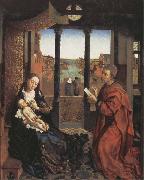 |
Roger Van Der Weyden -- Click Here
|
|
c.1399-1464
Rogier van der Weyden was the son of Henri de le Pasture, a cutler in Tournai, and Agn?s de Watreloz. His birthdate is estimated from the facts that he was stated to be 35 in April 1435 and 43 in September 1441. Before or in 1427 he married Elisabeth Goffaert (c. 1405-77), whose father was a prosperous shoemaker in Brussels. Rogier may have lived for a time in Brussels: his eldest child Cornelis (b 1427) was sometimes referred to as 'de Bruxella' but was not necessarily a native of Brussels. On 5 March 1427 'Rogelet de le Pasture, natif de Tournai' was apprenticed to the Tournai painter Robert Campin. This Rogelet duly completed his apprenticeship in 1431 and on 1 August 1432 became a master of the Tournai guild. Despite much debate, it would appear that Rogelet was Rogier van der Weyden, though it has also been argued that in 1427 Rogier was a married man well past the normal age of apprenticeship and that Rogelet must have been a second Tournai painter of the same name. JACQUES DARET, however, was in his twenties when in 1428 he was apprenticed to Campin, and other instances can be cited of married apprentices. The political situation at Tournai in 1427-8 was unusual, and the guild system was not functioning normally. |
|
 |
roger de la fresnaye -- Click Here
|
|
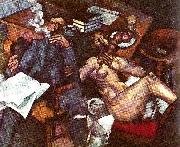
Roger de La Fresnaye (11 July 1885 - 27 November 1925) was a French cubist painter.
He was born in Le Mans where his father, an officer in the French army, was temporarily stationed. The La Fresnaye's were an aristocratic family whose ancestral home, the Château de La Fresnaye, is in Falaise. His education was classically based, and was followed from 1903 to 1904 by studies at the Acad??mie Julian in Paris, and from 1904 to 1908 at the Ecole des Beaux-Arts. From 1908 he studied at the Acad??mie Ranson under Maurice Denis and Paul S??rusier, whose joint influence is evident in early works such as Woman with Chrysanthemums, 1909. This demonstrates the dreamlike symbolist ambience and stylistic character of work by the Les Nabis group.
The Conquest of the Air, 1913. Museum of Modern Art, New York.From 1912 to 1914 he was a member of the Section d'Or group of artists, and his work demonstrates an individual response to cubism. He was influenced by Georges Braque and Pablo Picasso , but his work has a more decorative than structural feel and his prismatic colours reflect the influence of Robert Delaunay. He was a member of the Puteaux Group, an orphist offshoot of cubism led by Jacques Villon. His most famous work is The Conquest of the Air, 1913, and depicts a scene with himself and his brother outdoors with a balloon in the background.
La Fresnaye served in the French army in World War I and his health deteriorated rapidly after the war. He never recovered the physical energy to undertake sustained work. In the later paintings that he did create, he abandoned cubist spatial analysis for a more linear style. He died in Grasse in 1925. |
|
 |
ROELAS, Juan de las -- Click Here
|
|
Spanish painter (c. 1560-1625). |
|
 |
Roelant Savery -- Click Here
|
|
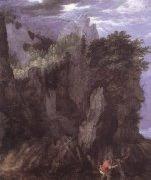
Flemish Northern Renaissance Painter, 1576-1639 . was a Flanders-born Dutch baroque painter of the Golden Age. Like so many other artists, Savery's Anabaptist family fled North from the Spanish occupied Southern Netherlands when Roelant was about 4 years old and settled in Haarlem around 1585. He was taught painting by his older brother Jacob Savery (c.1565-1603) and Hans Bol. After his schooling, Savery traveled to Prague around 1604, where he became court painter of the Emperors Rudolf II (1552-1612) and Mathias (1557-1619), who had made their court a center of mannerist art. Between 1606-1608 he traveled to Tyrol to study plants. Gillis d'Hondecoeter became his pupil.[3] Before 1616 Savery moved back to Amsterdam, and lived in the Sint Antoniesbreestraat. In 1618 he settled in Utrecht, where he joined the artist's guild a year later. His nephew Hans would become his most important assistant. In 1621 Savery bought a large house on the Boterstraat in Utrecht. The house had a large garden with flowers and plants, where a number of fellow painters, like Adam Willaerts were frequent visitors. Savery had kept his house in Amsterdam, and had one child baptized in Nieuwe Kerk (Amsterdam).[4] Savery was friends with still life painters like Balthasar van der Ast and Ambrosius Bosschaert. In the 1620s he was one of the most successful painters in Utrecht, but later his life got troubled, perhaps because of heavy drinking. Though he would have pupils until the late 1630s |
|
 |
Roelandt Savery -- Click Here
|
|
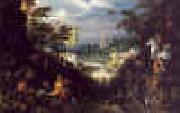
1576-1639
Roelandt Savery Gallery
Like so many other artists, Savery's Anabaptist family fled North from the Spanish occupied Southern Netherlands when Roelant was about 4 years old and settled in Haarlem around 1585. He was taught painting by his older brother Jacob Savery (c.1565-1603) and Hans Bol.
After his schooling, Savery traveled to Prague around 1604, where he became court painter of the Emperors Rudolf II (1552-1612) and Mathias (1557-1619), who had made their court a center of mannerist art. Between 1606-1608 he traveled to Tyrol to study plants. Gillis d'Hondecoeter became his pupil.
Before 1616 Savery moved back to Amsterdam, and lived in the Sint Antoniesbreestraat. In 1618 he settled in Utrecht, where he joined the artist's guild a year later. His nephew Hans would become his most important assistant.
In 1621 Savery bought a large house on the Boterstraat in Utrecht. The house had a large garden with flowers and plants, where a number of fellow painters, like Adam Willaerts were frequent visitors. Savery had kept his house in Amsterdam, and had one child baptized in Nieuwe Kerk (Amsterdam).
Savery was friends with still life painters like Balthasar van der Ast and Ambrosius Bosschaert. In the 1620s he was one of the most successful painters in Utrecht, but later his life got troubled, perhaps because of heavy drinking. Though he would have pupils until the late 1630s, amongst which Allaert van Everdingen and Roelant Roghman, he went bankrupt in 1638 and died half a year later. |
|
 |
Rodrigo de Villandrando -- Click Here
|
|
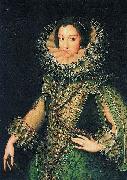
Rodrigo de Villandrando (1588 - December 1623) was a court painter during the reign of Philip III of Spain. He worked in the tradition of Alonso Senchez Coello and Juan Pantoja de la Cruz. His death opened the road to court for the young painter Diego Velezquez from Sevilla. |
|
 |
Rodolfo Amoedo -- Click Here
|
|
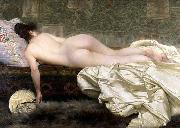
(born in Salvador, Bahia on December 11, 1857; died in Rio de Janeiro on May 31, 1941) was a Brazilian history painter. He began his career as an artist in 1873 as a student of Victor Meirelles. In 1878 he won the first prize at the Brazilian Academy, which allowed him to travel to Paris, where he lived from 1879 to 1887 studying at the École des Beaux Arts. He was a pupil of Alexandre Cabanel and also worked with Paul-Jacques-Aime Baudry. He was a professor and later director of the Brazilian Academy, renamed School of Fine Arts ou Escola Nacional de Belas Artes at the fall of the Brazilian Empire. His students include Eliseu Visconti. He died forgotten and so poor his friends had to help the widow pay for his funeral. His paintings still hang at the National Museum Museu Nacional de Belas Artes in Rio de Janeiro. |
|
 |
ROBERT, Hubert -- Click Here
|
|
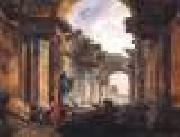
French Rococo Era Painter, 1733-1808
French painter, draughtsman, etcher and landscape designer. He was one of the most prolific and engaging landscape painters in 18th-century France. He specialized in architectural scenes in which topographical elements derived from the buildings and monuments of ancient and modern Italy and of France are combined in often fantastic settings or fictitious juxtapositions. The fluid touch and rich impasto employed in his paintings |
|
 |
Robert William Vonnoh -- Click Here
|
|
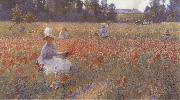
American portrait and landscape painter, 1858-1933
was an American Impressionist painter known for his portraits and landscapes. |
|
 |
Robert William Buss -- Click Here
|
|
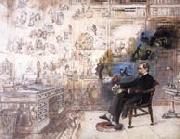
British painter and etcher , 1804-1875
was a Victorian artist, etcher and illustrator perhaps best known for his painting Dickens' Dream. Born in Bull and Mouth Street, Aldersgate in London in 1804, Buss served an apprenticeship with his father, a master engraver and enameller, and then studied painting under George Clint, a miniaturist, watercolour and portrait painter, and mezzotint engraver. At the start of his career Buss specialized in painting theatrical portraits, with many of the leading actors of the day sitting to him, including William Charles Macready, John Pritt Harley, and John Baldwin Buckstone. Later Buss painted historical and humorous subjects. He exhibited a total of 112 pictures between 1826 and 1859, twenty-five at the Royal Academy, twenty at the British Institution, |
|
 |
Robert Wilhelm Ekman -- Click Here
|
|
(August 13, 1808 - February 19, 1873), aka R. W. Ekman, was a significant teacher and painter of the Finnish romantic portraits and early national romanticism.
Robert Ekman was born in Uusikaupunki, Finland to an upper class family. His father was Karl Kristoffer Ekman, a medical doctor and a mayor. Mother was Sara Elisabet (maiden name Gadolin). Robert Ekman's both parents died when he was about 10 years old. They left behind five orphans who were placed in foster homes. Schooling was incomplete and there was no chance of academic education.
Robert Ekman first studied in Finland under the guidance of Gustaf Wilhelm Finnberg, but in 1824, with his brother Fredrubjm begun studies in Kungliga Akademien för de Fria Konsterna (The royal academy for free arts) in Stockholm. Already as a student Ekman specialized in portraying the life of the common people, instead of Classicism of the academic arts. Ekman graduated in 1836, and was granted a generous traveling scholarship for excelling in his studies. That supported him working in Holland, France and Italy between years 1837-1844. As the scholarship was not plausible otherwise, Ekman took the Swedish citizenship.
|
|
 |
Robert Whale -- Click Here
|
|
Born in Alternun, England in 1805. Died in Brantford, Ontario in 1887 |
|
 |
Robert Walter Weir -- Click Here
|
|
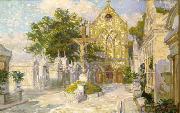
Jun 18.1803-May 1.1889, Painter and teacher. By his own account he was self-taught, with the exception of a few lessons from an unknown heraldic painter named Robert Cooke. However, after exhibiting a few works that were praised by the local press, he was sent to Italy by a group of New York and Philadelphia businessmen for further studies. There he trained with Florentine history painter Pietro Benvenuti. After three years in Europe (1824-7), he returned to New York, where he quickly became a mainstay of the artistic community. In 1831 he was elected to membership in the National Academy of Design in New York, and three years later he was made instructor of drawing at the US Military Academy in West Point, New York, a post he held for the next 42 years. |
|
 |
Robert Wadsworth Grafton -- Click Here
|
|
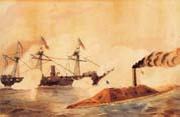
United States (1876 - 1936 ) - Painter |
|
 |
Robert W. Weir -- Click Here
|
|
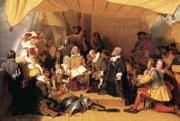
American Hudson River School Painter, 1803-1889,Painter and teacher. By his own account he was self-taught, with the exception of a few lessons from an unknown heraldic painter named Robert Cooke. However, after exhibiting a few works that were praised by the local press, he was sent to Italy by a group of New York and Philadelphia businessmen for further studies. There he trained with Florentine history painter Pietro Benvenuti. After three years in Europe (1824-7), he returned to New York, where he quickly became a mainstay of the artistic community. In 1831 he was elected to membership in the National Academy of Design in New York, and three years later he was made instructor of drawing at the US Military Academy in West Point, New York, a post he held for the next 42 years. Most scholars agree that he was more important as a teacher than as a painter. His best known work is the Embarkation of the Pilgrims (1837-43), which hangs in the Rotunda of the US Capitol Building in Washington, DC. |
|
 |
Robert Talbot Kelly -- Click Here
|
|
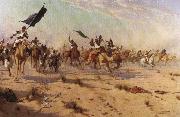
(1861 - 1934) was an English orientalist landscape and genre painter, author and illustrator.
Kelly was born in Birkenhead, Cheshire, the son of Irish landscape artist Robert George Kelly. He left school in 1876 to take up work in a firm of cotton traders, but was also taught art by his father, exhibiting under the name R. G. Kelly Jnr.
In the early 1880s, inspired by the places he saw while on vacation on an ocean cruise ship, Talbot-Kelly decided to take up his father's profession. He left his employment in 1882, travelled by boat to North Africa, and settled in Egypt in 1883, acquiring a studio in Cairo and becoming fluent in Arabic. He travelled throughout the country, writing about and painting the people and scenes he encountered both in towns and in the desert. He spent a considerable time with the Bedouin tribes who he described and illustrated in his 1902 book, "Egypt painted and described" (A & C Black). As his name became known he also earned an income from private commissions. He stayed in Egypt until 1915 when for reasons of health and age he returned to London - though he continued to paint constantly.
An Arab cafe in Cairo (from "Egypt painted and described", 1902)"Egypt painted and described", his first illustrated travel book, was published in 1902 (by A & C Black), and was an account of his impressions and experiences of that country during his long stay there; an exhibition of his Egyptian views was also held at the Fine Art Society in the same year. His paintings and writing showed a great empathy and respect for local people and culture, especially that of the desert Bedouin Arabs. |
|
 |
Robert Swain Gifford -- Click Here
|
|
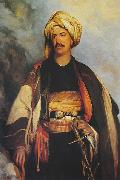
(December 23, 1840 - January 13, 1905) was an American landscape painter. He was influenced by the Barbizon school.
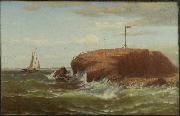
Much of his work focuses on the landscapes of New England, where he was born. He, along with Victorian contemporaries from the White Mountain and Hudson River Schools, helped immortalize the majestic cliffs of Grand Manan in the Bay of Fundy. His painting from the island, "Pettes Cove," is illustrative of his masterful marine work.
In the 1870s, he undertook several journeys to Europe and the Middle East and painted some subjects from those regions. In 1899, he was an artist on the famous Harriman Alaska Expedition.
Some of his works hang in the most prominent galleries in the USA, including the Fine Arts Museums of San Francisco, the Metropolitan Museum of Art, New York, and the Smithsonian American Art Museum, Washington DC. He was a member of the Society of American Artists.
|
|
 |
Robert Scott Lauder -- Click Here
|
|
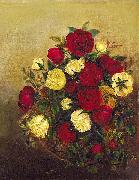
Robert Scott Lauder (25 June 1803 - 21 April 1869) was a Scottish mid-Victorian artist who described himself as a "historical painter". He was one of the original members of the Royal Scottish Academy.
Lauder was born at Silvermills, Edinburgh, on 25 June 1803, the third son of John Lauder of Silvermills (died 1838), Burgess of Edinburgh and proprietor of the tannery at Silvermills, by his wife Helen Tait (d.1850). After attending the Royal High School he went to London, where his eldest brother William was engaged in the family business.
He returned to Edinburgh about 1826 and was elected one of the original members of the Royal Scottish Academy in 1830. On 9 September 1833 at St.Cuthberts in Edinburgh he married Isabella Ramsay Thomson and they then went abroad, accompanied by his younger artist-brother, James Eckford Lauder. Robert studied for some years in Rome, Florence, Bologna, Venice and Munich.
Lauder returned to London in 1838 where he lived for several years, where his three children - Isabella, John, and Robert, were baptised at St.Thomases Church, Southwark, in 1840, 1841, and 1844. Whilst in London he exhibited at the Royal Academy and competed in the Westminster Hall competition of 1847, sending his Christ walking on the Sea, which was subsequently purchased by Lady Angela Burdett-Coutts, 1st Baroness Burdett-Coutts. He became the first president of the short-lived National Institution of Fine Arts and also exhibited there.
He later removed back to Edinburgh in 1849 where both his sons - Robert Scott Lauder (born 1844), who became a physician, and John Thomson Lauder (1841-1865) - attended the Edinburgh Academy. Sir Walter Scott's novels provided him with subjects for many of his most successful historical paintings. About 1860 he suffered a paralytic stroke and did not practice after 1861. He died at Edinburgh from a bout of bronchitis on 21 April 1869, still paralysed. He is buried in Warriston Cemetery in Edinburgh. |
|
 |
Robert Scott Duncanson -- Click Here
|
|
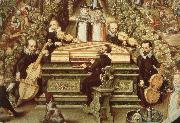
(1821 - December 21, 1872) was born in Seneca County, New York in 1821.Duncansones father was a Canadian of Scottish descent and his mother was an African American, thus making him ea freeborn person of color.e Duncanson, an artist who is relatively unknown today, painted America, both physically and figuratively, at a time when the country was in turmoil. Beautiful and serene, Duncansones work sheds light on American art that has been forgotten over the years.
|
|
 |
robert schumann -- Click Here
|
|
Date of birth: June 8, 1810 at Zwickau, Germany
Died: Jul 29, 1856 in Endenich, Germany Death: July 29, 1856 at Endenich, Germany |
|
 |
Robert Salmon -- Click Here
|
|
1775-1844
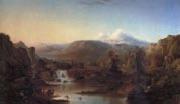
American painter of English origin. Having trained and painted in England and Scotland, he moved to Boston in 1828, painting in a 'little hut' near the wharves of South Boston. Reportedly an eccentric, he became a successful painter of marine views, adopting a range of different scales, including small wooden panels, larger canvases and theatre backdrops. Moonlight Coastal Scene (1836; St Louis, MO, A. Mus.) is typical of his works on panel, and it demonstrates his use of light to silhouette form. There are no extant examples of the panoramic views done as backdrops; his canvases such as Wharves of Boston (1829; Boston, MA, Old State House) and View of Charlestown (1833; Annapolis, MD, US Naval Acad. Mus.) are full of carefully delineated figures, minute and accurate details of the ships and their rigging, and, most importantly, large expanses of sky dominated by strong light. Salmon's portrayal of light-filled water and sky, increasingly luminous in the late 1830s and early 1840s, has caused him to be considered by some as the father of LUMINISM (i). He used a low viewpoint and contrasted a distant shoreline and small-scale figures in the foreground in a manner that prefigured the work of Fitz Hugh Lane and Martin Johnson Heade, both of whom were influenced by Salmon's manipulation of scale, light and subject-matter. It appears that he returned to England before his death. |
|
 |
Robert S.Duncanson -- Click Here
|
|
American artist .
1821-1872
A self-taught mulatto artist and a landscape painter of the Hudson River school tradition, Duncanson was the first Afro-American artist to receive international recognition. Born into a family of painters and handymen, Duncanson first worked as a house-painter and glazier in Monroe, MI. By 1841 he was in Cincinnati, OH, where he learnt to paint by executing portraits and copying prints. Throughout the 1840s he travelled as an itinerant artist between Cincinnati, Monroe and Detroit. |
|
 |
Robert Reid -- Click Here
|
|
1862-1929
Robert Reid Galleries
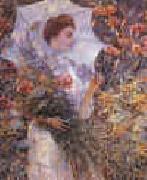
Robert Lewis Reid (July 29, 1862 ?C December 2, 1929) was an American Impressionist painter and muralist.
Reid was born in Stockbridge, Massachusetts and attended the School of the Museum of Fine Arts, Boston under Otto Grundmann, where he was also later an instructor. In 1884 he moved to New York City, studying at the Art Students League, and in 1885 he went to Paris to study at the Acad??mie Julian.
Upon returning to New York in 1889, he worked as a portraitist and later became an instructor at the Art Students League and Cooper Union. Much of his work centered on the depiction of young women set among flowers. His work tended to be very decorative.
In 1897, Reid was a member of the Ten American Painters, who seceded from the Society of American Artists. Around the turn of the century, Reid worked on several mural projects and when he returned to paintings, around 1905, his work was more naturalistic, even though his palette trended toward soft pastels.
He died in Clifton Springs, New York. |
|
 |
Robert Peckham -- Click Here
|
|
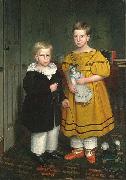
painted The Raymond Children in 1838 |
|
 |
Robert Peake the Elder -- Click Here
|
|
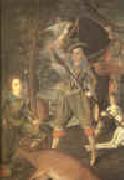
1576-1626
British
Robert Peake Gallery |
|
 |
Robert Nanteuil -- Click Here
|
|
1623-78
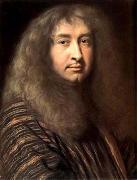
French engraver, draughtsman and pastellist. He was the son of Lancelot Nanteuil, a wool merchant, and submitted his thesis in philosophy, for which he engraved the headpiece, at the Jesuit College of Reims, in 1645. He went on to work in the studio of Nicolas Regnesson, whose sister he married in 1646, before moving to Paris in 1647. His early work mainly consisted of portrait drawings in black lead on parchment (e.g. Paris, Louvre), and he continued to draw throughout his career. He took 155 of his 221 portraits directly from life. His drawing style was influenced by Philippe de Champaigne, and he based his engraving technique on the work of Claude Mellan and Jean Morin. By 1652 he had developed his own technique |
|
|
|
 |
Robert Lundberg -- Click Here
|
|
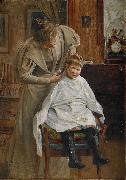
painted Mother cutting the hair in 1899 |
|
 |
Robert Loftin Newman -- Click Here
|
|
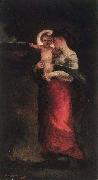
(November 10, 1827 - March 31, 1912). was an American painter and stained-glass designer. He specialized in oil on canvas as his medium. He is sometimes associated with Albert Pinkham Ryder as a painter of mood. His works include Good Samaritan, painted in 1886, Flight into Egypt, Harvest Time, Sailboat Manned by Two Men, and The Bather.
He was born in Richmond, Virginia and moved to Clarksville, Tennessee when he was 11 years of age. Later, as a young adult, he studied art in New York, England, and France. Newman served briefly as an artillery lieutenant for the Confederate Army during the American Civil War. He died of asphyxiation from a gas leak from a stove on March 31, 1912. |
|
 |
Robert Levrac Tournieres -- Click Here
|
|
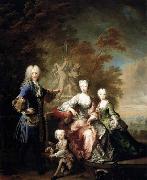
Thomas William Robertson (9 January 1829 ?C 3 February 1871), usually known professionally as T. W. Robertson, was an Anglo-Irish dramatist and innovative stage director best known for a series of realistic or naturalistic plays produced in London in the 1860s that broke new ground and inspired playwrights such as W.S. Gilbert and George Bernard Shaw. |
|
 |
Robert Lefevre -- Click Here
|
|
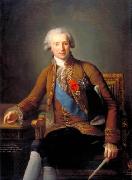
(24 September 1755, Bayeux - 3 October 1830, Paris) was a French painter of portraits, history paintings and religious paintings. He was heavily influenced by Jacques-Louis David and his style s reminiscent of the antique.
Robert Lefevre made his first drawings on the papers of a procureur to whom his father had apprenticed him. With his parents' consent, he abandoned this apprenticeship and walked from Caen to Paris to become a student of Jean-Baptiste Regnault (in whose studio he met and became friends with Charles Paul Landon). At the 1791 Paris Salon he exhibited his Dame en velours noir, the point of departure for his reputation. Lefevre made 1805 the portait empress Josephine. 1807 manufactured the counterpart of emperor Napoleon Louis-Andre-Gabriel Bouchet. Napoleon gave both paintings to the city Aachen 1807, where they are today in the city hall and decorate the entrance hall. His other portraits of Napoleon, Josephine, Madame Laetitia, Guerin, Carle Vernet (a portrait which is now at the Louvre) and pope Pius VII made him a fashionable portrait artist and one of the main portraitists of the imperial personalities, a reputation sealed by his portrait of Napoleon's new wife Marie Louise. |
|
 |
Robert Lefere -- Click Here
|
|
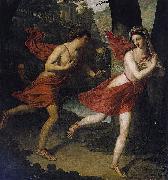
Robert Jacques François Faust Lefevre (24 September 1755, Bayeux - 3 October 1830, Paris) was a French painter of portraits, history paintings and religious paintings. He was heavily influenced by Jacques-Louis David and his style s reminiscent of the antique.
Robert Lefevre made his first drawings on the papers of a procureur to whom his father had apprenticed him. With his parents' consent, he abandoned this apprenticeship and walked from Caen to Paris to become a student of Jean-Baptiste Regnault (in whose studio he met and became friends with Charles Paul Landon). At the 1791 Paris Salon he exhibited his Dame en velours noir, the point of departure for his reputation. Lefevre made 1805 the portrait empress Josephine. 1807 manufactured the counterpart of emperor Napoleon Louis-Andre-Gabriel Bouchet. Napoleon gave both paintings to the city Aachen 1807, where they are today in the city hall and decorate the entrance hall. His other portraits of Napoleon, Josephine, Madame Laetitia, Guerin, Carle Vernet (a portrait which is now at the Louvre) and pope Pius VII made him a fashionable portrait artist and one of the main portraitists of the imperial personalities, a reputation sealed by his portrait of Napoleon's new wife Marie Louise.
On the Bourbon Restoration Robert Lefevre painted a portrait of Louis XVIII for the Chambre des Pairs and received the cross of the Legion d'honneur and the title of First Painter to the King, losing the latter on the July Revolution. He painted a large number of portraits and history paintings. The main example of his portraits are those of Malherbe (Bibliotheque publique de Caen), Charles X, the duchesse deAngouleme, the duchesse de Berry, Charles-Pierre-François Augereau duc de Castiglione (Musee de Versailles), and of Dominique Vivant-Denon. Two of his mythological paintings - Love sharpening his arrows and Love disarmed by Venus (t. 1,84 sur 1,30 ), were engraved by Desnoyers - the latter is reproduced in le Nu Ancien et Moderne. His most notable history paintings are his Phocion getting ready to drink hemlock, Roger delivering Angelique, Heloïse and Abelard and a Crucifixion for the Mont Valerien. His last painting was The Apotheosis of Saint Louis for the Cathedral of La Rochelle.
|
|
 |
Robert Koehler -- Click Here
|
|
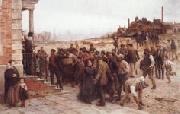
American Painter, 1850-1917
was a German born painter and art teacher who spent most of his career in the United States of America. Koehler was born in Hamburg; his family spelled their name Köhler until they moved to Milwaukee, Wisconsin in Robert's childhood. There he attended the historic German-English Academy. Koehler studied art from Henry Vianden and apprentice himself to a lithography firm. After some time working as a lithographer in New York City, Koehler went to Munich to study fine art at the Royal Academy in 1873. Koehler's work while in Munich won him silver and bronze awards from the Academy, and Bavaria's Cross of the Order of St. Michael. Koehler then set himself up as head of a private art school; pupils included Alfons Mucha. In 1892 Robert Koehler returned to New York City to work as a portrait artist. The following year he moved to Minneapolis, Minnesota, accepting an offer to be the director of the Minneapolis School of Fine Arts (now the Minneapolis College of Art and Design) Koehler was also involved with the establishment of Minneapolis' Museum of Fine Art, now the Minneapolis Institute of Arts. |
|
|
|
robert john thornton -- Click Here
|
|
Robert John Thornton (1768-1837) was an English physician and botanical writer, noted for "A New Illustration of the Sexual System of Carolus Von Linnæus" (1797-1807) and "The British Flora" of 1812. He was the son of Bonnell Thornton and studied at Trinity College, Cambridge. Inspired by Thomas Martyn's lectures on botany and the work of Linnaeus he switched from the church to medicine. He worked at Guy's Hospital in London, where he later lectured in medical botany. After spending some time abroad, he settled and practised in London. Robert inherited the family fortune after the death of both his brother and mother.
The most ambitious part of the "New Illustration of the Sexual System of Linnæus" was Part III, the "Temple of Flora" (1799-1807). The first plates were engraved by Thomas Medland (1755-1833) in May 1798 from paintings by Philip Reinagle. Between 1798 and 1807 they produced a total of thirty-three coloured plates, engraved in aquatint, stipple and line. When he planned the project, Thornton had decided to publish seventy folio-size plates. Lack of interest from the general public spelled disaster for the scheme, and the holding of a lottery could not save it from financial ruin, neither did a page in the work dedicated to the spouse of George III, Queen Charlotte, patroness of botany and the fine arts??Thornton died in destitution. |
|
|
|
 |
Robert Hills -- Click Here
|
|
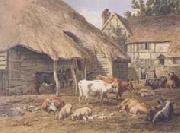
British Painter, 1769-1844
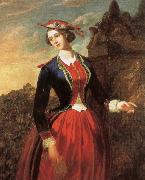
English painter and etcher. After taking drawing-lessons from John Alexander Gresse (1740-94), he enrolled at the Royal Academy Schools, London, in 1788. Village and rural scenes, and in particular studies of animals, occupied him throughout his working life; his favourite subjects were cattle, sheep, donkeys, pigs and above all deer, which he stalked for the purpose of sketching. As well as making plein-air drawings, Hills carried out careful anatomical studies of animal bones and joints. Between 1798 and 1815 he issued an extensive series of Etchings of Quadrupeds; the British Museum holds the artist's collection of his own etchings |
|
 |
robert herrick -- Click Here
|
|
The English poet and Anglican parson Robert Herrick (1591-1674) invented a fanciful world compounded of pagan Rome and Christian England, of reality and fantasy, which he ruled as his poetic domain. |
|
 |
Robert Henri -- Click Here
|
|
1865-1929
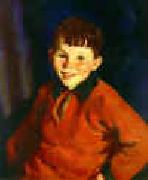
Robert Henri was born Robert Henry Cozad in Miami, Florida to Theresa Gatewood Cozad of Malden, Virginia and John Jackson Cozad, a gambler and real estate developer. Henri had a brother, Johnny, and was a distant cousin of the noted American painter Mary Cassatt. In 1871, Henri's father founded the town of Cozaddale, Ohio. In 1873, the family moved west to Nebraska, where they founded the town of Cozad.
In October 1882, Henri's father became embroiled in a dispute with a rancher, Alfred Pearson, over the right to pasture cattle on land claimed by the family. When the dispute turned physical, Cozad shot Pearson fatally with a pistol. Cozad was eventually cleared of wrongdoing, but the mood of the town turned against him. He fled to Denver, Colorado, and the rest of the family followed shortly. In order to disassociate themselves from the scandal, family members changed their names. The father became known as Richard Henry Lee, and his sons posed as adopted children under the names Frank Southern and Robert Earl Henri (pronounced "hen rye").
In 1883, the family moved to New York City, then to Atlantic City, New Jersey, where the young artist completed his first paintings. |
|
 |
Robert Havell Jr Prints -- Click Here
|
|
1793-1878
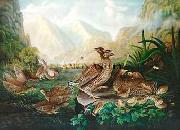
Engraver and painter, cousin of William Havell. He learnt the art of aquatint engraving from his father, Robert Havell I. He worked first in the family engraving business and then c. 1825-7 with Colnaghi in London. In 1827 he undertook the execution in aquatint of the plates for John James Audubon Birds of America, published in parts in London between 1827 and 1838. Havell engraved 425 of the plates and reworked the ten that had been engraved by William Home Lizars in Edinburgh. Havell father printed and coloured some of the double elephant folio sheets in 1827-8 after which Havell took on those tasks himself, establishing himself as a master of aquatint. Among his other important works in the medium are the plates for Mrs E. Bury Selection of Hexandrian Plants (London, 1831-4). In 1839, at Audubon invitation, Havell moved with his family to New York and embarked on a new career as a landscape painter in the style of the Hudson River school, while also working as an engraver. He settled in the Hudson River villages of Ossining (1841) and Tarrytown (1857) but painted throughout north-eastern America. View of Deerfield, Massachusetts (1847; Hist. Deerfield, MA) is characteristic of his quietly romantic idealization of his subjects. Niagara Falls from the Chinese Pagoda (1845; New York, Pub. Lib.), engraved by Havell after one of his paintings, is among the best known of his American aquatints. Though his reputation rests largely on his work for Audubon, his original subjects gave him greater opportunities to display the full range of his aquatint technique.
Part of the Havell family |
|
 |
Robert Gabriel Gence -- Click Here
|
|
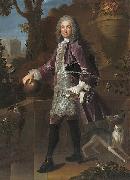
Paris vers 1670- Bayonne 1728 |
|
 |
Robert Frederick Blum -- Click Here
|
|
Major figure painter and illustrator
American , 1857-1903
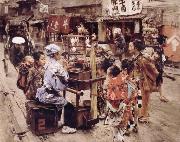
was an American artist born in Cincinnati, Ohio, on the 9th of July 1857. He was employed for a time in a lithographic shop, and studied at the McMicken Art School of Design in Cincinnati, and at the Pennsylvania Academy of Fine Arts in Philadelphia, but he was practically self-taught, and early showed great and original talent. He settled in New York in 1879, and his first published sketches of Japanese jugglers appeared in St. Nicholas. His most important work is a large frieze in the Mendelssohn Music Hall, New York, Music and the Dance (1895). His pen-and-ink work for the Century Magazine attracted wide attention, as did his illustrations for Sir Edwin Arnold's Japonica. "Man before grilled entrance"In the country and art of Japan he had been interested for many years. A Daughter of Japan, drawn by Blum and W. J. Baer, was the cover of Scribner's Magazine for May 1893, and was one of the earliest pieces of color printing for an American magazine. In Scribner's for 1893 appeared also his Artist's Letters from Japan. He was an admirer of Fortuny, whose methods somewhat influenced his work. Blum's Venetian pictures, such as A Bright Day at Venice (1882), had lively charm and beauty. He died on the 8th of June 1903 in New York City. |
|
 |
Robert Fenson -- Click Here
|
|
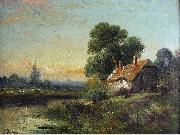
painted View with a Cottage by a Stream
in Probably Late 19th Century
|
|
 |
Robert Feke -- Click Here
|
|
1710-1752
Robert Feke Gallery
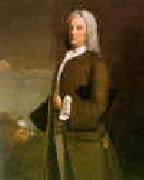
Robert Feke (1707 ?C 1752) was an American portrait painter born on Long Island, New York. Little is known for certain about his life before 1741, which is the year he painted his first portrait, Family of Isaac Royall. Sixteen portraits in total are known to be by Feke, and an additional 50 are disputed to be by him. His paintings are known for their sobriety and uniformity, but also for their rich colours and accuracy. |
|
 |
Robert Dowling -- Click Here
|
|
Australian Painter, 1827-1886
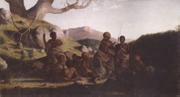
was an Australian colonial artist. Dowling was born in England the youngest son of Rev. Henry Dowling and his wife Elizabeth, nee Darke. He was brought to Launceston, Tasmania with his parents in 1839 in the Janet. He received lessons from Thomas Bock and Frederick Strange, and in 1850 advertised as a portrait painter. In 1856 Dowling left for London partly with the help of friends in Launceston. He exhibited 16 pictures at the Royal Academy between 1859 and 1882 and others at the British Institute. Returning to Launceston he afterwards came to Melbourne and painted portraits of Sir Henry Loch, Dr James Moorhouse, Francis Ormond, and others. He went to London again in 1886 but died shortly after his arrival. Dowling was a conscientious painter of figure subjects, often scriptural or eastern. |
|
 |
Robert Dodd -- Click Here
|
|
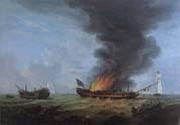
English Painter, 1748-1816, English painter and engraver. He exhibited at the Society of Arts from 1780 and at the Royal Academy, London, from 1782 to 1809. He had gained some reputation as a landscape artist by 1771 but soon concentrated on marine scenes. He became a ship portraitist and above all a prolific recorder of naval actions in the American and French Revolutionary wars such as the Sinking of the 'Vengeur de Peuple' at the Battle of the Glorious First of June, 1794 (1795; London, N. Mar. Mus.). He was also praised for his handling of storm scenes, notably a series depicting the loss of the Ramillies in the West Indies hurricane of September 1782 (1783-5; London, N. Mar. Mus.). His work was engraved by others but he also executed over 100 plates himself, mostly in aquatint, including views of the naval dockyards at Chatham, Woolwich and Deptford and also of the Thames at Blackwall and Greenwich, the last-named based on his oil painting of 1792 (London, N. Mar. Mus.). |
|
|
|
 |
Robert Dampier -- Click Here
|
|
(1799 - 1874) was a British artist and clergyman.
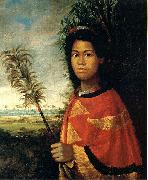
Dampier was born in 1799 at the village of Codford St Peter in Wiltshire, England He was baptised on the 20th of Dec. 1799 (LDS IGI record batch # C014402). He was one of 13 children of Codford St Peter's rector Reverend John Dampier (1763-1839) and his wife Jane. In 1819 he went to Rio de Janeiro in Brazil as a clerk. In 1825, he was picked up in Rio to be the expedition artist on the English ship HMS Blonde under the command of Captain George Anson Byron. The ship was returning the bodies of King Kamehameha II and Queen Kamemalu to the Hawaiian islands (known by the British as "Sandwich Islands"), after both died from measles during a visit to England. Robert Dampier spent 11 weeks in Hawaii painting portraits in oil paint and making pencil drawings of landscapes.
After returning to England, he studied law at Cambridge University and then was ordained in the Church of England. He married Sophia Francis Roberts in 1828. In 1837 he became rector of Langton Matravers church. Circa 1843 they had a daughter Juliana Sophia, His wife Sophia died in 1864, and he married again in 1872. He had a daughter Frederika from the second marriage. Although employed a rector, he continued to sketch until his death in 1874.
Major works by Robert Dampier are held by the Honolulu Academy of Arts and Washington Place, also in Honolulu, Hawaii.
|
|
 |
Robert Crannell Minor -- Click Here
|
|
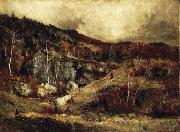
(1839-1904), American artist, was born in New York City on 30 April 1839, and received his art training in Paris under Diaz, and in Antwerp under Joseph Van Luppen. His paintings are characteristic of the Barbizon school, and he was particularly happy in his sunset and twilight effects; but it was only within a few years of his death that he began to have a vogue among collectors. In 1897 he was elected a member of the National Academy of Design, New York. After 1900 he lived at Waterford, Connecticut, where he died on 4 August 1904. |
|
 |
Robert Cleveley -- Click Here
|
|
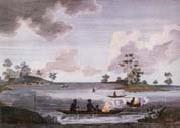
British, 1747-1809,was an English maritime painter. His father and twin brother (John Cleveley the Elder, c.1712?C1777, and John Cleveley the Younger, 1747?C1786) were also artists, with John the Younger (and possibly Robert too, to judge from his style) gaining some training in watercolours from Paul Sandby, previously a teacher at the Royal Military Academy, Woolwich. John the Elder had tried and failed to make a living in working in a dockyard, and so did Robert, as a caulker. However, mocked by other dockyard workers for wearing gloves whilst working, John did not enjoy his time there, giving it up and in 1770 volunteering for the navy as a clerk. His first service as a clerk was briefly under Captain William Locker (who acted as patron to artists probably known to John the Elder), then soon afterwards under Captain George Vandeput on his voyage in the Asia to the West Indies and North America, during which time Vandeput became a lifelong friend. The Asia returned in 1777, and from then to the end of his life Robert followed a double career as purser on board various ships stationed in the Home Fleet (though most probably exercising his functions through a deputy for some or all of the time) and as a marine painter. This meant he could exhibit his works as "Robert Cleveley of the Royal Navy". First exhibiting at the Royal Academy in 1780, his specialism was naval battles (though he also produced pictures of royal naval occasions, such as his "View of the Fleet at Spithead Saluting George III at his Review in 1793", now at the National Maritime Museum) and many of his works were reproduced as engravings. Like his brother John, he also exploited their brother James' presence as a carpenter on Captain Cook's third voyage to gain access to art produced on the voyage and to produce art to cash in on the popular demand for South Sea images (eg a 1789 print of A view of Botany Bay). He did, however, still make occasional voyages with Vandeput, such as when he served as eassistant to the clerk of the kitchene in the royal entourage when the royal yacht Princess Augusta (under Vandeput) took Prince William Henry, later Duke of Clarence, to Hanover in July and August 1783. |
|
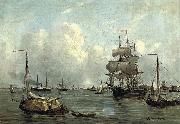 |
Robert Charles Laurens Gustave Mols -- Click Here
|
|
Belgium (1848- 1903 ) - Painter
painted Bustling activity in a Dutch harbour in |
|
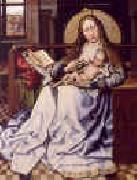 |
Robert Campin -- Click Here
|
|
1406-1444
Robert Campin Location
South Netherlandish painter. He is first mentioned in 1405-6 as a painter in Tournai. As he purchased citizenship there in 1410, he may have been born elsewhere. There is evidence of some connection with Valenciennes, where the name Campin is said to have been common, but nothing certain is known of his artistic training and background. |
|
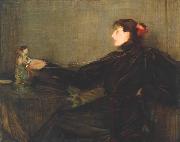 |
Robert Brough -- Click Here
|
|
(1872 - 21 January 1905) was a Scottish painter born in Invergordon, Ross and Cromarty.
He was educated in Aberdeen, and, whilst apprenticed for over six years as lithographer to Messrs Gibb & Co., attended the night classes at Gray's School of Art. He then entered the Royal Scottish Academy, and in the first year took the Stuart prize for figure painting, the Chalmers painting bursary, and the Maclame-Walters medal for composition.
After two years in Paris under J. P. Laurens and Benjamin-Constant at Julian's atelier, he settled in Aberdeen in 1894 as a portrait painter and political cartoonist. A portrait of Mr. W. D. Ross first drew attention to his talent in 1896, and in the following year he scored a marked success at the Royal Academy with his Fantaisie en Folie, which he bequeathed to the National Gallery of British Art (now the Tate gallery). Two of his paintings, Twixt Sun and Moon and Childhood of St. Anne of Brittany, were at the Venice municipal gallery. Brough's art was influenced by Henry Raeburn and by modern French training, but it strikes a very personal note.
Brough died from injuries received in a railway disaster in 1905.
|
|
|
|
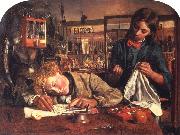 |
Robert Braithwaite Martineau -- Click Here
|
|
English genre and portrait Painter, 1826-1869
was an English painter. He first trained as a lawyer and later entered the Royal Academy where he was awarded a silver medal. He studied under Pre-Raphaelite artist William Holman Hunt and once shared a studio with him. He died at the age of 43. He married Maria Wheeler and had two children with her. His most famous painting, "The Last Day in the Old Home" portrays a man who has brought ruin upon his family and can be seen at the Tate Gallery in London. Other paintings were bequeathed to the Ashmolean Museum in Oxford and Liverpool Art Gallery by his daughter Helen. Other less well known paintings include "Kit's First Writing Lesson" and "Picciola". |
|
|
|
 |
Robert Alexander Hillingford -- Click Here
|
|
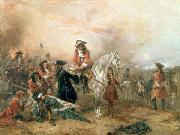
(1825-1904) was an English painter. He specialized in historical pictures, often battle scenes.
Contents
He was born in London on January 28, 1828, and studied in Desseldorf in 1841 for five years and before traveling to Munich, Rome, Florence and Naples, where he married and worked for several years, producing paintings of Italian life. One painting from this period entitled The Last Evening of the Carnival was exhibited at St. Petersburg in 1859. He returned to London in 1864, and first exhibited at the Royal Academy in 1866; it was at this time that he began to work on historical subjects, especially of the Napoleonic Wars. He was a regular exhibitor at the Royal Academy, British Institution and at other galleries. While he was attracted to costume pieces such as An incident in the early life of Louis XIV and During the wanderings of Charles Edward Stuart', he also included some contemporary military scenes including his 1901 RA painting South Africa, 1901 - The Dawn of Peace.
Wellington at Waterloo
Lord Hill invites the last remnants of the French Imperial Guard to surrenderThe original paintings often come up at auction, and, with a large amount of the collection dispersed in 1998, the original paintings are widely scattered.
|
|
 |
RING, Pieter de -- Click Here
|
|
Dutch Baroque Era Painter, ca.1615-1660 |
|
 |
RING, Ludger tom, the Younger -- Click Here
|
|
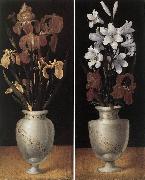
German Painter, 1522-1584 |
|
 |
Rinaldo Mantovano -- Click Here
|
|
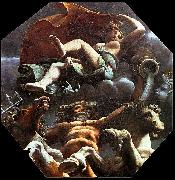
Rinaldo Mantovano ( fl Mantua, c . 1527-39). Italian painter. According to Vasari, he was the best pupil of Giulio Romano. |
|
|
|
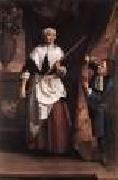 |
RILEY, John -- Click Here
|
|
English Baroque Era Painter, 1646-1691
English painter. He was the son of John Riley of St Botolphs, Bishopsgate, and a pupil of Isaac Fuller and Gerard Soest. He is said to have worked independently for some years, but he made no impact before Lely's death in 1680. Riley maintained a prolific and successful practice as a portrait painter over the next decade against keen foreign competition. |
|
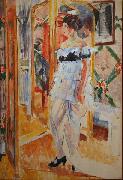 |
Rik Wouters -- Click Here
|
|
(21 August 1882, Mechelene11 July 1916, Amsterdam) was a Belgian fauvist painter and sculptor. Wouters was educated at the Academie Royale des Beaux-Arts in Brussels.
|
|
 |
RIJCKHALS, Frans -- Click Here
|
|
Dutch painter (b. 1600, Middelburg, d. 1647, Middelburg) |
|
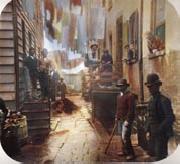 |
Riis Jacob August -- Click Here
|
|
Danish-American journalist and social reformer.
b.1849 d.1914
American photographer of Danish birth. The son of a school-teacher and editor, he was well-educated when he came to the USA in 1870. He was a self-taught photographer and worked at a variety of jobs before becoming a journalist, and he understood the power of the written and illustrated word. Riis's work in journalism began in 1873 when he was employed by the New York News Association. By 1874 he was editor and then owner of the South Brooklyn News. |
|
 |
Rihard Jakopic -- Click Here
|
|
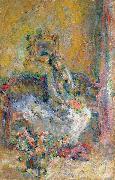
Rihard Jakopic
Rihard Jakopič (12 April 1869 - 21 April 1943) was a Slovenian painter. He was the leading Slovenian Impressionist painter and theoretician. Together with Matej Sternen, Matija Jama and Ivan Grohar, he is considered the pioneer of Slovenian impressionist painting. |
|
 |
RIGAUD, Hyacinthe -- Click Here
|
|
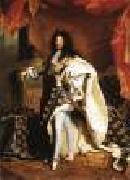
French Baroque Era Painter, 1659-1743
.was a French baroque painter of Catalan origin whose career was based in Paris. He is renowned for his portrait paintings of Louis XIV, the royalty and nobility of Europe, and members of their courts. Rigaud was born Jacint Rigau i Ros -- though in many encyclopaedias is "re-christened" with the name of H??acint Francesc Honrat Mathias Pere Martyr Andreu Joan Rigau -- in Perpignan, which became part of France by the Treaty of the Pyrenees (7 November 1659) shortly after his birth. In 1682, he was awarded the Prix de Rome. He was the most important portrait painter during the reign of King Louis XIV. His instinct for impressive poses and grand presentations precisely suited the tastes of the royal personages, ambassadors, clerics, courtiers, and financiers who sat for him. Because Rigaud's paintings captured very exact likenesses along with the subject's costumes and background details, his paintings are considered precise records of contemporary fashions. Rigaud was a master of the Baroque style of art. Rigaud's best-known work is his 1701 painting of Louis XIV which today hangs in the Louvre in Paris, as well as the second copy also requested by Louis XIV that now hangs at the Palace of Versailles. In 1709, he was made a noble by his hometown of Perpignan. In 1727 he was made a knight of the Order of Saint Michael. Rigaud died in Paris in 1743 at the age of 84. |
|
|
|
|
| | |
|
|
|
|