|
|
|
|
|
Oil On
Canvas, Real Flavor of Old Masters
|
|

|
ARTWORKS
INDEX
A B C D E F G H I J K L M N O P Q R S T U V W X Y Z |
ARTISTS
INDEX
A B C D E F G H I J K L M N O P Q R S T U V W X Y Z |
|
|
| | |
|
|
 |
Henri Gascar -- Click Here
|
|
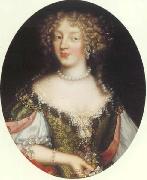
Henri Gascar, Portrait of Barbara Palmer, 1st Duchess of Cleveland
James II of England, then Duke of York (1660s)Henri Gascar (1635 -1 Jan 1701) was a French-born portrait painter who achieved artistic success in England during the reign of Charles II. He painted many leading ladies at court, including several of the King's mistresses.
Gascar was born in Paris, the son of Pierre Gascar, a minor painter and sculptor. Gascar came to England about 1674, probably at the behest of Louise de Keroualle, Duchess of Portsmouth, Charles II's favourite mistress. Gascar (or Gascard, as he seems to have spelt his name at first) was already known as a skillful portrait-painter; among the portraits already painted by him was that of Nicolas de Lafond, author of the "Gazette of Holland", painted in 1667, and engraved by Peter Lombart.
The patronage of the Duchess of Portsmouth insured Gascar a rapid success in England. His flamboyant style, contrasting with the stolid English approach, seemed to suit the frivolity of the time and he painted many of the ladies of Charles II's court. His lack of attention to detail in the likeness he made up for by the sumptuous draperies and tawdry adornments around the subject. For a short time he became fashionable, and is said to have amassed a fortune of over £10,000.
Among the portraits painted by him during his time in England were Charles II (engraved by Peter Vanderbank); Louise, Duchess of Portsmouth (twice - once engraved by Étienne Baudet); Barbara, Duchess of Cleveland (nee Villiers), and her daughter, Barbara Fitzroy; Charles Lennox, 1st Duke of Richmond; Frances Stewart, Duchess of Richmond; George FitzRoy, 1st Duke of Northumberland; Nell Gwyn; Sophia Bulkeley (engraved by Robert Dunkarton); Edmund Verney; and Philip Herbert, 7th Earl of Pembroke. It is stated that the last-named portrait was done surreptitiously for Louise, Duchess of Portsmouth. A portrait by Gascar of James II as Duke of York was in that king's collection. |
|
 |
Henri Felix Emmanuel Philippoteaux -- Click Here
|
|
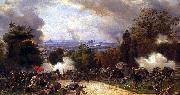
(1815-1884) was a French artist. He was born in Paris, France, studied art at the studio of Leon Cogniet,and first exhibited his work at the Paris Salon of 1833.
One of his most well-known works was a depiction of the Siege of Paris during the Franco-Prussian War, painted in the form of a cyclorama, a type of large panoramic painting on the inside of a cylindrical platform designed to provide a viewer standing in the middle of the cylinder with a view of the painting. Viewers surrounded by the panoramic image are meant to feel as if they are standing in the midst of a historic event or famous place.
Philippoteaux also produced a large number of works chronicling the rise and successes of Napoleon Bonaparte, including a portrait of Napoleon in his regimental uniform and a group of paintings of French victories in the Napoleonic Wars. Philippoteaux was awarded the Legion d'honneur in 1846.
Philippoteaux's son Paul Philippoteaux was also an artist; both were famous for their production of cycloramas. Father and son collaborated on The Defence of the Fort d'Issy in 1871. |
|
 |
Henri Fantin-Latour -- Click Here
|
|
French 1836-1904
Henri Fantin Latour Locations
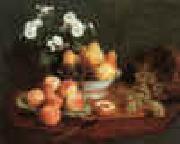
Bure) French painter and printmaker. He was trained by his father, a portrait painter, and at the Ecole des Beaux-Arts. Though he associated with progressive artists (Gustave Courbet, Eugene Delacroix, Edouard Manet), he was a traditionalist best known for his portraits and still lifes with flowers. His portrait groups, reminiscent of 17th-century Dutch guild portraits, depict literary and artistic persons of the time; his flower paintings were especially popular in England, thanks to James McNeill Whistler and John Everett Millais, who found patrons to support him. His later years were devoted to lithography. |
|
 |
Henri Evenepoel -- Click Here
|
|
Belgian, 1872-1899
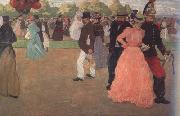
was a Belgian artist whose most important works are associated with Fauvism. He first studied art in Brussels at the Acad??mie des Beaux-Arts between 1889 and 1890, and entered Paris's Ecole des Beaux-Arts in 1892. Evenepoel entered the atelier of Gustave Moreau in 1893, which put him in contact with Henri Matisse and Georges Rouault. The artist debuted a portrait of his cousin (Louise in Mourning) at the 1894 Salon des Artistes Français. He showed four portraits at the Salon du Champ-de-Mars in 1895 and continued to exhibit there until his death. His first solo exhibition came at the Brussels Cercle Artistique (December 1897 C January 1898). Family and friends were the artist's preferred subjects; his full-length portraits, often against a neutral background, show the influence of Edouard Manet and James Abbott McNeill Whistler. His Parisian scenes were influenced by Henri de Toulouse-Lautrec and Jean-Louis Forain. |
|
 |
Henri Edmond Cross -- Click Here
|
|
1856-1910
French
Henri Edmond Cross Locations
French painter and printmaker. The only surviving child of Alcide Delacroix, a French adventurer and failed businessman, and the British-born Fanny Woollett, he was encouraged as a youth to develop his artistic talent by his father cousin, Dr Auguste Soins. He enrolled in 1878 at the Ecoles Academiques de Dessin et d Architecture in Lille, where he remained for three years under the guidance of Alphonse Colas (1818-87). He then moved to Paris and studied with Emile Dupont-Zipcy (1822-65), also from Douai, whom he listed as his teacher when exhibiting at Salons of the early 1880s. His few extant works from this period are Realist portraits and still-lifes, painted with a heavy touch and sombre palette (example in Douai, Mus. Mun.). |
|
 |
Henri Decaisne -- Click Here
|
|
a Belgian historical and portrait painter, was born at Brussels in 1799. As early as 1814 he began to study painting under François, and in 1818 upon the advice of David he went to Paris and entered the studio of Girodet, whence he removed to that of Gros. Several pictures by him are at Versailles; among them are the 'Entry of Charles VII into Rouen' (1838), and the 'Institution of the Order of St. John of Jerusalem' (1842). In 1839 he completed his colossal work, ' Les Belges Illustres.' He died in Paris in 1852. Among his best works are:
|
|
 |
Henri de toulouse-lautrec -- Click Here
|
|
1864-1901
French painter and printmaker. He is best known for his portrayals of late 19th-century Parisian life, particularly working-class, cabaret, circus, nightclub and brothel scenes. He was admired then as he is today for his unsentimental evocations of personalities and social mores. While he belonged to no theoretical school, he is sometimes classified as Post-Impressionist. His greatest contemporary impact was his series of 30 posters (1891-1901), |
|
 |
Henri De Braekeleer -- Click Here
|
|
Belgian Painter, 1840-1888
Belgian painter, was born at Antwerp. He was trained by his father, a genre painter, and his uncle, Baron Henri Leys, and devoted himself to scenes of everyday Antwerp life. The first pictures he exhibited, The Laundry (Van Cutsem collection, Brussels), and The Coppersmith's Workshop (Vleeshouwer collection, Antwerp), were shown. at the Antwerp exhibition in 1861. He received the gold medal at Brussels in 1872 for The Geographer and The Lesson (both in the Brussels gallery); the gold medal at Vienna in 1873 for The Painter's Studio and Grandmother's Birthday ; and the medal of honor at the Exposition Universelle at Amsterdam for The Pilot House. Among his more notable works are A Shoemaker (1862), A Tailor's Workroom (1863), A Gardener (1864, Antwerp gallery), Interior of a Church (1866), Interior, Flanders (1867), Woman Spinning (1869), Man Reading (1871), Theruedu Serment, Antwerp (1875), A Copperplate Printer, The Sailor's Return, The Man at the Window (Couteaux collection, Brussels), The Horn-blower (Couteaux collection), Man Retouching a Picture (Couteaux collection), The Potters (Marlier collection, Brussels), Staircase in the Hydraulic House at Antwerp (Marlier collection), and The Brewer's House at Antwerp (Marlier collection). The last, better known as A Man Sitting, is generally regarded as his masterpiece. As a lithographer and etcher, his work resembles that of Henri Leys. |
|
|
|
Henri Bellech-ose -- Click Here
|
|
Brabant active in Dijon 1415-Dijon 1440/44 |
|
 |
Henri Toulouse-Lautrec -- Click Here
|
|
French Post-Impressionist Painter and Printmaker, 1864-1901
Henri de Toulouse-Lautrec, a direct descendant of the counts of Toulouse, was born on Nov. 24, 1864, at Albi. His eccentric father lived in provincial luxury, hunting with falcons and collecting exotic weapons. Henri began to draw at an early age. He suffered a fall in 1878 and broke one femur; in 1879 he fell again and broke the other one. His legs did not heal properly; his torso developed normally, but his legs were permanently deformed.
Encouraged by his first teachers, the animal painters Rene Princeteau and John Lewis Brown, Toulouse-Lautrec decided in 1882 to devote himself to painting, and that year he left for Paris. Enrolling at the Ecole des Beaux-Arts, he entered the studio of Fernand Cormon. In 1884 Toulouse-Lautrec settled in Montmartre, where he stayed from then on, except for short visits to Spain, where he admired the works of El Greco and Diego Velazquez; Belgium; and England, where he visited Oscar Wilde and James McNeill Whistler. At one point Toulouse-Lautrec lived near Edgar Degas, whom he valued above all other contemporary artists and by whom he was influenced. From 1887 his studio was on the Rue Caulaincourt next to the Goupil printshop, where he could see examples of the Japanese prints of which he was so fond.
Toulouse-Lautrec habitually stayed out most of the night, frequenting the many entertainment spots about Montmartre, especially the Moulin Rouge cabaret, and he drank a great deal. His loose living caught up with him: he suffered a breakdown in 1899, and his mother had him committed to an asylum at Neuilly. He recovered and set to work again. He died on Sept. 9, 1901, at the family estate at Malrome. |
|
 |
Hennessy, William John -- Click Here
|
|
English, 19th Century.was an Irish artist. William John Hennessy was born in Thomastown, County Kilkenny in 1839. His father, John Hennessy, was forced to leave Ireland in 1848 as a result of his involvement in the Young Ireland movement. He landed in Canada and settled in New York. William, his mother Catherine, and brother joined their father there in 1849. He gained admittance to the National Academy of Design in 1854 and exhibitioned his first works there. Hennessy developed a skill in wood engraving and was hired to illustrate the works of renowned poets, including that of Tennyson, Longfellow and Whittier. As an American he became the co-founder of the Artists?? Fund Society, and an honorary member of the American Society of Painters in Watercolours. In 1870 he moved to London where he became a member of the Royal Institute of Oil Painters in 1902. |
|
 |
Hendrik Willem Mesdag -- Click Here
|
|
Hendrik Willem Mesdag was born on February 23, 1831 in Groningen. His father, a merchant and banker, was an amateur painter who saw to it that his two sons were also educated in the art of painting. He was a Dutch marine painter. He was born in Groningen, the son of the banker Klaas Mesdag and his wife Johanna Wilhelmina van Giffen. Mesdag was encouraged by his father, an amateur painter, to study art. He married Sina van Houten in 1856, and when they inherited a fortune from her father, Mesdag retired from banking to pursue a career as a painter. He studied in Brussels with Willem Roelofs and in 1868 moved to The Hague to paint the sea. In 1870 he exhibited at the Paris Salon and won the gold medal for The Breakers of the North Sea. Preparations for departureIn 1880 he received a commission from a Belgian company to paint a panorama giving a view over the village of Scheveningen on the North Sea coast near The Hague . |
|
|
|
 |
Hendrik Valkenburg -- Click Here
|
|
painted An old kitchen with a mother and two children at the cauldron in 1872 |
|
 |
Hendrik Heerschop -- Click Here
|
|
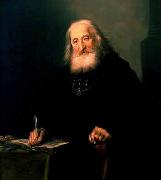
painted Alexander the Great and Diogenes in 1661 |
|
 |
Hendrik Gerritsz. Pot -- Click Here
|
|
(c. 1580 - 15 October 1657 (buried)) was a Dutch painter. He lived and painted in Haarlem, where he was an officer of the militia, or schutterij. Dutch artist Frans Hals painted Pot in militia sash in Hals' The Banquet of the Officers of the St George Militia Company (c. 1639). Pot is the man reading a book on the far right.
Pot was born in Amsterdam and spent his early years in Amsterdam and Haarlem. In 1632 he traveled to London, where he painted the Royal Family. He lived from 1633 to 1648 in Haarlem, after which he moved to Amsterdam, where he died in 1657.. He served as Dean of the Haarlem Guild of St. Luke in 1626, 1630 and 1635. He served as the Guild's headman or Hoofdman in 1634 and 1648. He died in Amsterdam. |
|
 |
Hendrik Cornelisz. Vroom -- Click Here
|
|
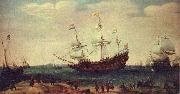
painted Ausfahrt der Ostindiensegler in c. 1630-1640
|
|
 |
hendrik averkamp -- Click Here
|
|
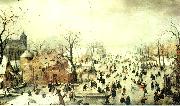
Hendrick Avercamp (bapt. January 27, 1585, Amsterdam - buried May 15, 1634, Kampen (Overijssel)) was a Dutch painter.
Avercamp studied in Amsterdam with the Danish-born portrait painter Pieter Isaacks (1569-1625), and perhaps also with David Vinckbooms. In 1608 he moved from Amsterdam to Kampen in the province of Overijssel. Avercamp was mute and was known as "de Stomme van Kampen" (the mute of Kampen).
As one of the first landscape painters of the 17th-century Dutch school, he specialized in painting the Netherlands in winter. Avercamp's paintings are colorful and lively, with carefully crafted images of the people in the landscape. Many of Avercamp's paintings feature people ice skating on frozen lakes.
Avercamp's work enjoyed great popularity and he sold his drawings, many of which were tinted with water-color, as finished pictures to be pasted into the albums of collectors. The Royal Collection has an outstanding collection of his works.
Avercamp died in Kampen and was interred there in the Sint Nicolaaskerk.
|
|
 |
Hendrick van Somer -- Click Here
|
|
Hendrick van Someren, or Somer (1615, Amsterdam - 1685, Amsterdam), was a Dutch Golden Age painter.
According to Houbraken he was the son of the "van Zomeren" who took in the young Adriaen Brouwer after he fled Frans Hals' workshop to try his luck in Amsterdam. Houbraken claimed Henrik van Someren was a good painter of historical allegories, landscapes, and flower still lifes.
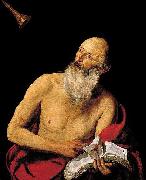
According to the RKD no works survive in the styles Houbraken mentioned, only "hermits" in the style of Ribera. He was the son of the painter Barend van Someren and the grandson of Aert Mijtens. He was the pupil of Jusepe de Ribera and at least one of his works had a forged signature of Ribera.He is possibly the same painter sometimes referred to as Enrico Fiammingo.
|
|
 |
Hendrick van Balen the Elder -- Click Here
|
|
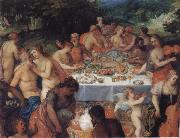
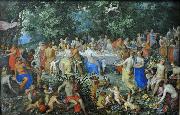
painted The Wedding of Thetis and Perseus with Apollo and the Concert of the Muses, or The Feast of the Gods in ca. 1618
|
|
 |
Hendrick van balen -- Click Here
|
|
Dutch Baroque Era Painter, ca.1575-1632
was a Flemish painter, who was born and died in Antwerp. Van Balen studied art while traveling in Italy. He was the teacher of Anthony Van Dyck and Frans Snyders and was also a contemporary of many of the other famous Flemish artists |
|
 |
Hendrick van Anthonissen -- Click Here
|
|
(29 May 1605, Amsterdam - 12 November 1656, Amsterdam) was a Dutch marine painter.
Van Anthonissen was the son of Aert Anthonisz (a.k.a. Aart van Antum) and painted in the style of his brother-in-law and teacher Jan Porcellis and of Jan van Goyen. He is the author of sea paintings in the Hermitage, St. Petersburg and the Prague Gallery, which through their signatures have been ascribed to a mythical Hendrik van Antem. In the 1630's he lived in The Hague, Leiden, and Leiderdorp, but from 1642 he was back in Amsterdam. He is known for beach scenes and seascapes in the manner of Jan Porcellis, sometimes in grisaille. He was the father of the marine painter Arnoldus van Anthonissen.
|
|
 |
Hendrick the Brugghen -- Click Here
|
|
1588-1629
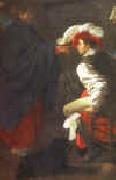
Dutch painter and draughtsman. He was, with Gerrit van Honthorst and Dirck van Baburen, one of the leading painters in the group of artists active in Utrecht in the 1620s who came to be known as the UTRECHT CARAVAGGISTI, since they adapted Caravaggio's subject-matter and style to suit the Dutch taste for religious and secular paintings. Ter Brugghen was an important innovator for later Dutch 17th-century genre painting; his recognition as an unorthodox, |
|
 |
Hendrick Terbrugghen -- Click Here
|
|
1588-1629
Dutch Hendrick Terbrugghen Galleries
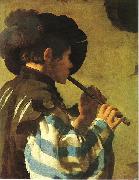
Dutch painter and draughtsman. He was, with Gerrit van Honthorst and Dirck van Baburen, one of the leading painters in the group of artists active in Utrecht in the 1620s who came to be known as the UTRECHT CARAVAGGISTI, since they adapted Caravaggio subject-matter and style to suit the Dutch taste for religious and secular paintings. Ter Brugghen was an important innovator for later Dutch 17th-century genre painting; his recognition as an unorthodox, but significant influence on the work of Johannes Vermeer and others is a relatively recent, 20th-century phenomenon. |
|
 |
Hendrick ter Brugghen -- Click Here
|
|
(1588 - Nov 1, 1629) was a Dutch painter, and a leading member of the Dutch followers of Caravaggio ?? the so-called Dutch Caravaggisti.
Little is known of the early life of ter Brugghen; he could have been born in The Hague, but his family seems to have moved to the strongly Catholic Utrecht in the early 1590s. Here he started painting at the age of thirteen, studying with Abraham Bloemaert. From Bloemaert, a Mannerist history painter, he learned the basics of the art. Around 1604, however, ter Brugghen travelled to Italy to expand his skills, a rather unusual move for Dutch painters at the time. He was in Rome in 1604, and could therefore have been in direct contact with Caravaggio. |
|
 |
Hendrick Staets -- Click Here
|
|
Dutch marine painter , Active in Leiden circa 1643-1659
|
|
 |
Hendrick Martensz Sorgh -- Click Here
|
|
Dutch Baroque Era Painter ,
ca.1611-1670
|
|
 |
Hendrick Leys -- Click Here
|
|
1815-1869
Belgian
Hendrick Leys Gallery |
|
 |
Hendrick Goltzius -- Click Here
|
|
1558-1617 Dutch
Hendrik Goltzius (1558 - January 1, 1617), Dutch printmaker, draftsman, and painter, was born at Millebrecht, in the duchy of Julich. He was the leading Dutch engraver of the early Baroque period, noted for his sophisticated technique.
After studying painting on glass for some years under his father, he was taught the use of the burin by Dirk Volkertszoon Coornhert, a Dutch engraver of mediocre attainment, whom he soon surpassed, but who retained his services for his own advantage. He was also employed by Philip Galle to engrave a set of prints of the history of Lucretia.
At the age of 21 he married a widow somewhat advanced in years, whose money enabled him to establish at Haarlem an independent business; but his unpleasant relations with her so affected his health that he found it advisable in 1590 to make a tour through Germany to Italy, where he acquired an intense admiration for the works of Michelangelo, which led him to emulate that master in the grotesqueness and extravagance of his designs. He returned to Haarlem considerably improved in health, and laboured there at his art till his death.
Goltzius' painting Lot and his daughters (Rijksmuseum Amsterdam) shows Lot being seduced by his two daughters. Sodom and Gomorrah are shown burning in the background, with Lot's wife who had turned into a pillar of salt, in front.Goltzius ought not to be judged chiefly by the works he valued most, his eccentric imitations of Michelangelo. His portraits, though mostly miniatures, are masterpieces of their kind, both on account of their exquisite finish, and as fine studies of individual character. Of his larger heads, the life-size portrait of himself is probably the most striking example. His masterpieces, so called from their being attempts to imitate the style of the old masters, have perhaps been overpraised.
Goltzius brought to an unprecedented level the use of the "swelling line", where the burin is manipulated to make lines thicker or thinner to create a tonal effect from a distance. He also was a pioneer of "dot and lozenge" technique, where dots are placed in the middle of lozenge shaped spaces created by cross-hatching to further refine tonal shading.
A self portraitHollstein credits 388 prints to him, with a further 574 by other printmakers after his designs.
In his command of the burin Goltzius is said to rival that of Durer's; but his technical skill is not equally aided by higher artistic qualities. Even, however, his eccentricities and extravagances are greatly counterbalanced by the beauty and freedom of his execution. He made engravings of Bartholomeus Spranger's paintings, thus increasing the fame of the latter - and his own. Goltzius began painting at the age of forty-two; some of his paintings can be found in the imperial collection at Vienna. He also executed a few chiaroscuro woodcuts. He was the stepfather of engraver Jacob Matham. |
|
 |
Hendrick Danckerts -- Click Here
|
|
(c.1625 - 1680) was a Dutch Golden Age landscape painter and engraver.
Danckerts was born in The Hague, where he learned his trade and remained until 1653.He visited England for the first time in 1650.In 1653 he went to Italy, where he stayed for five years. He then moved to England where he entered the service of Charles II and the Duke of York. He painted Italianate landscapes, especially views of harbors and royal residences. He also produced portraits and devotional pictures and made engravings after the Italian old masters in the Royal Collection. He left England in 1679due to the public hostility towards Roman Catholics after the Popish Plot controversy. He died soon after in Amsterdam. |
|
 |
Hendrick Bloemaert -- Click Here
|
|
(1601 -- 1672), was a Dutch Golden Age painter.
Hendrick was the oldest son of Abraham Bloemaert. His brothers Cornelis and Adriaen were also painters. In 1626 he was registered in Rome, but by 1631 he was back in Utrecht, where he registered in the Utrecht Guild of St. Luke and married Margaretha van der Eem, the daughter of a lawyer. |
|
 |
Hendrick Avercamp -- Click Here
|
|
1585-1634
Dutch
Hendrick Avercamp Galleries
Hendrick Avercamp (bapt. January 27, 1585, Amsterdam - buried May 15, 1634, Kampen (Overijssel)) was a Dutch painter.
Avercamp studied in Amsterdam with the Danish-born portrait painter Pieter Isaacks (1569-1625), and perhaps also with David Vinckbooms. In 1608 he moved from Amsterdam to Kampen in the province of Overijssel. Avercamp was deaf and was known as "de Stomme van Kampen" (the mute of Kampen).
As one of the first landscape painters of the 17th-century Dutch school, he specialized in painting the Netherlands in winter. Avercamp's paintings are colorful and lively, with carefully crafted images of the people in the landscape.
Avercamp's work enjoyed great popularity and he sold his drawings, many of which were tinted with water-color, as finished pictures to be pasted into the albums of collectors. Queen Elizabeth II has an outstanding collection of his works at Windsor Castle, England. |
|
|
|
 |
HEMESSEN, Jan Sanders van -- Click Here
|
|
Netherlandish Mannerist Painter, ca.1500-1566
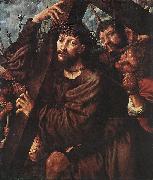
was a Flemish Northern Renaissance painter. He was born in Hemiksem, then called Hemessen or Heymissen. Following studies in Italy, in 1524 he settled in Antwerp. A mannerist, his images focused on human failings such as greed and vanity. Like his daughter, Catarina van Hemessen, he also painted portraits. Jan Sanders van Hemessen was a Flemish Northern Renaissance painter. Jan Sanders van Hemessen was from Netherlands. The type of movement he did was mannerism Jan Sanders was born in Hemessen but settled in Antwerp in 1524 after studying in Italy. Hemessen specialized in scenes of human character flaws such as vanity and greed. His pictures are also normally religious and his style helped found the Flemish traditions of genre painting. Hemessen was also a portrait painter, which influenced his daughter to become a Flemish Northern Renaissance painter as well. The Surgeon was painted by Jan Sanders Van Hemessen, in 1555. The oil painting is in a museum called Museo Del Prado, which is in Madrid, Spain. I think the scene painted by Jan Sanders van Hemessen shows a stone cutter at a fair. The surgeon, who is clearly happy that his operations have been successful, painstakingly moves his knife towards the stone, which is already visible. Behind him hang stones which have been successfully cut out of the head of other patients as a sign of his skill. |
|
 |
HELST, Bartholomeus van der -- Click Here
|
|
Dutch Baroque Era Painter, 1613-1670
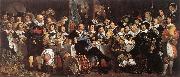
Dutch painter. He was the son of a Haarlem inn-keeper and presumably undertook part or all of his training in Amsterdam. His earliest works suggest that the painter Nicolaes Eliasz. Pickenoy was his master. Although van der Helst had probably already established himself as an independent master by the time he married Anna du Pire in Amsterdam in 1636, his earliest known work, a portrait of The Regents of the Walloon Orphanage, Amsterdam (Amsterdam, Maison Descartes), dates from 1637. Stylistically it is close to the work of Pickenoy. His portrait of a Protestant Minister of 1638 (Rotterdam, Boymans-van Beuningen) reveals the influence of Rembrandt. The young artist must have risen rapidly to fame in Amsterdam, for as early as 1639 he received the prestigious commission for a large painting for the Kloveniersdoelen (Arquebusiers' or Musketeers' Hall): The Civic Guard Company of Capt. Roelof Bicker and Lt Jan Michielsz. Blaeuw (Amsterdam, Rijksmus.), which formed part of the same series as Rembrandt's 'Night Watch' (Amsterdam, Rijksmus.). Van der Helst may not have completed this commission until 1642 or 1643. The ingenious arrangement of the figures in a broad composition shows the artist's special talent for composing large groups. Pickenoy's influence is less noticeable here than in the portrait of 1637; the self-assured poses of the individual figures were to become a characteristic feature of van der Helst's work. The successful execution of this portrait established van der Helst's reputation: from 1642, when he began to receive an increasing number of commissions for individual portraits, until 1670 he was the leading portrait painter of the ruling class in Amsterdam. From 1642 his technique in portrait painting gradually became more fluent and the rendering of costume materials more detailed. Some typical portraits of his earlier period are those of Andries Bicker (Amsterdam, Rijksmus.), his wife Catharina Gansneb Tengnagel (Dresden, Gem?ldegal. Alte Meister) and their son Gerard Bicker (Amsterdam, Rijksmus.), all of 1642, and the Portrait of a Young Girl (1645; London, N.G.). In 1648 van der Helst painted a second civic guard portrait, The Celebration of the Peace of M?nster at the Crossbowmen's Headquarters, Amsterdam (Amsterdam, Rijksmus.), a superbly composed and well painted portrait that, until the late 19th century, was considered one of the masterpieces of the Golden Age but later lost popularity because of its smooth and modish execution. It can nevertheless still be regarded as one of the most important group portraits of the 17th century. |
|
|
|
 |
Helge Johansson -- Click Here
|
|
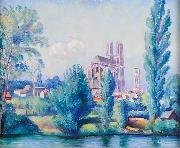
painted Mantes, France in 1920 |
|
 |
Helen Thomas Dranga -- Click Here
|
|
Helen Thomas Dranga (1866-1940), who is also known as Carrie Helen Dranga, was a painter who was born Carrie Helen Tufts in Oxford, England. She lived in Oakland, California from 1894 until 1900, when she moved to Hilo, Hawaii. Her paintings regularly appeared on the cover of Paradise of the Pacific magazine in the 1920s and 1930s. She lived in Hilo until shortly before her death in 1940.
The Honolulu Academy of Arts and the Lyman House Memorial Museum (Hilo, Hawaii) are among the public collections holding works by Helen Thomas Dranga
|
|
 |
Helen Galloway McNicoll ( -- Click Here
|
|
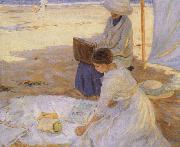
Canadian, 1879-1915 |
|
 |
Helen Frankenthaler Prints -- Click Here
|
|
Born 1928
Helen Frankenthaler (born December 12, 1928) is an American post-painterly abstraction artist. Born in New York City, she was influenced by Jackson Pollock's paintings and by Clement Greenberg. She was the youngest daughter of a justice on the New York State Supreme Court. She studied at the Dalton School under Rufino Tamayo and also at Bennington College in Vermont. She later married fellow artist Robert Motherwell. |
|
|
|
|
|
Helen Allingham,R,W.S -- Click Here
|
|
1848-1926
Studies of Flowers
Studies of Flowers .was a well-known watercolour painter and illustrator of the Victorian era. Helen Mary Elizabeth Paterson was born in Swadlincote in Derbyshire,[1] England. Her sister and her father, a doctor, died of diphtheria in 1862, and the rest of the family went to live in Birmingham. In 1867 she went to study art at the "Female School of Art", a section of what became the Royal College of Art in London, and became an illustrator of children's books. She was a great friend of Kate Greenaway. On 22 August 1874, she married William Allingham, who was almost twice her age. At the time, she was employed in illustrating some of the novels of Thomas Hardy, and they were attracted to one another when they met. Helen Allingham illustrated several books, including Six to sixteen: a story for girls (1876), Happy England (1903) and The homes of Tennyson (1905), written with her brother Arthur Paterson. After her marriage to Allingham, she became a watercolour painter, and she was the first woman to become a full member of the Royal Watercolour Society. As well as landscapes, she completed several portraits, including one of Thomas Carlyle. |
|
 |
Helel Allingham,RWS -- Click Here
|
|
1848-1926
was a well-known watercolour painter and illustrator of the Victorian era. Helen Mary Elizabeth Paterson was born in Swadlincote in Derbyshire,[1] England. Her sister and her father, a doctor, died of diphtheria in 1862, and the rest of the family went to live in Birmingham. In 1867 she went to study art at the "Female School of Art", a section of what became the Royal College of Art in London, and became an illustrator of children's books. She was a great friend of Kate Greenaway. On 22 August 1874, she married William Allingham, who was almost twice her age. At the time, she was employed in illustrating some of the novels of Thomas Hardy, and they were attracted to one another when they met. Helen Allingham illustrated several books, including Six to sixteen: a story for girls (1876), Happy England (1903) and The homes of Tennyson (1905), written with her brother Arthur Paterson. After her marriage to Allingham, she became a watercolour painter, and she was the first woman to become a full member of the Royal Watercolour Society. |
|
 |
HEINTZ, Joseph the Younger -- Click Here
|
|
Swiss/German painter (b. ca. 1600, Augsburg, d. ca.
1678, Venezia) |
|
 |
HEINTZ, Joseph the Elder -- Click Here
|
|
Swiss/German painter (b. 1564, Basle, d. 1609, Praha).
|
|
 |
Heinrich von Angeli -- Click Here
|
|
1840 - 1925
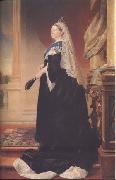
Austrian painter. In 1853 he moved to Vienna to live with his uncle, who was a collector and a friend of the painters Friedrich von Amerling and Mathias Ranftl (1805-54). Angeli's early Self-portrait reflects the precocious maturity of his style, and in 1854 he enrolled at the Akademie der Bildenden K?nste in Vienna. In 1856, on the advice of Amerling, he went to study under Emanuel Gottlieb Leutze in D?sseldorf, where he executed one of his most significant history paintings, Mary Stuart Reading her Death Warrant (1857). In 1859 he moved to Munich, where he worked independently and was encouraged by Karl Theodor von Piloty, producing the history paintings Ludwig XI and Franz de Paula (1859) and Antony and Cleopatra for Ludwig I of Bavaria. In 1862 he again settled in Vienna, where he enjoyed increasing success. The life-size portrait of Baronin Seidler and the genre painting Avengers of Honour (1869), both exhibited at the Weltausstellung in Vienna in 1873, secured his reputation. After brief stays in Paris and Berlin (c. 1866), he went in 1871 to Italy, where he painted numerous portraits and the genre work Absolution Denied. His final genre paintings, Youthful Love (sold London, Sotheby's, 3 Oct 1980) and Calabrian Shepherd Couple, also date from this year. Henceforth he devoted himself entirely to portrait painting, receiving important commissions from such aristocratic circles as the Kinsky and Auersperg families (e.g. Graf Anton Alexander Auersperg, 1876; Vienna, Pr?sidium des Nationalrates). Whereas his early portraits were influenced by Amerling, Anton Einsle and 17th-century Dutch art, from the 1870s he developed his own elegant and restrained style. This helped him to obtain commissions at the courts of Vienna, St Petersburg and London |
|
 |
Heinrich Vogeler -- Click Here
|
|
1872-1942,German painter, printmaker and architect. He studied from 1890 to 1893 in D?sseldorf. In 1895 he bought the Barkenhoff in Worpswede, near Bremen. Soon afterwards, with colleagues from the WORPSWEDE COLONY, including Fritz Mackensen, Fritz Overbeck (1869-1909), Hans am Ende (1864-1918) and Otto Modersohn (1865-1943), he exhibited successfully at the Glaspalast in Munich. He provided illustrations for the periodical Die Insel, and undertook the interior decoration of the G?ldenkammer in Bremen. In 1906 he visited Ceylon (now Sri Lanka) for convalescence and in 1909 he went to England to study the principles of the garden city movement. He served in the German army in World War I, his writing of a pacifist letter to the Emperor in January 1918 prompting an official inquiry into his state of mental health. In 1919 he founded the Arbeitsgemeinschaft Barkenhoff in Worpswede, in an unsuccessful attempt to create an Arbeitsschule and a utopian community. |
|
 |
Heinrich Martin Krabbe -- Click Here
|
|
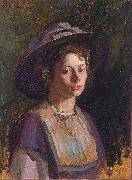
painted Young Lady in 19th/20th century
|
|
 |
Heinrich Jakob Fried -- Click Here
|
|
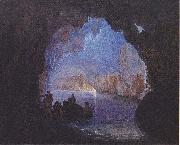
painted The Blue Grotto of Capri in 1835 |
|
 |
Heinrich Hellhoff -- Click Here
|
|
Heinrich Hellhoff (1868 - 1914). |
|
 |
heinrich hansen -- Click Here
|
|
Heinrich Hansen (13 October 1861 ?C 17 April 1940) was a German Lutheran theologian and the father of the Lutheran High Church movement in Germany.
Hansen was born in Klockries near Lindholm (Nordfriesland) as a son of a teacher. In Kiel and Erlangen he studied theology, Hebrew, Syriac, Arabic and in particular the Old Testament under August Klostermann. He worked since 1887 as a pastor in Schleswig-Holstein: in Reinfeld, Lindholm, on the island Pellworm, in Kropp and in Olderup near Husum.
Hansen wrote Latin hymns and worked on a Low German Bible translation and published a Low German hymnal. By the study of the old Lutheran theologians, particularly Martin Chemnitz, and the Roman Catholic theologian Johann Adam Möhler, he came to an Evangelical Catholic view about church. In the Reformation jubilee year of 1917??exactly 100 years after Claus Harms?? Hansen published 95 theses (Stimuli et Clavi) in Latin and German, as a sharp criticism against contemporary Protestantism. His theses influenced the foundation of "Hochkirchliche Vereinigung" in October 1918. Hansen is well-known as a co-founder and the first chairman of Hochkirchliche Vereinigung. He died in Breklum
|
|
 |
Heinrich Fussli -- Click Here
|
|
Swiss romanticist, 1741-1825 |
|
 |
Heinrich Friedrich Fuger -- Click Here
|
|
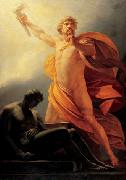
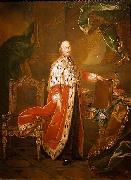
painted Prometheus brings Fire to Mankind in 1817 |
|
 |
Heinrich Foelix -- Click Here
|
|
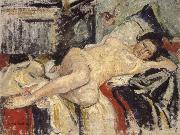
painted Kurfurst Clemens Wenzeslaus von Sachsen in ca. 1776 |
|
 |
Heinrich Eduard Linde-Walther -- Click Here
|
|
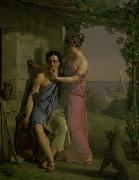
1868-1939
|
|
 |
Heinrich Eddelien -- Click Here
|
|
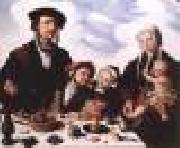
Matthias Heinrich Elias Eddelien (22 Januar 1802 in Greifswald - 24 December 1852 in Stuer) was a Danish history painter of German origin. Eddelien arrived in Copenhagen as a young man and attended the Royal Danish Academy of Fine Arts from 1821 studying under Christoffer Wilhelm Eckersberg. In 1837, he was awarded the Academy's large gold medal. From 1839 to 1843, he travelled to Italy and Germany to widen his studies. He painted portraits, altarpieces and decorative works, including the Pompeian Apartment in Christian VIII's Palace at Amalienborg Palace. His principal work is the decoration of Christian IV's Chapel in Roskilde Cathedral but this led to the laming of his right arm. He died when receiving spa treatment at Stuer. |
|
|
|
 |
HEEMSKERCK, Maerten van -- Click Here
|
|
Netherlandish painter (b. 1498, Heemskerck, d. 1574,
Haarlem). |
|
 |
HEEM, Jan Davidsz. de -- Click Here
|
|
Dutch painter (b. 1606, Utrecht, d. 1684, Antwerpen).
Dutch painter of fruit and flower pieces. He studied with his father, David de Heem, and became one of Holland's foremost still-life painters. His paintings are found in many leading European museums; the Metropolitan Museum possesses three examples. His son and pupil, Cornelis de Heem, c.1631 C 1695, |
|
 |
HEEM, Cornelis de -- Click Here
|
|
Dutch painter (b. 1631, Leiden, d. 1695, Antwerpen).
Son of Jan Davidsz. de Heem. He spent a great deal of his life in Antwerp, where he was taught by his father. Cornelis also worked in Utrecht in 1667, in nearby IJsselstein in 1676 and in The Hague from 1676 for more than ten years. His best works approach the quality of his father's, particularly in works executed during the decade starting in 1655. Cornelis's still-lifes can be distinguished by daring colour harmonies, sometimes with a strong blue. His compositions are often simpler: fruit-pieces, floral bouquets, festoons and garlands and sumptuous still-lifes, |
|
 |
hedvig eleonoras -- Click Here
|
|
Hedvig Eleonora av Holstein-Gottorp, född 23 oktober 1636, död 24 november 1715, var svensk drottning och riksföreståndare, dotter till Fredrik III av Holstein-Gottorp och Marie Elisabeth av Sachsen och gift i november 1654 med Karl X Gustav. Hon var med honom i Polen 1656 och i Danmark 1658. Hon var Sveriges drottning i sex år, men de facto "första dam" till sin död 1715, i femtiofem års tid.
Hon blev änka 1660 och levde som änkedrottning i ytterligare 55 år. Kung Karl II av England friade till henne något år efter makens död, men hon tackade nej, med den formella motiveringen att hon önskade vara sin döde make evigt trogen.
Hon satt i förmyndarregeringarna för både sin son Karl XI och sin sonson Karl XII, 1660-1672 samt 1697, och sedan i rådet 1700-1713, men hade i verkligheten aldrig så mycket att göra med politik, utan var nöjd med att formellt presidera över regeringen och hovet som monarkins symboliska överhuvud och representant. Hon stödde dock den profranska och antidanska policy som fördes av regenterna. Hennes son var djupt beroende av henne i hela sitt liv; då han blev gammal nog att sitta med vid regeringens sammanträden, talade han inte direkt till ledamöterna, han viskade i stället vad han ville veta till riksänkedrottningen, och Hedvig Eleonora frågade sedan regeringen med hög röst vad han ville veta.
Då sorgeperioden formellt bröts år 1663 var hon värdinna för omfattande festligheter, och det var i hennes namn Sveriges första fasta teater öppnades i Stora Bollhuset och Lejonkulan 1667.
Hedvig Eleonora, "Riksänkedrottningen", hade en dominant och temperamentsfull personlighet och dominerade det svenska hovet totalt fram till sin död. Även efter sin sons giftermål 1680 och fram till sin död 1715 var hon den verkliga drottningen och behöll sin position som "första dam"; sonen kallade henne "drottningen" och sin fru för "min fru". Under stora nordiska kriget var hon 1700-13 representant för kungen, men intresserade sig inte heller nu mycket för politik- vid audienser för utländska sändebud kunde antingen "moltiga" eller gapskratta åt dem. Hon intresserade sig för kortspel och arkitektur. Hon kunde spela kort till inpå småtimmarna. Drottningholms slott samt Strömsholms slott påbörjades av henne. Vid båda slotten lät hon anlägga stora parker i tidens stil. |
|
 |
Hedouin Pierre -- Click Here
|
|
A fine French painter, etcher and lithographic artist , Boulogne 1820-Paris 1889
|
|
 |
HEDA, Willem Claesz. -- Click Here
|
|
Dutch painter (b. 1594, Haarlem, d. 1680, Haarlem).
Dutch still-life painter. His excellent studies of tables laden with food, called ontbijt still life, are seen in many important European galleries. They are characterized by delicate lighting effects and somber colors. |
|
 |
Hector Hanoteau -- Click Here
|
|
(25 May 1823 - 7 April 1890, 66) or Hector Charles Auguste Octave Constance Hanoteau was a French landscape painter, born at Decize in Nievre. At the École des Beaux-Arts, he was a pupil of Gignoux, and devoted himself chiefly to landscapes, characterized by sturdy realism and skillful color. He famous works are "The Village Pond," "The Frogs," and "The Water Lilies," all of which are in the Musee du Luxembourg. He is represented also in several French provisional museums. He received a first-class medal at the Paris Exposition of 1889 and the cross of the Legion of Honor in 1870.
|
|
 |
Hector Caffieri -- Click Here
|
|
British,the New Water Colour Society which later became the Royal.1847-1832
|
|
 |
hector berlioz -- Click Here
|
|
Period: Romantic (1820-1869)
Country: France
Born: December 11, 1803 in La Cocirc;te-St.-Andre, Isere, France
Died: March 08, 1869 in Paris, France
|
|
|
|
|
|
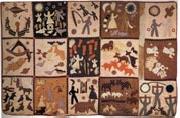 |
Harriet Powers -- Click Here
|
|
African-American Textile Artist, 1837-1911 |
|
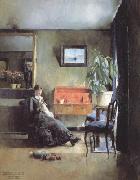 |
Harriet Backer -- Click Here
|
|
Norwegian Painter, 1845-1932
Norwegian painter. In the 1860s and early 1870s she took lessons in drawing and painting in Christiania (now Oslo) and also travelled extensively in Europe with her sister Agathe, a composer and pianist. She copied works in major museums and took occasional art lessons; she later considered this experience to have been of fundamental importance to her artistic development. Little Red Riding Hood (1872; Oslo, N.G.) is impressive in technique, and the early portrait of her sister, Agathe Backer-Grendahl (1874; Holmestrand, Komm.), shows a refined colour scheme. At the age of nearly 30 Backer decided to train professionally as a painter and in 1874 went to Munich. She was never attached to a particular institution, but the influence of her friend the artist Eilif Peterssen was crucial to her development. In Munich she made a thorough study of perspective, which formed a secure basis for her later work. |
|
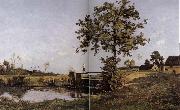 |
Harpignies Henri Joseph -- Click Here
|
|
French Painter , 1819-1916
was a French landscape painter of the Barbizon school. He was born at Valenciennes. His parents intended for him to pursue a business career, but his determination to become an artist was so strong that it conquered all obstacles, and he was allowed at the age of twenty-seven to enter Achard's atelier in Paris. From this painter he acquired a groundwork of sound constructive draughtsmanship, which is so marked a feature of his landscape painting. After two years under this exacting teacher he went to Italy, whence he returned in 1850. During the next few years he devoted himself to the painting of children in landscape setting, and fell in with Corot and the other Barbizon masters, whose principles and methods are to a certain extent reflected in his own personal art. To Corot he was united by a bond of warm friendship, and the two artists went together to Italy in 1860. |
|
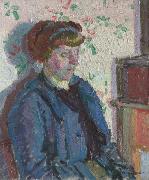 |
Harold Gilman -- Click Here
|
|
(11 February 1876 - 12 February 1919) was a painter of interiors, portraits and landscapes, and a founder-member of the Camden Town Group.
Though born in Rode, Somerset, Gilman spent his early years at Snargate Rectory, in the Romney Marshes in Kent, where his father was the Rector. He was educated in Kent at Abingdon, Rochester and Tonbridge schools, and for one year at Brasenose College in Oxford University.
Although he developed an interest in art during a childhood convalescence period, Gilman did not begin his artistic training until after his non-collegiate year at Oxford University (cut short by ill health) and after working in the Ukraine as a tutor to a British family in Odessa (1895). In 1896 he entered the Hastings School of Art to study painting, but in 1897 transferred to the Slade School of Fine Art in London, where he remained from 1897 to 1901, and where he met Spencer Gore. In 1904 he went to Spain and spent over a year studying Spanish masters (Velezquez and Goya as well as Whistler were major early influences).
At this time he met and married the American painter Grace Cornelia Canedy. The couple settled in London (apart from a visit to her family in Chicago, when Gilman ducked pressure to join the Canedy family business). They had two daughters (one in London, one in Chicago).
|
|
 |
Harold Gilman -- Click Here
|
|
British
1878-1919
Harold Gilman Gallery
Developing an interest in art during a childhood convalescence period, he began his artistic training after a non-collegiate year at Oxford University (again cut short by ill health) and time working as a tutor to an English family living in Odessa. Studying at the Hastings School of Art (1896) and then the Slade School of Fine Art (1897?C1901), he then spent over a year studying the Spanish masters (Velazquez as well as Whistler were major early influences) and meeting and marrying the American painter Grace Cornelia Canedy. Moving back to London, where they settled (apart from an abortive trip to visit her family in Chicago, in which Gilman ducked pressure to join the Canedy family business), they had two daughters (one in London, one in Chicago).
Meeting Walter Sickert in 1907, Gilman became a founder member of both the Fitzroy Street Group (in 1907) and the Camden Town Group (in 1911). In the meantime he joined the Allied Artists' Association, moved to Letchworth, and began to show influence from work of Vuillard as well as Sickert. He soon outpaced Sickert's understanding of post-Impressionism and moved out from under his shadow, however, using ever stronger colour and identifying with Charles Ginner as a 'Neo-Realist' (exhibiting with Ginner under that label in 1914).
Canal Bridge, Flekkefjord, c. 1913Gilman visited Scandinavia in 1912 and 1913, and may have travelled with the artist William Ratcliffe, who had relations there. Gilman made studies of the environment, and painted Canal Bridge, Flekkefjord, an accurate depiction, whose subject is likely to have been inspired by Vincent van Gogh's depiction of a similar bridge in Provence. Gilman had rejected Van Gogh's work when he first encountered it, but later became a strong admirer and, according to Wyndham Lewis, keeping postcards of Van Gogh's work on his wall and sometimes hanging one of his own works next to them, if he was especially satisfied with it.
At that time he also joined Robert Bevan's short-lived Cumberland Market Group with Ginner and John Nash. Remarrying in 1917, in 1918 he was commissioned to travel to Nova Scotia by the Canadian War Records. |
|
 |
Harmen van Steenwyck -- Click Here
|
|
Dutch Painter of still lifes, notably of fruit ,
1612-1659 |
|
 |
Harmen Hals -- Click Here
|
|
Herman, or Harmen Hals (1611, Haarlem - 1669, Haarlem), was a Dutch Golden Age painter.
According to Houbraken he was the son of the painter Frans Hals and was like his brothers Jan and Frans II, good at music and painting. He was a member of the Haarlem Guild of St. Luke.
According to the RKD he was the oldest son of Frans Hals, and spent most of his life in Haarlem, but is registered in Vianen from 1642-45, and in Amsterdam in 1645. |
|
 |
Harald Torsslow -- Click Here
|
|
(1838 -1909 ) - Painter
|
|
 |
Harald Sohlberg -- Click Here
|
|
Harald Oskar Sohlberg (29 September 1869?C19 June 1935) was a Norwegian Neo-romantic painter, particularly known for his depictions of the mountains of Rondane and the town of Røros. His perhaps most well-recognized painting is his 'Fisherman's Cottage' from 1907. |
|
|
|
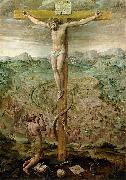 |
Hans Vredeman de Vries -- Click Here
|
|
(1527 - c. 1607) was a Dutch Renaissance architect, painter, and engineer. Vredeman de Vries is known for his publication in 1583 on garden design and his books with many examples on ornaments (1565) and perspective (1604).
Born in Leeuwarden and raised in Friesland, in 1546 Vredeman de Vries went to Amsterdam and Kampen. In 1549 he moved to Mechelen where the Superior Court was seating. Sebastian, his brother, was the organist in the local church. Vredeman de Vries designed ornaments for merry parades of Charles V and Philip II. Studying Vitruvius and Sebastiano Serlio, (translated by his teacher Pieter Coecke van Aelst), he became an internationally known specialist in perspective. He continued his career in Antwerp, where he was appointed city architect and fortification engineer. After 1585 he fled the city because of the Spanish occupation by Alessandro Farnese. Then the Protestants had to leave the city within two years. Vredeman de Vries moved to Frankfurt and worked in Wolfenbettel, designing a fortification and a new lay-out of the city for Julius, Duke of Brunswick-Leneburg. After his death the project was cancelled and Hans worked in Hamburg, Danzig (1592), Prague (1596) and Amsterdam (1600). On his trips Vredeman was accompanied by his son Paul and Hendrick Aerts.
Vredeman de Vries tried to get an appointment at the University of Leiden in 1604. It is not known when and where Hans Vredeman de Vries died, however, it is recorded that his son Paul was living in Hamburg when he inherited.
|
|
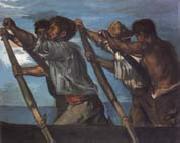 |
Hans von Maress -- Click Here
|
|
1837 Elberfeld-1887 Rome |
|
|
|
|
| | |
|
|
|
|