 |
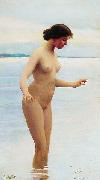
Eugen von Blaas -- Click Here
|
|
painted In the water in 1914 |
|
|
|
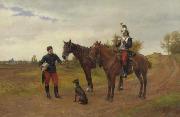 |
etienne Prosper Berne-Bellecour -- Click Here
|
|
1838-1910 |
|
|
|
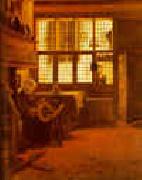 |
Esaias Boursse -- Click Here
|
|
1631-1672 Dutch
Dutch painter and draughtsman. Boursse was the son of Walloon parents, Jacques Boursse and Anne de Forest. A testimony of 23 July 1658 states that Esaias brother Jan provided for his artistic training. There is nothing to confirm a view of the early 20th-century scholars Bode, Bredius and Valentiner that Boursse was a pupil of Rembrandt, although the two artists may have had some contact, since Rembrandt lived near Jan in Amsterdam. According to an inventory of 24 November 1671, Jan collected a number of paintings, drawings and etchings by Rembrandt. |
|
 |
eric bogislaus skjoldebrand -- Click Here
|
|
1873-1888
Swedish Artist. |
|
 |
Emma Minnie Boyd -- Click Here
|
|
Australian Painter, 1858-1936 |
|
 |
Emma Brownlow King -- Click Here
|
|
British, 1832-1905 |
|
 |
Emile Bernard -- Click Here
|
|
1868-1941
French
Emile Bernard Galleries
(b Lille, 28 April 1868; d Paris, 15 April 1941). French painter and writer. He was the son of a cloth merchant. Relations with his parents were never harmonious, and in 1884, against his fathers wishes, he enrolled as a student at the Atelier Cormon in Paris. There he became a close friend of Louis Anquetin and Toulouse-Lautrec. In suburban views of Asnires, where his parents lived, Bernard experimented with Impressionist and then Pointillist colour theory, in direct opposition to his masters academic teaching; an argument with Fernand Cormon led to his expulsion from the studio in 1886. He made a walking tour of Normandy and Brittany that year, drawn to Gothic architecture and the simplicity of the carved Breton calvaries. In Concarneau he struck up a friendship with Claude-Emile Schuffenecker and met Gauguin briefly in Pont-Aven. During the winter Bernard met van Gogh and frequented the shop of the colour merchant Julien-Franois Tanguy, where he gained access to the little-known work of Cezanne. |
|
|
|
Emil Barentzen -- Click Here
|
|
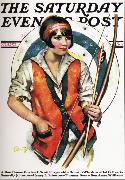
Emilius Ditlev Bærentzen, usually known as Emil Barentzen, (30 October 1799, Copenhagen - 14 February 1868, Copenhagen) was a Danish portrait painter and lithographer, active during the Golden Age of Danish Painting.
Born in Copenhagen on 30 October 1799, Barentzen served an apprenticeship at the pharmacy in Nykobing Sjælland but then travelled to Christiansted on the then Danish island of St. Croix in the West Indies where he worked in one of the government offices. Five years later he returned to Denmark and, after qualifying as a lawyer, moved into painting which until then he had practiced as a hobby. In 1821, he entered the Danish Academy where he studied under Christoffer Wilhelm Eckersberg. He was awarded the little silver medal in 1826 and the large silver medal the following year. He soon became one of Copenhagen's most popular portrait painters. His paintings were characterized by an elegant but sober style, free of psychological trimmings in accordance with contemporary practice. One of his most successful works is the portrait of Soren Kirkegaard's fiancee Regine Olsen (1840).
In 1837, he began to specialize in lithography with H.L. Danschell who managed his deceased father-in-law's oilcloth factory where stones were used to colour the fabric. This led to the founding of a lithographic company, Emilius Bärentzen & Co.s litografiske Institut, which later became Hoffensberg, Jespersen & Fr. Trap. Bærentzen made lithographs of many of the period's most important figures. He continued to work both as a lithographer and artist until 1866 when he painted the portraint of Cosmus Bræstrup for the Freemasons lodge in Helsingor. He died on 14 February 1868. |
|
 |
Ellen Bernard Thompson -- Click Here
|
|
American , 1876-1936
|
|
 |
Elizabeth Lyman Boott Duveneck -- Click Here
|
|
1846-1888
Elizabeth Lyman Boott Duveneck Gallery |
|
 |
Elizabeth Louise Vigee Le Brun -- Click Here
|
|
French Neoclassical Painter, 1755-1842 |
|
 |
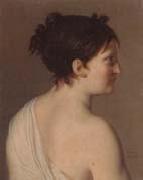
Elizabeth Gardner Bouguereau -- Click Here
|
|
1837-1922 |
|
 |
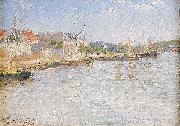
Elise Bruyere -- Click Here
|
|
French ,
Paris 1776-1842
|
|
 |
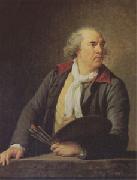
Elisabeth Warling -- Click Here
|
|
painted Strandvagen-Stockholm in 1874 |
|
 |
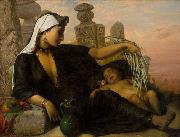
Elisabeth Louise Viegg-Le Brun -- Click Here
|
|
Paris 1755-1842 |
|
 |
Elisabeth Jerichau Baumann -- Click Here
|
|
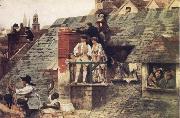
(born November 21, 1819 - died July 11, 1881 in Copenhagen) was a Polish-born Danish painter. She was married to the sculptor Jens Adolf Jerichau.
Elisabeth Jerichau-Baumann was born in Zoliborz (Jolibord) a borough of Warsaw.Her father Philip Adolph Baumann (1776 - 1863), a mapmaker, and her mother, Johanne Frederikke Reyer (1790 - 1854), were German.
At the age of nineteen, she began her studies in Desseldorf which at the time was one of the most important art centres in Europe and her early subject matter was drawn from Slovak life. She began exhibiting there and in 1844 attracted public attention for the first time. After she moved to Rome, her paintings were primarily of local life. It was here that she met her future husband, Jens Adolf Jerichau, whom she married in 1846. When the artist couple was not travelling, she spent many hours a day in their studio in Rome. She was particularly fond of the Italian carnival as a theme.
|
|
 |
Edwin Howland Blashfield -- Click Here
|
|
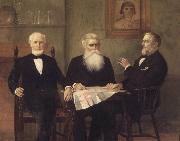
mural painter and mosaic designer.
American ,1848-1936
American painter. He began to study art seriously in 1867 in Paris under L?on Bonnat, with whom he remained (except between 1870 and 1874) until 1880. Blashfield's mural style was significantly influenced by Pierre Puvis de Chavannes, Jean-Paul Laurens and Paul Baudry, whose decorations he had studied in the Panth?on while in Paris. He made a trip in 1887 to England, where he became briefly associated with the Anglo-American artists' colony in Broadway, Glos, which included Edwin Austin Abbey, John Singer Sargent, Lawrence Alma-Tadema and Frederic Leighton. |
|
 |
Edwin Blashfield -- Click Here
|
|
(December 5, 1848 - October 12, 1936), an American artist, was born in New York City.
He was a pupil of Leon Joseph Florentin Bonnat in Paris beginning in 1867, and became (1888) a member of the National Academy of Design in New York. For some years a genre painter, he later turned to decorative work, where his academic background in painting and extensive travels to study fresco painting in Italy melded in work marked by rare delicacy and beauty of coloring.
Considered a leading muralist of the late 19th century, he painted mural decorations or created mosaics in a number of places associated with the American Renaissance period.
His style is cited as an influence of Pierre Puvis de Chavannes, Jean-Paul Laurens, and Paul Baudr.
With his wife he wrote Italian Cities (1900) and edited Vasari's Lives of the Painters (1896), and was well known as a lecturer and writer on art. He became president of the Society of Mural Painters, and of the Society of American Artists.
|
|
 |
Edward Mitchell Bannister -- Click Here
|
|
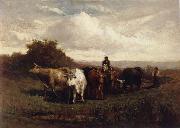
Born in Canada, Edward Mitchell Bannister moved to Boston in 1848 to work as a ship cook |
|
 |
Edward La Trobe Bateman -- Click Here
|
|
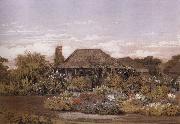
book illuminator, draughtsman, architectural decorator and garden designer.
English
c.1815-1897
was a pre-raphaelite landscape artist, book illuminator and draughtsman. He was probably born in Derbyshire. Edward had lived in London where he had been engaged to the daughter of William and Mary Howitt. Edward visited Australia and stayed initially with Godfrey Howitt. In 1856, the Carlton Gardens in Melbourne were redesigned and Edward la Trobe Bateman was engaged to do the designs. |
|
 |
Edward Caledon Bruce -- Click Here
|
|
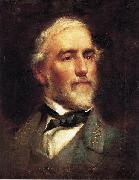
painted Robert E. Lee in 1865 |
|
 |
Edward Burne-Jones -- Click Here
|
|
British Pre-Raphaelite Painter, 1833-1898
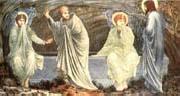
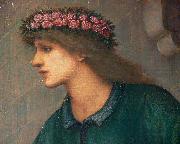
English painter and decorative artist. He was the leading figure in the second phase of the Pre-Raphaelite movement. His paintings of subjects from medieval legend and Classical mythology and his designs for stained glass, tapestry and many other media played an important part in the Aesthetic Movement and the history of international Symbolism. |
|
 |
Edward Burne Jones -- Click Here
|
|
Sir Edward Coley Burne-Jones, 1st Baronet (28 August 1833 - 17 June 1898) was a British artist and designer closely associated with the later phase of the Pre-Raphaelite movement, who worked closely with William Morris on a wide range of decorative arts as a founding partner in Morris, Marshall, Faulkner, and Company. Burne-Jones was closely involved in the rejuvenation of the tradition of stained glass art in England; his stained glass works include the windows of St. Philip's Cathedral, Birmingham, Holy Trinity Church, Sloane Square, Chelsea, St Martin's Church in Brampton, St Michael's Church in Brighton, Cumbria, the church designed by Philip Webb, All Saints, Jesus Lane, Cambridge and in Christ Church, Oxford.
Burne-Jones's early paintings show the heavy inspiration of Dante Gabriel Rossetti, but by the 1860s Burne-Jones was discovering his own artistic "voice". In 1877, he was persuaded to show eight oil paintings at the Grosvenor Gallery (a new rival to the Royal Academy). These included The Beguiling of Merlin. The timing was right, and he was taken up as a herald and star of the new Aesthetic Movement.
In addition to painting and stained glass, Burne-Jones worked in a variety of crafts; including designing ceramic tiles, jewellery, tapestries, mosaics and book illustration, most famously designing woodcuts for the Kelmscott Press's Chaucer in 1896.
Edward Coley Burne Jones (the hyphen came later) was born in Birmingham, the son of a Welshman, Edward Richard Jones, a frame-maker at Bennetts Hill, where a blue plaque commemorates the painter's childhood. His mother Elizabeth Coley Jones died within six days of his birth, and he was raised by his grieving father and the family housekeeper, Ann Sampson, an obsessively affectionate but humorless and unintellectual local girl. He attended Birmingham's King Edward VI grammar school from 1844 and the Birmingham School of Art from 1848 to 1852, before studying theology at Exeter College, Oxford. At Oxford he became a friend of William Morris as a consequence of a mutual interest in poetry. The two Exeter undergraduates, together with a small group of Jones' friends from Birmingham known as the Birmingham Set, speedily formed a very close and intimate society, which they called "The Brotherhood". The members of the Brotherhood read John Ruskin and Tennyson, visited churches, and worshipped the Middle Ages. At this time Burne-Jones discovered Thomas Malory's Le Morte d'Arthur which was to be so influential in his life. At that time neither Burne-Jones nor Morris knew Rossetti personally, but both were much influenced by his works, and met him by recruiting him as a contributor to their Oxford and Cambridge Magazine which Morris founded in 1856 to promote their ideas.[ |
|
|
|
 |
Edward Beyer -- Click Here
|
|
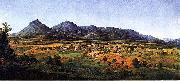
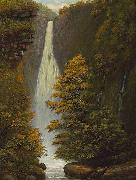
painted The Peaks of Otter and the Town of Liberty in 1855 |
|
 |
Edward Bailey -- Click Here
|
|
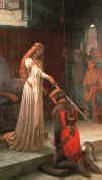
(1814-1903) was the most accomplished of the missionary artists in Hawaii. Along with his wife, Bailey arrived in Hawaii as a missionary-teacher in 1837 on the ship Mary Frazier. He worked at the Wailuku Female Seminary in Maui from 1840 until its closure in 1849. After the seminary closed, he built the still standing Ka'ahumanu Church in Wailuku and operated a small sugar plantation that eventually became part of the Wailulu Sugar Company. He began painting about 1865, at the age of 51, without any formal instruction.
Bailey's best known paintings are landscapes depicting the natural beauty of central Maui, The Bailey House Museum (Wailuku, Hawaii) and the Lyman House Memorial Museum (Hilo, Hawaii) are among the public collections holding works by Edward Bailey.
|
|
 |
Edmund Blair Leighton -- Click Here
|
|
1853-1922
British
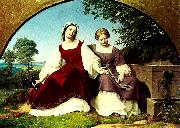
Leighton was the son of the artist Charles Blair Leighton. He was educated at University College School, before becoming a student at the Royal Academy Schools. He married Katherine Nash in 1885 and they went on to have a son and daughter. He exhibited annually at the Royal Academy from 1878 to 1920.
Leighton was a fastidious craftsman, producing highly-finished, decorative pictures. It would appear that he left no diaries, and though he exhibited at the Royal Academy for over forty years, he was never an Academician or an Associate. |
|
 |
e. j. f. bendemann -- Click Here
|
|
Eduard Julius Friedrich Bendemann (3 December 1811, Berlin - 27 December 1889, Dusseldorf) was a German painter.
Bendemann was born in Berlin. His father, Anton Heinrich Bendemann, a Jewish banker, monitored his education closely; it was one that would have naturally led him to some sort of technical occupation, but his talent and propensity towards art resulted in his being allowed to pursue other interests. His mother Fanny Eleonore Bendemann nee von Halle, also a daughter of the Jewish banker Joel Samuel von Halle.
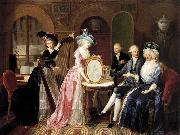
After he completed elementary school he enrolled in the Wilhelm von Schadow's School in Dusseldorf. In 1830 he went on a school trip to Italy. After a series of jobs, among them with Boas and Ruth, his talent as an artist began to show, especially with his very large 1832 painting titled, The Sad Jews of Babylon which was featured in the Berlin art exhibition. The picture garnered a great deal of attention, which was in part due to the deep and simple feeling and the noble composition of the piece (museum in Cologne). Bendemanns second picture: The Two Girls at the Well (1832), was acquired by the North Rhine-Westphalia art association.
Soon thereafter followed Jeremias on the Ruins of Jerusalem for which the artist received a medal in Paris in 1837. This painting was for the most part about the progress of the Jews in Babylon. (Royal Palace in Hanover). His best known work is The Harvest.
The artist's first fresco was a symbolic representation of the art at the Poetry Well at the house of his parents-in-law in Berlin. In the year 1838 he was appointed professor of the academy of arts in Dresden, where he had the opportunity to paint even larger frescos. Bendemann was given the task to decorate three halls of the Dresden royal palace, the throne room, the tower room, and the tower hall with wall paintings. In the throne room, on both sides of the throne, there are representations of important rulers and legislators in gold leaf with smaller representations in relief form below, from Moses up to Albrecht III, the King at the time. On the wall facing the throne there are four paintings depicting events from the life of King Heinrich I each with other pictures attached which explain each of the four events. Bendemann died in Dusseldorf. |
|
|
|
 |
DUVIVIER, Jan Bernard -- Click Here
|
|
b. 1762, Bruges, d. 1837, Paris |
|
 |
Duccio di Buoninsegna -- Click Here
|
|
1255-1318
Italian Duccio di Buoninsegna Locations
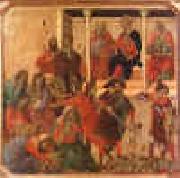
Italian painter. He was one of the most important painters of the 14th century and like his slightly younger contemporary, Giotto, was a major influence on the course of Italian painting. An innovator, he introduced into Sienese painting new altarpiece designs, a dramatic use of landscape, expressive emotional relationships, extremely complex spatial structures and a subtle interplay of colour. His most important and revolutionary work, the Maeste for Siena Cathedral, was never matched during the 14th century, if at all, and his influence lasted well into the 15th century. |
|
 |
Domenico di Pace Beccafumi -- Click Here
|
|
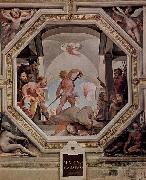
(1486?CMay 18, 1551) was an Italian Renaissance-Mannerist painter active predominantly in Siena. He is considered one of the last undiluted representatives of the Sienese school of painting.
Domenico was born in Montaperti, near Siena, the son of Giacomo di Pace, a peasant who worked on the estate of Lorenzo Beccafumi. Seeing his talent for drawing, Lorenzo adopted him, and commended him to learn painting from Mechero, a lesser Sienese artist. In 1509 he traveled to Rome, but soon returned to Siena, and while the Roman forays of two Sienese artists of roughly his generation (Il Sodoma and Peruzzi) had imbued them with elements of the Umbrian-Florentine Classical style, Beccafumi's style remains, in striking ways, provincial. In Siena, he painted religious pieces for churches and of mythological decorations for private patrons, only mildly influenced by the gestured Mannerist trends dominating the neighboring Florentine school. |
|
 |
Domenico Brusasorci -- Click Here
|
|
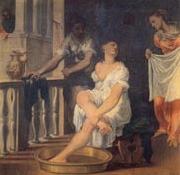
Italian High Renaissance Painter , Verona 1515 ca. - 1567 |
|
 |
Domenico Beccafumi -- Click Here
|
|
c1486-1551
Domenico Beccafumi Gallery
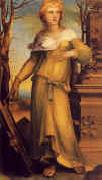
Italian painter, sculptor, draughtsman, printmaker and illuminator. He was one of the protagonists, perhaps even the most precocious, of Tuscan Mannerism, which he practised with a strong sense of his Sienese artistic background but at the same time with an awareness of contemporary developments in Florence and Rome. He responded to the new demand for feeling and fantasy while retaining the formal language of the early 16th century. None of Beccafumis works is signed or dated, but his highly personal maniera has facilitated almost unanimous agreement regarding the definition of his corpus and the principal areas of influence on it. However, some questions concerning the circumstances of his early career and the choices available to him remain unanswered. The more extreme forms of Beccafumis reckless experimentation underwent a critical reappraisal only in the later 20th century. |
|
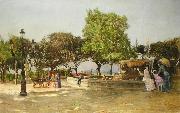 |
Domenica Battaglia -- Click Here
|
|
painted La Fontana delle Paperelle, Napoli, in
1842/46-1904 |
|
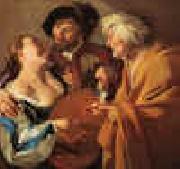 |
Dirck van Baburen -- Click Here
|
|
b.c. 1595, Utrecht, Netherlands.
d.Feb. 21, 1624, Utrecht
Dutch
Dirck van Baburen Gallery |
|
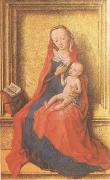 |
Dirck Bouts -- Click Here
|
|
Haarlem ca 1420-Louvain 1475
was an Early Netherlandish painter. According to Karel van Mander in his Het Schilderboeck of 1604, Bouts was born in Haarlem and was mainly active in Leuven (Louvain), where he was city painter from 1468. Van Mander confused the issue by writing biographies of both "Dieric of Haarlem" and "Dieric of Leuven," although he was referring to the same artist. The similarity of their last names also led to the confusion of Bouts with Hubrecht Stuerbout, a prominent sculptor in Leuven. Very little is actually known about Bouts' early life, but he was greatly influenced by Jan van Eyck and by Rogier van der Weyden, under whom he may have studied. He is first documented in Leuven in 1457 and worked there until his death in 1475. Bouts was among the first northern painters to demonstrate the use of a single vanishing point |
|
 |
Dirck Barendsz -- Click Here
|
|
(1534?C1592) was a Dutch Renaissance painter from Amsterdam who traveled to Italy in his youth to learn from the Italian masters, most notably Titian.
|
|
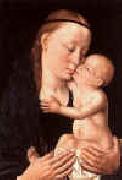 |
Dieric Bouts -- Click Here
|
|
1420-1475 Flemish Dieric Bouts Locations
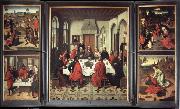
Dirk Bouts whose real name was Theodorik Romboutszoon, was probably born in Haarlem, where he may have studied under the painter Albert van Ouwater. Sometime before 1450 Bouts took up residence in the Flemish city of Louvain. His name appeared in the records of Louvain in 1457 and again in 1468, when he was appointed "city painter."
It is likely that Bouts spent some time in Bruges, as his earliest work, the Infancy Altarpiece shows the distinct and strong influence of Petrus Christus, the leading master of that city after the death of Jan van Eyck. The slightly later Deposition Altarpiece (ca. 1450) displays strong connections with the style of Rogier van der Weyden in both the figure types and the composition. About 1460, the period of the Entombment in London, the early, formative influence of Petrus Christus had been almost totally displaced by that of Rogier, though Bouts personal vision began to emerge in the fluid and continuous landscape background.
The great Last Supper Altarpiece (1464-1467) marks the high point of Bouts career. In this solemn and dignified masterpiece the painter achieved spiritual grandeur in the context of convincing physical reality. The central panel of the altarpiece is the most emphatically significant treatment of the theme of the Last Supper in Northern European art. The wings, which contain Old Testament prefigurations of the central theme, are freer and more loosely organized. Eschewing the symmetry and rigid axial construction of the main panel, Bouts produced rhythmic foreground compositions in combination with fluid and dramatic spatial recessions.
In 1468 Bouts was commissioned to paint four panels on the subject of justice for the Town Hall of Louvain. At the painter death in 1475 only two of the paintings had been completed; they are among the most remarkable productions of his career. The unusual subjects, taken from the chronicles of a 12th-century historian, concern the wrongful execution by Emperor Otto III of one of his counts and the subsequent vindication of the nobleman by his wife. The finer of the panels represents the dramatic trial by fire which the wife was obliged to undergo to prove her husband innocence. Rich draperies and sumptuous colors are applied to tall angular forms to create a work of rare formal elegance and high decorative appeal. In order to dignify the event, however, the artist has employed restrained gestures and expressions as well as a completely rationalized spatial setting. As in the Last Supper Altarpiece, a sense of solemn and hieratic importance is expressed by means of an austere and rigid geometry in the construction of both persons and places.
The late productions of Bouts workshop, such as the well-known Pearl of Brabant Altarpiece, are characterized by the close collaboration of the painter two sons, Dirk the Younger (1448-1491) and Aelbrecht (1455/1460-1549). In the paintings of his less gifted sons, the master distinctive figure style was appreciably altered, though Dirk the Younger appears to have retained much of his father sensitivity to the landscape.
In addition to his innovations in the depiction of landscape, Bouts made a substantial contribution to the development of the portrait. His Portrait of a Man (1462) localizes the sitter in an enlarged architectural setting while permitting the interior space to merge with the exterior through an open window. For the first time in Northern painting a common bond was forged between a particularized individual and the universal world of nature. |
|
 |
dierec bouts -- Click Here
|
|
c. 1415-1475
He was an Early Netherlandish painter.
According to Karel van Mander in his Het Schilderboeck of 1604, Bouts was born in Haarlem and was mainly active in Leuven (Louvain), where he was city painter from 1468. Van Mander confused the issue by writing biographies of both "Dieric of Haarlem" and "Dieric of Leuven," although he was referring to the same artist. The similarity of their last names also led to the confusion of Bouts with Hubrecht Stuerbout, a prominent sculptor in Leuven. Very little is actually known about Bouts' early life, but he was greatly influenced by Jan van Eyck and by Rogier van der Weyden, under whom he may have studied. He is first documented in Leuven in 1457 and worked there until his death in 1475. |
|
 |
DIANA, Benedetto -- Click Here
|
|
Italian painter, Venetian school (known 1482-1525 in Venice)
|
|
 |
Dennis Miller Bunker -- Click Here
|
|
1861-1890
Dennis Miller Bunker Gallery
The paintings of Bunker's early maturity in New York (ca. 1880-82) were often marine subjects, featuring a series of beached boats, painted on Long Island. In these he followed the standard academic practice of first painting loose, preparatory sketches (Beached, ca. 1881-2) prior to more conventionally finished exhibition pieces. The early portraits (Portrait of Walter Griffin, 1881, Portland Museum of Art) also evidence rigorous craftsmanship.
While studying in Paris, Bunker's summer excursions to the countryside resulted in another series, this time of scenes of Larmor, a town in Brittany. The focus of these compositions, be it church spire (Brittany Town Morning, Larmor, 1884, Terra Foundation for American Art), cemetery cross, or a lone tree (Tree, 1884-5, private collection), was invariably that of a richly painted, dark graphic shape against a bright sky. Nevertheless, the pictures are characterized by soft atmospheric effects and tonal subtlety. No less subtle are the landscapes Bunker painted after returning to America; paintings done in South Woodstock, Connecticut (Pines Beyond the Fence, 1886, private collection) still favor dramatic value contrasts, with subjects carefully painted against a light sky, but the palette has grown lighter, the color more saturated.
By 1887 Bunker completed his Portrait of Anne Page, a painting requiring much labor, but one of his most poignant works. In its restrained use of color, delicate modeling of form, and aesthetic elegance it is reminiscent of the works of Thayer and James McNeill Whistler. There soon followed the Boston commissions, portraits mostly of male sitters--still somber in tone, they are painted in a more confident manner, suggesting the influence of Sargent (Portrait of George Augustus Gardner, 1888, Museum of Fine Arts, Boston).
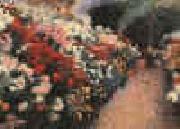
Portrait Sketch of Eleanor Hardy Bunker, 1890. Private collection.That Bunker spent the summer of 1888 painting with Sargent is verified by personal correspondence, as well as through several pieces by the latter artist (Dennis Miller Bunker Painting at Calcot, 1888, Terra Foundation for American Art), but no paintings of the English sojourn by Bunker have survived; possibly he destroyed them in dissatisfaction. However, once back in Boston the experience came to fruition, for over the next two years Bunker produced a series of canvases which evidenced that he was one of the first American artists to fully understand and successfully practice impressionism. In the Greenhouse, ca. 1888, Chrysanthemums, 1888 (Isabella Stewart Gardner Museum), The Pool, Medfield, 1889 (Museum of Fine Arts, Boston), and Meadow Lands, 1890 (Museum of Fine Arts, Boston) all feature a rich palette, vertiginous compositions, and his unique "fish hook" shaped brush strokes.
At the same time, Bunker's last figure pieces remained faithful to his academic training. Jessica, 1890 (Museum of Fine Arts, Boston), The Mirror, 1890 (Terra Foundation for American Art), and Eleanor Hardy Bunker, 1890 (Metropolitan Museum of Art) are characterized by a restricted color range and heightened elegance. |
|
 |
Demont-Breton Virginie -- Click Here
|
|
French Painter ,1859-Wissant 1935
|
|
 |
De Braekeleer Adrien -- Click Here
|
|
Belgian , 1818-1904
|
|
 |
Davies Arthur Bowen -- Click Here
|
|
American Symbolist Painter, printmaker and tapestry designer , b.1862 d.1928
American painter and illustrator. He first trained as an architectural draughtsman at the Academy of Design, Chicago (1878). After studying briefly at the Art Institute of Chicago, he went to New York, where he attended the Gotham School and the Art Students League (1886-8). By 1887 he was working as an illustrator for Century magazine. A realist landscape painter in the 19th-century academic tradition, he was influenced by the painters of the Hudson River school and particularly by the luminist, dream-like landscapes of George Inness. |
|
 |
David Gilmour Blythe -- Click Here
|
|
(May 9, 1815 - May 15, 1865) was a self-taught American artist best known for paintings which satirically portrayed political and social situations.
Blythe was born in East Liverpool, Ohio on May 9, 1815 to poor parents of Scottish and Irish ancestry. After a childhood in a log cabin by the Ohio River, at the age of 16, Blythe moved to Pittsburgh, Pennsylvania. There he apprenticed himself to woodcarver Joseph Woodwell. In his subsequent work as an itinerant portrait painter, Blythe traveled widely from Baltimore to Philadelphia and perhaps as far as New Orleans. Other than his stint with Woodwell, Blythe had no known artistic education or training. |
|
 |
David Bailly -- Click Here
|
|
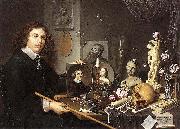
(1584-1657) was a Dutch Golden Age painter.
Bailly was born at Leyden in the Dutch Republic, the son of a Flemish immigrant, calligrapher and fencing master, Peter Bailly. As a draftsman, David was pupil of his father and the copper engraver Jacques de Gheyn.
David Bailly apprenticed with a surgeon-painter Adriaan Verburg in Leiden and then with Cornelius van der Voort (1576-1624), a portrait painter in Amsterdam. According to Houbraken, in the winter of 1608, Bailly took his Grand Tour, travelling to Frankfurt, Nuremberg, Augsburg Hamburg, and via Tirol to Venice, and from there to Rome. On his return he spent five months in Venice, all the while working as a journeyman where he could, before crossing the alps again in 1609. On his return voyage, Bailly worked for several German princes including the Duke of Brunswick. Upon his return to the Netherlands in 1613, Bailly began painting still-life subjects and portraits, including self-portraits and portraits of his students and professors at the University of Leiden. He is known for making a number of vanities paintings depicting transience of this life, with such ephemeral symbols as flowers and candles. Bailly taught his nephews Harmen and Pieter Steenwijck.
|
|
 |
DADDI, Bernardo -- Click Here
|
|
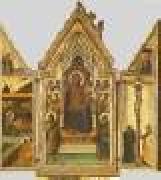
Italian Early Renaissance Painter, active ca.1290-1348 |
|
 |
CUYP, Benjamin Gerritsz. -- Click Here
|
|
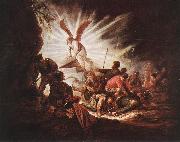
b. 1612, Dordrecht, d. 1652, Dordrecht
Dordrecht,,Painter, half-brother of Jacob Cuyp. Houbraken stated that he studied with his half-brother Jacob. Benjamin entered the Guild of St Luke on 27 January 1631, at the same time as his brother Gerrit Gerritsz. the younger. In 1641 Benjamin gave evidence in a medical affair, which has prompted speculation that he may have trained as a doctor, but in 1643 he is twice recorded in The Hague as a painter, living with other artists. |
|
 |
Cristiano Banti -- Click Here
|
|
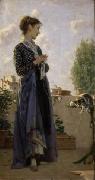
Italy (Santa Croce Sull'arno 1824-Montemurlo 1904 ) - Painter |
|
 |
Cornelis de Baellieur -- Click Here
|
|
Cornelis de BAELLIEUR (Flemish) Antwerp 1607-1671. |
|
 |
Cornelis Bol -- Click Here
|
|
Dutch, born circa 1589-1666,Painter, etcher and draughtsman, active in London. He was probably from a family of painters originating in Mechelen who later settled in Antwerp. Bol and his wife were members of the Dutch Church in London in 1636. An etching of an Action between the Dutch and Spanish Fleets (Oxford, Bodleian Lib.) is signed and dated 1639, and a set of etchings by him after Abraham Casembrot ( fl c. 1650-75) includes a view of Lambeth Palace as well as four imaginary Mediterranean seaports. A signed drawing of the Blockhouse at Gravesend is in the British Museum, London. George Vertue saw at Wotton House, Bucks, 'three views of London from the River side Arundel House Somersett house Tower Lond. painted before the fire of London by Cornelius Boll: a good free taste'. They were probably commissioned by John Evelyn, the diarist, around 1660 and descended in the Evelyn family. Their attribution to Bol is confirmed by a signed version of Somerset House (London, Dulwich Pict. Gal.). Although Bol was only moderately accomplished, he was able to reproduce the distinctive light and character of the River Thames and to render the riverside and its landmarks with much topographical detail; his pictures make pleasing visual documents. The handling of the naval craft is identical in a small signed oil panel of an Action between Dutch and Spanish Ships (Amsterdam, Rijksmus.) and in other marine subjects that have appeared in London salerooms. According to Immerzeel, Bol was still working in London at the time of the Great Fire in 1666. |
|
 |
Cornelis Bisschop -- Click Here
|
|
In ca. 1650 he was a student of Ferdinand Bol in Amsterdam. In 1653 he was back in Dordrecht, where he got married. According to Houbraken he was the first to paint carved trompe l'oeil wooden panels in such an ingenious way that they became quite popular. He painted historical allegories, portraits, still lifes, and genre-works. He was asked to paint for the Danish court, but he died unexpectedly, leaving his wife and eleven children. Of these children, two sons (Abraham (1660-1700) & Jacobus Bisschop (1658-1698)) and three daughters became painters. These had been his students when he died, and Margaretha van Godewijk studied with his daughters. She wrote an emblem about his self-portrait with a curtain, which illustrates the legend of Zeuxis.
His son Jacobus later became a student of Augustinus Terwesten in the Confrerie Pictura
|
|
 |
Cornelis Bega -- Click Here
|
|
1632-1664
Dutch
Cornelis Bega Galleries
Dutch painter, draughtsman and etcher. He was born into prosperous circumstances; his mother, Maria Cornelis, inherited half the estate (gold, silver, paintings, drawings and prints) and all of the red chalk drawings of her father, Cornelis Cornelisz. van Haarlem, a renowned Mannerist artist. Begas father was Pieter Jansz. Begijn (d 1648), a gold- and silversmith. Like other family members, Bega was probably Catholic. Houbrakens claim that Bega studied with Adriaen van Ostade is likely to be correct; this was probably before 24 April 1653, when Bega joined Vincent Laurentsz. van der Vinne in Frankfurt for a journey through Germany, Switzerland and France. Bega had returned to Haarlem by 1 September 1654, at which time he joined the Guild of St Luke; he was already a competent draughtsman, as indicated by his first extant dated work, Interior with a Nursing Mother (1652; Frankfurt am Main, Stedel. Kstinst.), and by a remarkable double portrait (Amsterdam, Rijksmus.) drawn by him and Leendert van der Cooghen in 1654.
|
|
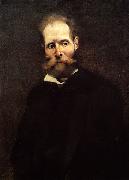 |
Columbano Bordalo Pinheiro -- Click Here
|
|
(Lisbon, 21 November 1857 - Lisbon, 6 November 1929), who is usually referred to as Columbano, was a Portuguese Realist painter. Usually considered the greatest Portuguese painter of the 19th century, he has been compared to the likes of Wilhelm Leibl and Thomas Eakins.
Columbano was the son of a mediocre romantic painter, Manuel Maria Bordalo Pinheiro, and the younger brother of the great caricaturist, Rafael Bordalo Pinheiro. He became the leading painter of his generation and the master of realism in Portuguese painting, specializing in portraiture. He was disciple of his father, of the painter Miguel Ângelo Lupi and the sculptor Simões de Almeida. After attempting twice for a bursar to study abroad finally in 1881 the countess of Edla, second wife of D.Fernando would finance his study in France. There he studied the work of French naturalist, realist and impressionist painters, like Courbet, Manet and Degas without losing his distinctive style which is often gloomy and intimist. He joined the "Grupo do Leão" (The Lion's Group), a usual meeting of artists, writers and intellectuals in a Lisbon downtown restaurant called "Leão de Ouro" (The Golden Lion) in order to discuss aesthetic issues and proclaim Naturalism against the academic art of the time. The group also included Rafael Bordalo Pinheiro, Antenio da Silva Porto, Marques de Oliveira and Jose Malhoa. He painted portraits of some of the greatest names of Portuguese society and culture of his time like Jose Maria de Eça de Queiroz, Teefilo Braga, Raul Brandão and had great psychological accuracy in defining the personality of those depicted. His most famous portrait was that of the poet Antero de Quental in 1889. In this haunting work Columbano seems to have anticipated Antero's suicide.
Columbano was a well known Republican, so it wasn't surprising that after the Republic proclamation, in 1910, he was invited to design the flag of the new regime and was nominated director of the National Museum of Contemporary Art, currently the Chiado Museum, in Lisbon, of which he was in charge from 1914 to 1927. The best collection of his paintings is in the Chiado Museum, in Lisbon. He's also represented in some of the finest Portuguese museums, like the National Museum Soares dos Reis, in Porto.
|
|
 |
Clarice Beckett -- Click Here
|
|
Australian Painter, 1887-1935,Australian painter. She studied at the National Gallery School, Melbourne (1914-16), and with Max Meldrum became involved (c. 1917) with the Meldrum circle of artists, which included Colin Colahan (1897-1987), Justus Jorgensen (1893-1975), John Farmer (b 1897) and Percy Leason (1889-1959). In 1919 she moved to the seaside suburb of Beaumaris, where she lived and worked for the rest of her life. |
|
|
|
 |
Christian Ernst Bernhard Morgenstern -- Click Here
|
|
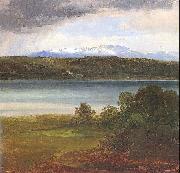
(29 September 1805 - 12 Februar 1867) was a German landscape painter. Morgenstern is regarded as one of the pioneers in Germany of early Realism in painting. He gained this reputation in Hamburg 1826-1829 together with his contemporary Adolph Friedrich Vollmer while both were still studying; from 1830 onwards, Morgenstern, together with Friedrich Wasmann, Johan Christian Dahl and Adolph Menzel, introduced Munich to Realist painting.
Morgenstern was born in Hamburg as one of six children to a painter of miniatures, Johann Heinrich Morgenstern (1769-1813). After the early death of his father he was placed as an apprentice in the graphic workshop of the brothers Suhr. Cornelius Suhr took the young Morgenstern as his servant on a two-year journey through Germany to publicise the panorama prints which the brothers Suhr produced. 1822 followed another long journey to St. Petersburg, where they stayed for a year and to Moscow. On their return to Hamburg Morgenstern succeeded in leaving Suhr (Vollmer took his place). He became a student of the Hamburg painter Siegfried Bendixen with whom he stayed from 1824 to 1827, then continued his studies at the Royal Danish Academy of Fine Arts in Copenhagen (1827-1828) and undertook study journeys through Sweden and Norway. Bendixen introduced him to the wealthy aristocrat and supporter of the arts, Carl Friedrich von Rumohr, patron to many young Hamburg artists, on whose estate in Holstein he spent several summers. In 1830 Morgenstern went to Munich on Ruhmor's advice. He settled there permanently while undertaking extensive yearly study trips: for the first years through Bavaria, then in the summer of 1836 and in the following summers to the Alsace as guest of a patron of the arts. The winter 1839/40 he returned to Hamburg to stay with his mother. In 1841 he visited Venice and Trieste together with the landscape painter Eduard Schleich and in 1843, and again in 1846 the central Alps. In the summer of 1850 he stayed on Heligoland. |
|
|
|
 |
Charles W. Bartlett -- Click Here
|
|
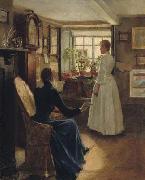
(born 1 June 1860 in Bridport, Dorset) was an English painter and printmaker. He studied metallurgy and worked in that field for several years. At age 23, he enrolled in the Royal Academy in London, where he studied painting and etching. After three years of study in London, he entered the private studio school Academie Julian in Paris, where he studied under Jules Joseph Lefebvre (1836-1911) and Gustave Boulanger (1824-1888).
In 1889, he returned to England and married Emily Tate, but shortly thereafter, his wife and infant son died in childbirth. Bartlett then traveled to Europe, spending several productive years in Holland, Brittany and Venice with his friend and fellow artist Frank Brangwyn (1867-1956). Brangwyn is believed to have introduced Bartlett to Japanese prints. Bartlett produced some of his most important early works on the Continent, especially studies of peasants painted in broad areas of color. He was invited to join the Societe Nationale des Beaux-Arts in France in 1897. In 1898, he returned to England and married Catherine Kate Main. |
|
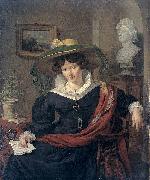 |
Charles Van Beveren -- Click Here
|
|
Charles van Beveren, born at Mechlin in 1809, was instructed in the rudiments of art in the academy of his native city and at Antwerp. He settled in Amsterdam in 1830, subsequently visiting Paris, Rome, and other cities of Italy, and distinguished himself as a painter of history, genre, and portraits. He died at Amsterdam in 1850. The best known of his works are:
The Confession of a Sick Girl (in the Pinakothek at Munich).
Male Figure. A study (in the Rotterdam Museum).
The Vision of St. Ignatius.
The Death of St. Anthony of Padua (in the church of Moses and Aaron at Amsterdam, his chef-d'oeuvre). |
|
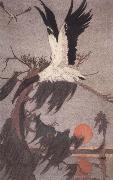 |
Charles Livingston Bull -- Click Here
|
|
the premier wildlife artist , American,1874-1932 |
|
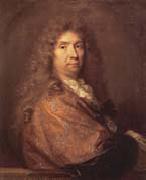 |
Charles le Brun -- Click Here
|
|
French Baroque Era Painter, 1619-1690
French painter and designer. He dominated 17th-century French painting as no other artist; it was not until over a century later, during the predominance of Jacques-Louis David, that artistic authority was again so concentrated in one man. Under the protection of a succession of important political figures, including Chancellor Pierre S?guier, Cardinal Richelieu and Nicolas Fouquet, Le Brun created a series of masterpieces of history and religious painting. For Louis XIV and his chief minister Jean-Baptiste Colbert he executed his greatest work, the royal palace of Versailles: an almost perfect ensemble of architecture, decoration and landscape. After Colbert's death in 1683, he was no longer able to count on prestigious commissions |
|
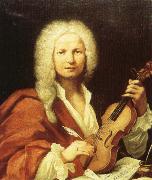 |
charles de brosses -- Click Here
|
|
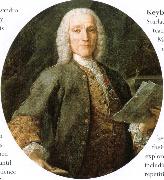
(1709-77). President of the Parlement de Dijon, friend of the philosophes, and in Diderot's words ??une petite t??te gaie, ironique et satiriquee. His learned publications include important work on the origins of language (Traite de la formation m??canique des langues, 1765) and on primitive religion (Du culte des dieux fetiches, 1760). His Lettres familieres crites d Italie en 1739 et 1740, published posthumously in 1799 and much loved by Stendhal, offer a model of personal travel writing, in which detailed accounts of art works and monuments, not always complimentary, or a careful description of Vesuvius, addressed to Buffon, are interspersed with sprightly, enthusiastic accounts of the peculiarities and the aesthetic and sensual pleasures of life in Italy.
|
|
 |
charles burney -- Click Here
|
|
Period: Classical (1750-1819)
Country: England
Born: April 07, 1726
Died: April 12, 1814 in Chelsea |
|
 |
Charles Blechen -- Click Here
|
|
1789-1840
German
Charles Blechen Locations |
|
 |
Charles Bird King -- Click Here
|
|
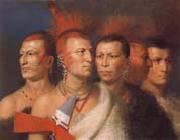
American Painter, 1785-1862,is a United States artist who is best known for his portraiture. In particular, the artist is notable for the portraits he painted of Native American delegates coming to Washington D.C., which were commissioned by government's Bureau of Indian Affairs. Charles Bird King was born in Newport, Rhode Island as the only child of Deborah Bird and American Revolutionary veteran Captain Zebulon King. The family traveled west, but when King was four years old, his father was killed and scalped by Native Americans near Marietta, Ohio. King and his mother moved back to Newport to live with Bird's mother. When King was fifteen, he went to New York to study under the portrait painter Edward Savage. At age twenty he moved to London to study under the famous painter Benjamin West at the esteemed Royal Academy. King returned to the U.S. due to the War of 1812 after a seven-year stay in London, and spent time working in Philadelphia, Baltimore, and Richmond. He eventually settled in Washington, due to the economic appeal that the burgeoning city offered. In the nation's new capital, the artist earned a solid reputation as a portraitist among politicians, and earned enough to maintain his own studio and gallery. King's economic success in the art world, particularly in the field of portraiture, had more to do with his ability to socialize with the wealthy celebrities, and relate to the well educated politicians of the time: His industry and simple habits enabled him to acquire a handsome competence, and his amiable and exemplary character won him many friendse . These patrons included John Quincy Adams, John Calhoun, Henry Clay, James Monroe, and Daniel Webster . |
|
|
|
 |
Charles Beaubrun -- Click Here
|
|
(Charles Bobrun) (1604 - 1692) was a French portrait painter active in Paris between 1630-70.
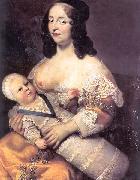
Charles Beaubrun was born at Amboise, a member of a distinguished family of painters. He studied under his uncle Louis Beaubrun (d. 1627). He and his cousin Henri Beaubrun (II) (1603 - 1677), were portrait painters in the courts of King Louis XIII and Louis XIV of France. Some of his work is jointly attributed to Henri. His youngest brother, Michel Beaubrun (d 1642), was also a painter. Charles Beaubrun died at Paris.
|
|
 |
Charles Bargue -- Click Here
|
|
(c. 1826/1827?CApril 61883) was a French artist, a lithographer as well as a painter, who devised a drawing course.
Charles Bargue is mostly remembered for his Cours de dessin, one of the most influential classical drawing courses conceived in collaboration with Jean-L??on G??rôme. The course, published between 1866 and 1871 by Goupil & Cie, and composed of 197 lithographs printed as individual sheets, was to guide students from plaster casts to the study of great master drawings and finally to drawing from the living model.
Among the artists whose work is based on the study of Bargue's platework, is Vincent van Gogh who copied the complete set in 1880/1881, and (at least a part of it) again in 1890. |
|
|
|
|
|
 |
Cecilia Beaux -- Click Here
|
|
American figure and portrait painter , 1855-1942
American painter. She began her career painting on porcelain and producing lithographs and portrait drawings. She studied with Catharine Ann Drinker (1871), Francis Adolf van der Wielen (1872-3) and Camille Piton (1879), at the Pennsylvania Academy of the Fine Arts in Philadelphia (1877-8), and privately with William Sartain (1881-3). Under Sartain's guidance, she learnt to paint, producing her first major portrait, the Last Days of Infancy |
|
 |
CAVAROZZI, Bartolomeo -- Click Here
|
|
Italian painter, Roman school (b. ca. 1590, Viterbo, d. 1625, Roma).
Italian painter, active also in Spain. His formative years were spent in Rome, where he went as a boy and where his first teacher was the Viterbese painter Tarquinio Ligustri. Through Ligustri he became acquainted with the aristocratic Roman family headed by the Marchese Virgilio Crescenzi (d 1592) and eventually lived with them in their home near the Pantheon and studied at Giovanni Battista Crescenzi's academy of art. |
|
 |
CAVALLINO, Bernardo -- Click Here
|
|
Italian Baroque Era Painter, ca.1616-1656
Italian painter and draughtsman. He was the most individual and most poetic painter active in Naples during the first half of the 17th century. He painted mainly small cabinet pictures, on canvas or on copper, for dealers and for highly cultivated private patrons; he had few public commissions and apparently never painted any large-scale decorations for private or ecclesiastical patrons. His subject-matter is largely derived from the Old and New Testaments, the Apocrypha, Tasso and from Roman history and mythology. Documentary evidence for his life and work is almost non-existent, and he remains enigmatic and elusive as a historical figure. Yet as a painter he is strikingly distinctive, uniting a refinement and virtuosity of brushwork with an intensely naturalistic observation of surfaces, and complex and dramatic compositions with an extraordinary brilliance of palette. Only eight pictures are signed, initialled or inscribed with Cavallino's name. No works are documented and only five may be tentatively identified with pictures in mid-18th-century Neapolitan collections described by Bernardo de Dominici. |
|
 |
Carlo di Braccesco -- Click Here
|
|
active in Liguria and Lombardy 1478-1501 |
|
 |
Carlo Bononi -- Click Here
|
|
Italian, 1569-1632,Italian painter. He was among the last great painters of the Ferrarese school, his style uniting warm Venetian colour with the lyrical effects of light and elegant draughtsmanship of Ludovico Carracci. He was a pupil of Giuseppe Mazzuoli (c. 1536-89), but his early activity is little documented. The Martyrdom of St Paul (Pommersfelden, Schloss Weissenstein), which is indebted to Mazzuoli and combines elements of Ferrarese and Venetian traditions, may represent the earliest phase of his development. Later, through a study of the art of Ludovico Carracci, modified by a response to Dosso Dossi and to Correggio, he developed a more individual style. An altarpiece of the Virgin with SS Maurilius and George (Vienna, Ksthist. Mus.) is unanimously dated before 1600. It is probable that Bononi made study tours to Bologna, Parma, Verona and Venice. Between 1605 and 1610 he spent two years in Rome (Baruffaldi), a visit confirmed by three paintings of scenes from the Life of St Paternian in the church of S Paterniano in Fano; dated between 1610 and 1612 (Emiliani), these reflect a direct study of Caravaggio and of his early Roman followers, such as Orazio Borgianni. |
|
 |
Carlo Bonavia -- Click Here
|
|
was an Italian painter known for idyllic landscape paintings, engravings and drawings. He was active from 1740 until his death in 1788. He is thought to be from Rome, but worked in Naples from about 1751 to 1788. He was trained in the Neapolitan landscape tradition of Salvator Rosa (1615-1673) and Leonardo Coccorante (1680-1750), but was much more strongly influenced by the work of Claude Joseph Vernet, who visited Naples in 1737 and 1746. |
|
|